LeeG
Well-known member
Someone brought this up, and since it is a rainy day and I can't get much done out in the garage, I thought I'd put my thoughts and experiences down for some initial context.
Major Types:
Advantages:
I use this as a part of my fastener storage system. I use the shallow drawers of a US General 26" wide box for the fastener size I use most often and have the most variations of - 1/4"-20.
2" deep drawer with Shaller bins.

3" deep drawer with Shaller and 3D printed bins

Advantages:
I used these extensively when I first set up my shop. I started with the plastic 2"x8" bins, and later moved to a Durham 30 drawer cabinet that I used for many years for my 1/4-20 fasteners and wood screws. I only sold it because I needed the bench space for other tools.
Advantages:
I have had both types of these in my garage in the past. I don't use enough large fasteners for the metal one to be efficient, and it ended up becoming as bad set of shelves that always were full of dust. The plastic bins worked much better for me, with me using one of the sets from Harbor Freight for several years. I eventually replaced it when I needed the wall space for larger items.
Advantages
Personal Note
I use the Allit bins for all fasteners smaller than 1/4" and M6 and smaller. I have about 50 of them and have used them for years. For larger fasteners, I use the mostly the 22" Keter cantilever boxes that used to be available at Home Depot under the Husky name or the Ridid 22" Organizer. I have a set of Festool Systainers that I use for on-the-go work (I do some volunteer work) and Plano style boxes for lighweight items (think resistors and electronics stuff). I used to use the Harbor Freight bins, but switched to the Allit for the additional flexibility - this was prior to 3D printers being a thing.
Sorry for the long read, and thanks
Lee
Major Types:
- Cabinets with full width drawers
- Cabinets with multiple narrow drawers
- Open face bins
- Stand alone containers
- Portable storage containers with multiple internal bins
Cabinets with full width drawers
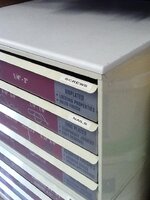
These would be fairly shallow drawer boxes. Lista and Vidmar are the top of the line, but any toolbox with drawers less than 3" deep could qualify. The space inside these drawers can be organized with a variety of sizes of bins. Shaller Corporation sells high quality plastic bins in a variety of sizes and depths. If you have access to a 3D printer, you can print your own boxes, or fabricate them out of wood, metal, or left over containers of any sort.Advantages:
- Versatile
- Reconfigurable
- High capacity
- You can take a bin of parts to where you are working
- High initial cost
- Takes up a lot of floor space
- Not portable
I use this as a part of my fastener storage system. I use the shallow drawers of a US General 26" wide box for the fastener size I use most often and have the most variations of - 1/4"-20.
2" deep drawer with Shaller bins.
3" deep drawer with Shaller and 3D printed bins
Cabinets with multiple narrow drawers
The items in this category can be metal Durham drawer cabinets, plastic Akro-Mills storage cabinets, or wood antique card catalogs, and the like. The drawers in these cabinets usually have provision for dividers to allow sub dividing a single drawer into smaller compartments. These are typically much less expensive than a full size toolbox, and typically do not require the extra cost of storage bins. The smaller of these are often used for small, lightweight parts, while the larger, all metal units can are quite durable and can handle much larger fasteners.Advantages:
- Moderate to low initial cost
- Can usually be wall mounted, or at least bench top mounted
- Single drawers can be removed and taken to where you are working
- Not typically as deep as a full size chest
- Drawer widths are much smaller
- Drawer dividers are not as good as separate bin
I used these extensively when I first set up my shop. I started with the plastic 2"x8" bins, and later moved to a Durham 30 drawer cabinet that I used for many years for my 1/4-20 fasteners and wood screws. I only sold it because I needed the bench space for other tools.
Open Face Bins
These are typically wall mounted. Either fixed size metal or removable plastic bins. The fixed size bins work well for larger fasteners - 1/4" and up and are quite common in farm and heavy equipment repair shops. The removable plastic bins are less durable, but can be swapped out with various sizes or colors.Advantages:
- Quick access to a variety of fasteners
- Durable (metal bins)
- Able to take a bin to your work area (plastic bins)
- Take up wall space
- Metal bins are not very versatile
- Open, so dust and grit tend to accumulate inside
I have had both types of these in my garage in the past. I don't use enough large fasteners for the metal one to be efficient, and it ended up becoming as bad set of shelves that always were full of dust. The plastic bins worked much better for me, with me using one of the sets from Harbor Freight for several years. I eventually replaced it when I needed the wall space for larger items.
Stand alone containers
This was the standard for many years. Some people leave items in their original boxes. Some use zip lock plastic bags. My dad used baby food jars. There are many commercial alternatives. Just have a line of them on your bench or on a shelf (which makes it a subset of the top group).Advantages
- Low entry cost (perhaps free)
- Expandable
- Not really much different from no organization method.
Portable storage containers with multiple internal bins
This is a big group, and is the subject of many posts here on GJ. This can really be a sweet spot for most hobbyists. You can have expandability, low initial cost and flexibility. Plus, you are not tied to a single platform, so you can mix and match as your need and budget changes. Following is a list of some that I have experience with and a quick comment on each. If you have access to a 3D printer, you can make your own bin sizes, reducing the downsides of some offerings.- Milwaukee Packout
- Expensive and overbuilt for in-shop use. Limited sizes on internal bins.
- Rigid Pro Gear System
- Less expensive than Milwaukee and slightly less durable. Limited sizes on internal bays, still over build for in-shop use
- Sortimo - L-Boxx, I-Boxx, and T-Boxx
- Very high quality, configurable, durable. Preferred by Adam Savage. Very expensive.
- Harbor Freight storage bins
- Available in large (8 bit) and medium (20 bin) sizes. Good for the money, but limited options on bin sizes
- Hart/Keter cantilevel parts organizer
- Limited size bins, fairly durable.
- Plano style boxes
- Great for smaller parts. Limited sizes available. Generally very cost effective.
- Allit Storage Bins
- Made in Germany, sold by Lee Valley tools. Low cost, large variety of bin sizes. Bins sold seperately. Three box sizes.
- Durham Steel Compartment box
- Very durable, but limited bin sizes and configurations
- Festool Systainer Organizer
- Portable but not water proof. Various bin sizes available. Expensive.
Personal Note
I use the Allit bins for all fasteners smaller than 1/4" and M6 and smaller. I have about 50 of them and have used them for years. For larger fasteners, I use the mostly the 22" Keter cantilever boxes that used to be available at Home Depot under the Husky name or the Ridid 22" Organizer. I have a set of Festool Systainers that I use for on-the-go work (I do some volunteer work) and Plano style boxes for lighweight items (think resistors and electronics stuff). I used to use the Harbor Freight bins, but switched to the Allit for the additional flexibility - this was prior to 3D printers being a thing.
Sorry for the long read, and thanks
Lee