To avoid these ads, REGISTER NOW!

Fasteners on bicycles?

qqzj

Well-known member
Joined
Nov 28, 2017
Messages
3,747
Last night, I had to install a set of pedals. The spec should be 9/16. But I tried 9/16 inch and 15mm wrenches, they don't fit. I also tried 16mm and 5/8 inch wrenches, they feel too loose. So I have to finish the job reluctantly with adjustable wrenches.

I never had such issue on cars. Is there something special about bicycles that I am missing? Thanks for the help!
 
To avoid these ads, REGISTER NOW!

mrpizza

Well-known member
Joined
Nov 1, 2011
Messages
2,935
Location
IL
I just did this the other day. Ill look at what wrench I used when I get home because I left it laying on the workbench.
 

K13

Well-known member
Joined
Oct 24, 2007
Messages
2,233
Location
St. Albert, AB Canada
Every pedal I have ever put on a bike has been 15 mm. I just went and checked 5 different bikes in my garage all with different pedals and they were all 15mm.
 

rlitman

Well-known member
Joined
Oct 18, 2010
Messages
24,662
Location
Long Island
I've seen a LOT of pedals. The ONLY ones that weren't 15mm (the most commonly made in the past 50 years) or 9/16" had an internal hex without any wrench flats.
 

JradM

Well-known member
Joined
Sep 4, 2019
Messages
1,821
Location
Alberta
Probably just sloppy fasteners. Should be 15mm. Channellock makes a nice thin adjustable that can be handy for pedals (and other things) too. I can't always get any of my regular wrenches between the pedal and crank arm.

Another alternative would be a bike-specific tool kit from Chain Reaction Cycles - I think the one I have is branded "X-Tools" if I recall correctly. It was cheap and included some thin wrenches for pedals and headsets and the like. The kit isn't "fantastic" by any means, but sometimes it's nice to have a kit with bike-specific tools nonetheless. The tools aren't junk - they're just also not the pro-level tools I buy for more frequent use. I'd spend more if I worked on bikes often.

Just something to consider if, for example, working on your own bikes is likely to come up again in the future. That way you'll have an assortment of spoke wrenches, a chain breaker, a chain whip, some non-marring pry bars, a chainring nut wrench, a cassette remover, etc... Pretty much what you need to take any part of a typical bike apart. I added a couple extra items to remove headset bearings, work on my forks and a few other very specific tasks, but the kits usually have 90%+ of what you would ever need.

I don't always endorse buying big tool kits with mediocre versions of a bunch of tools just in case - often I prefer to buy "good" tools and only as I need them. Working on bikes though seems like an exception. It's handy to be ready and the tools work - and the need arises only occasionally for me.

I don't see the kit I bought on the website anymore - but it looks like they carry a new budget tool brand called "Lifeline" where some of it looks pretty similar. My kit was bigger than any of the kits I see now - but the 18 piece lifeline kit looks like a reasonable base.

Also, I realize I went way off on a tool tangent when your question was about the size of a pedal wrench, but you already got that answer and your thread might have died without me. You're welcome. 😄

For the record, there are smaller sizes on pedals - but those are usually on small kids bikes (or maybe something old).
 

PFSard

Well-known member
Joined
Sep 12, 2013
Messages
2,423
Location
Mesa, AZ
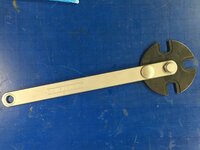
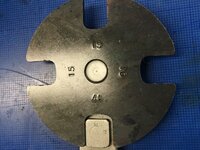
I have one of these. 15 mm or 9/16". Bought it at a yard sale for $2.00 or $3.00, Before that I used a 15 mm open end wrench. I've changed and/or tightened quite a few pedals.


4xdog

Well-known member
Joined
Aug 18, 2012
Messages
5,628
Location
Santa Fe, NM
Odd. I don't think I've seen a set of pedals that weren't 9/16" or 15mm. That's all my Park Tools pedal wrench has.
i-MTGW9n5-X5.jpg

My Campy lollipop pedal wrench has 15mm, 16mm, and 17mm. To be honest, I've never found a set that needed those other two sizes.
i-5mJLxkS-X5.jpg

i-nhfz2zJ-X5.jpg

Most pedals these days have 5mm or 8mm hex sockets on the inboard side, and that's what I use these days almost exclusively.

And note, of course, that pedals are both right-hand and left-hand threaded so that forward motion tightens them no matter which side they're on.
 

FMB4

Well-known member
Joined
Jan 19, 2017
Messages
2,926
Yep, modern (not made in the US) pedals are 15mm. Made in the US cycles are almost always 9/16.
 
OP
Q

qqzj

Well-known member
Joined
Nov 28, 2017
Messages
3,747
Thanks for the reply guys!

I went back to the removed pedals and I tried again. 15mm actually works. 9/16 does not. I guess yesterday 15mm did not work because I was in a hurry and it was dark. Everything was not easy when pedal was still on the bike ....

However, I am still puzzled why the pedal says it is 9/16 and I need a 15mm wrench? 9/16 is 14.2875mm. Quite a bit smaller than 15mm. Thanks for the help!

Also what is the typical torque on the fastener and how do you torque it? I have to ask my son to push the bike seat down hard to stablize it. Any better way to do it? I have various torque wrenches, maybe I should do some calculation and use a craw foot wrench with my usual torque wrench? (Hope I have enough space there.)
 

4xdog

Well-known member
Joined
Aug 18, 2012
Messages
5,628
Location
Santa Fe, NM
...what is the typical torque on the fastener and how do you torque it?...

Shimano often recommend 34 N-m (25 ft-lb). That's not hard to estimate by hand, and it's nowhere near gorilla-torque levels. If the pedals have a hex drive on the end of the threaded stud it's easy-peasy to use that for precise torque.

Note that small stainless washers for the specific size to protect the crank from repeated installation/removal of pedals are available, and can be a good idea depending on how you use your bikes. I keep my bikes for decades, so these help me keep components in use fo6 many, many years. A bike store or online should have them. I think I got my last batch from McMaster-Carr by putting in the right size.
 

rlitman

Well-known member
Joined
Oct 18, 2010
Messages
24,662
Location
Long Island
...My Campy lollipop pedal wrench has 15mm, 16mm, and 17mm. To be honest, I've never found a set that needed those other two sizes...
That wrench looks like it doubles as a cone wrench. I've replaced a lot of weird European pedals, and still never saw anything other than 15mm or internal hex.
...However, I am still puzzled why the pedal says it is 9/16 and I need a 15mm wrench? 9/16 is 14.2875mm. Quite a bit smaller than 15mm. Thanks for the help!

Also what is the typical torque on the fastener and how do you torque it? I have to ask my son to push the bike seat down hard to stablize it. Any better way to do it? I have various torque wrenches, maybe I should do some calculation and use a craw foot wrench with my usual torque wrench? (Hope I have enough space there.)
9/16" is the thread size. Some cranks have 1/2" threads, but 9/16" is the most common, and they typically have 15mm wrench flats.

Don't sweat the torque. Less is better. Remember that left side pedals are left hand threaded, so they tighten with use. Also, aluminum crank arms have aluminum threads. If I had to give a number, I'd suggest no more than 10 ft-lbs.
 

FMB4

Well-known member
Joined
Jan 19, 2017
Messages
2,926
Ya, Park makes some great bicycle tools. I have several Park products, but not that pedal tool.
 

CallumRD1

Well-known member
Joined
Jul 7, 2017
Messages
339
Location
Colorado
I am so glad that modern pedals have done away with needing pedal wrenches for removal. All the pedals I've used in the last handful of years have had either a 6mm or 8mm hex in the spindle.
 
To avoid these ads, REGISTER NOW!

rlitman

Well-known member
Joined
Oct 18, 2010
Messages
24,662
Location
Long Island
I am so glad that modern pedals have done away with needing pedal wrenches for removal. All the pedals I've used in the last handful of years have had either a 6mm or 8mm hex in the spindle.
And I HATE those. I've seen so many get stuck, they drive me nuts. If your pedal has a hex socket, be sure the threads are well lubricated. The other issue is that most pedals that use these do so because they want to slim down the spindle to shave a few grams of weight, and I've seen many bent and broken spindles because of that. At least the better ones use good plating on the threads to prevent seizing, but it only helps so much.
 

dscheidt

Well-known member
Joined
Apr 26, 2017
Messages
2,909
I am so glad that modern pedals have done away with needing pedal wrenches for removal. All the pedals I've used in the last handful of years have had either a 6mm or 8mm hex in the spindle.
I've run into pedals that were extremely tight, beyond that you can easily use a hex key for. Being able to whack a wrench with a hammer is much nicer than digging out a socket and a breaker bar.
 
OP
Q

qqzj

Well-known member
Joined
Nov 28, 2017
Messages
3,747
I have one of these. 15 mm or 9/16". Bought it at a yard sale for $2.00 or $3.00, Before that I used a 15 mm open end wrench. I've changed and/or tightened quite a few pedals.

I always dream that I can find a yard sale like that. Nope, never happened to me ever. Either junk or fully priced yard sale around me.
 

CallumRD1

Well-known member
Joined
Jul 7, 2017
Messages
339
Location
Colorado
And I HATE those. I've seen so many get stuck, they drive me nuts. If your pedal has a hex socket, be sure the threads are well lubricated. The other issue is that most pedals that use these do so because they want to slim down the spindle to shave a few grams of weight, and I've seen many bent and broken spindles because of that. At least the better ones use good plating on the threads to prevent seizing, but it only helps so much.
I've run into pedals that were extremely tight, beyond that you can easily use a hex key for. Being able to whack a wrench with a hammer is much nicer than digging out a socket and a breaker bar.
I guess I should clarify that I mean on well maintained, good condition bikes and quality (mostly mid to upper tier Shimano) pedals. I'm regularly swapping pedals around on my mountain bikes and I find it much faster and easier to throw a bit socket on a ratchet than use a pedal wrench. On neglected or poorly maintained bikes I'm sure it's much more of an issue.
 

rlitman

Well-known member
Joined
Oct 18, 2010
Messages
24,662
Location
Long Island
I guess I should clarify that I mean on well maintained, good condition bikes and quality (mostly mid to upper tier Shimano) pedals. I'm regularly swapping pedals around on my mountain bikes and I find it much faster and easier to throw a bit socket on a ratchet than use a pedal wrench. On neglected or poorly maintained bikes I'm sure it's much more of an issue.
I get it. And I'll freely admit that the Shimano SPD pedals on both of my bikes have 6mm hex. It's part of the reason that I threw out such a low torque value above.

To be fair, I've found that a breaker bar on a hex bit socket will do a lot (until the hole rounds out and you're buying new crank arms).
 

CallumRD1

Well-known member
Joined
Jul 7, 2017
Messages
339
Location
Colorado
I get it. And I'll freely admit that the Shimano SPD pedals on both of my bikes have 6mm hex. It's part of the reason that I threw out such a low torque value above.

To be fair, I've found that a breaker bar on a hex bit socket will do a lot (until the hole rounds out and you're buying new crank arms).
I find it interesting to see when pedals have 6mm hex and when they have 8mm hex. The cheap Shimano commuter pedals I have are 6mm hex, as are a pair of hybrid clip/flat pedals a friend has but my Ultegra and XT pedals all have 8mm hex, far superior in my opinion.
 

honcho

Well-known member
Joined
Feb 2, 2011
Messages
2,305
Location
Near Sodom & Gommorah (aka Wash. DC)
Just wanted to add that you should ALWAYS add anti seize compound to pedal threads before installing them.
I don't believe I've ever used anti-seize compound on pedal threads and have never had seizing or galling problems. Very tight pedals certainly, especially on our tandem. I did go looking to see what the appropriate anti-seize compound is recommended for aluminum to steel / stainless steel / titanium. Looks like for for aluminum / steel, aluminum or copper based compound is ok. Loctite brand has a compound they recommend for stainless steel and titanium which is graphite based.

By the way, Loctite's graphic for the anti-seize page uses a photograph of bicycle crank gears meshed together in a way that you'd never see in reality.
 

Attachments

  • loctite-anti-seize-banner.jpg
    loctite-anti-seize-banner.jpg
    111.3 KB · Views: 33

CallumRD1

Well-known member
Joined
Jul 7, 2017
Messages
339
Location
Colorado
I've always just used generic grease on my pedal threads, but then again my pedals get removed and reinstalled not too infrequently, at least a couple time a year.
 

neophyte

Well-known member
Joined
Apr 23, 2012
Messages
9,783
Location
Pennsylvannia
Last night, I had to install a set of pedals. The spec should be 9/16. But I tried 9/16 inch and 15mm wrenches, they don't fit. I also tried 16mm and 5/8 inch wrenches, they feel too loose. So I have to finish the job reluctantly with adjustable wrenches.

I never had such issue on cars. Is there something special about bicycles that I am missing? Thanks for the help!
Maybe the spec for the fastener head is Whitworth or BS.
5/16W and 3/8BS should have fastener heads that measure 15.24mm( .6 inch )
The old British standards are still used in some industries, and pop up in other industries and regions for weird reasons.
1/2Whitworth for instance is used on 1/2 inch arbor grinders from Asia(or at least used to be), supposedly because “13” is considered an unlucky number, and standard Coarse Thread (UNC) bolts are 1/2-13.
This turned up for me on an old Makita 5” grinder which used Whitworth thread geometry, and Whitworth BS nut sizing. (makita just included a 13mm wrench though instead of a Whitworth/BS sized one.
 

Grant Gunderson

Well-known member
Joined
May 17, 2013
Messages
2,330
Location
Bellingham, WA
I don't believe I've ever used anti-seize compound on pedal threads and have never had seizing or galling problems. Very tight pedals certainly, especially on our tandem. I did go looking to see what the appropriate anti-seize compound is recommended for aluminum to steel / stainless steel / titanium. Looks like for for aluminum / steel, aluminum or copper based compound is ok. Loctite brand has a compound they recommend for stainless steel and titanium which is graphite based.

By the way, Loctite's graphic for the anti-seize page uses a photograph of bicycle crank gears meshed together in a way that you'd never see in reality.
For most bike applications I use the standard AL based stuff from permtex. For titanium to Titanium on my ti pedal spindles to titanium cranks I use the Copper based formula. I have been starting to experiment with TefGel for Titanium to Carbon applications. I.E. TI bolts into Carbon stems.
 
To avoid these ads, REGISTER NOW!
Top Bottom