To avoid these ads, REGISTER NOW!

Fiber core wire rope

rslaback

Well-known member
Joined
Jul 24, 2010
Messages
4,068
Location
Westcentral Wisconsin
So I picked up around 1600 feet of 1/2" and 5/8" wire rope at an auction for around $200. My plan is to chunk it up and either braid in loops at the ends or put on clevis hooks and then sell them off as 40-50' retrieval/logging cables.

ea35af5d5971010eb8cc445415099b75.jpg

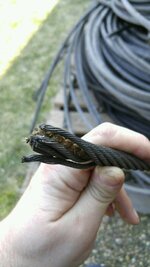
When moving it all today, I noticed that this (which I'm guessing is off cranes) is a fiber core rope with a sisal core. I've personally never worked with anything other than IWRC wire ropes. Does a fiber core weave and/or terminate in the same manner as a wire core or do I have some learning to do?

f9b9864a87227c6fd8f0310e01bd3762.jpg

75f35db67085a1690e0c1fbb29e2c498.jpg
 
Last edited:
To avoid these ads, REGISTER NOW!

jallyn

Well-known member
Joined
Jun 29, 2015
Messages
448
Location
Fort Wayne, Indiana
Ran across some interesting reading http://www.globalsecurity.org/military/library/policy/army/fm/5-125/ch1.pdf

And for making loops on the ends I would personally loop the wire rope back on itself and secure it using 2 (or 3 if I was generous) wire rope (U-bolt and saddle) clamps on each end. I'm sure you know the mnemonic "don't saddle a dead horse" for properly installing saddle clamps.
 

jallyn

Well-known member
Joined
Jun 29, 2015
Messages
448
Location
Fort Wayne, Indiana
And in today's litigious culture it is wise to clearly mark your retrieval/logging cables with "USE FOR DEAD LOADS ONLY. NOT INTENDED FOR LIFTING!!!"
 

NKlamerus

Well-known member
Joined
Feb 3, 2014
Messages
1,378
Location
Springfield, Or. (From Florida)
That's some odd stuff.

Off the top of my head I can only presume the rope helps with stretch and breakage? Or maybe it's just the cheapest core?

Living in a salty environment, I can only imagine how much damage that stuff does when it's put away wet.
 

wkndwarrior29

Well-known member
Joined
Jan 19, 2015
Messages
718
Location
NorthEast
I'm familiar with that type of rope for use on cranes and hoists, and there are very specific considerations for wire rope damage. I've never seen it used in an application where it would be subject to potential abrasive damage because on a crane it would ride in lubricated sheaves at predetermined radius. I would be cautious in how you market it - a damaged core or wire could lead to cable failure with safety implications. There is an ANSI standard somewhere on how to terminate the rope ends.
 

rlitman

Well-known member
Joined
Oct 18, 2010
Messages
24,591
Location
Long Island
That's some odd stuff.

Off the top of my head I can only presume the rope helps with stretch and breakage? Or maybe it's just the cheapest core?

Living in a salty environment, I can only imagine how much damage that stuff does when it's put away wet.

I don't think it is odd at all. Metal core is odd.

That wire rope is 6x7 (right handed, regular lay). If it had a metal core, it would be 7x7.

The metal core adds 1/7 more to the breaking strength (the fiber core adds essentially nothing), BUT greatly weakens the wire rope when bent (as in when run through a sheave for example). In a dynamic use, 6x7 is stronger than 7x7.
 

NKlamerus

Well-known member
Joined
Feb 3, 2014
Messages
1,378
Location
Springfield, Or. (From Florida)
I don't think it is odd at all. Metal core is odd.

That wire rope is 6x7 (right handed, regular lay). If it had a metal core, it would be 7x7.

The metal core adds 1/7 more to the breaking strength (the fiber core adds essentially nothing), BUT greatly weakens the wire rope when bent (as in when run through a sheave for example). In a dynamic use, 6x7 is stronger than 7x7.
So does adding the 1/7 wire core weaken the cable when bent?

I can't comprehend the final paragraph, I keep finding it contradicting.

(I've also been writing term papers for what seems like 4 days straight...)
 

jallyn

Well-known member
Joined
Jun 29, 2015
Messages
448
Location
Fort Wayne, Indiana
"Sisal rope is about 80 percent as
strong as high quality Manila rope and can
be easily obtained. It withstands exposure
to sea water very well and is often used for
this reason."

"FIBER-ROPE CORES
The fiber-rope core can be of vegetable or
synthetic fibers. It is treated with a special
lubricant that helps keep wire rope lubricated
internally. Under tension, wire rope
contracts, forcing the lubricant from the core
into the rope. This type of core also acts as a
cushion for the strands when they are under
stress, preventing internal crushing of individual
wires. The limitations of fiber-rope
cores are reached when pressure, such as
crushing on the drum, results in the collapse
of the core and distortion of the rope strand.
Furthermore, if the rope is subjected to
excessive heat, the vegetable or synthetic
fibers may be damaged."
 
To avoid these ads, REGISTER NOW!

rlitman

Well-known member
Joined
Oct 18, 2010
Messages
24,591
Location
Long Island
So does adding the 1/7 wire core weaken the cable when bent?

Exactly.

In a straight line pull, all the wires should act in unison (assuming the clamping at the end is good...), so the center section helps.

Now imagine how the rope acts when it wraps around a curve. The inner part follows a shorter path than the outer part.

If you had a solid center, that puts all the tension on the outside, and may even put the inside under compression (depending on the radius). This greatly weakens the rope.

Having a soft core allows the rope to flatten a bit when wrapped, which keeps the tension among all the strands more evenly distributed.
 

NKlamerus

Well-known member
Joined
Feb 3, 2014
Messages
1,378
Location
Springfield, Or. (From Florida)
Exactly.

In a straight line pull, all the wires should act in unison (assuming the clamping at the end is good...), so the center section helps.

Now imagine how the rope acts when it wraps around a curve. The inner part follows a shorter path than the outer part.

If you had a solid center, that puts all the tension on the outside, and may even put the inside under compression (depending on the radius). This greatly weakens the rope.

Having a soft core allows the rope to flatten a bit when wrapped, which keeps the tension among all the strands more evenly distributed.
Ah. So the stretch of the rope allows comparable distribution of force throughout the wire on a bight.

So In the OP's case, logging setups with loops in each end would suite the cable quite nicely?
 

2oolhound

Well-known member
Joined
Dec 18, 2010
Messages
5,918
Location
BC Canada
rlitman is correct. Steel core is special and fibre core is standard.

I worked as a rigger in the 70's and 80's and fibre was the most common standard cable you could get. Yours is regular lay, and looks like 6X19 (6 strands of 19 wires) which is the best compromise of strength and flexability. The fibre core holds lubricant. Wire rope is considered a machine. Each wire in the rope is preformed to a specific spiral shape with slight flats spots so it nests together with the other wires to form the strands which form the rope and these wires move under load or around bends to share the load. The fibre core has some give and holds the lubricant needed to keep it friction free.

Steel cores were only used for extra strength. Crane and elevator cable have more outer strands with an inner core wound the opposite direction so it doesn't spin under load. Other cable operated equipment uses Langs lay where the individual wires turn the same direction as the strands so they are very flexible for bending through sheaves.

Logging cables have thicker wires on the out side to resist abrasion and thinner wires on the inside for flexibility. If you look at yours you can see the strands turn to the right but the wires in the strands turn left so they look rather straight. This is "Regular Lay"

We used to splice eyes in the ends or use steel ferrules that we'd pour molten zinc into. Now a days the ferrules are pressed on. You can take your cables into a shop and have them press ferrules on for a reasonable fee. Cable clamps are for guy wires and not working cables. Eye splices are great but too much work and rough on the hands unless you were stuck way out in the bush and had no choice.

1/2" was good for bundling small logs into bundles for booming. Logs under 20" wouldn't stay in a boom in rough weather so they were bundled into 6' round bundles before it went into a boom. We made a simple eye splice called a "Molly Hogan" where you split 3 strands, un wound them and wrapped them back into their own grooves backward. These are best done on site so you can make the length you want.


You should advertise it as is and let the buyer decide how he wants to use it. If you commit it to a specific use you are limiting the market.
 

rlitman

Well-known member
Joined
Oct 18, 2010
Messages
24,591
Location
Long Island
...I worked as a rigger in the 70's and 80's and fibre was the most common standard cable you could get. Yours is regular lay, and looks like 6X19 (6 strands of 19 wires) which is the best compromise of strength and flexability. The fibre core holds lubricant. Wire rope is considered a machine. Each wire in the rope is preformed to a specific spiral shape with slight flats spots so it nests together with the other wires to form the strands which form the rope and these wires move under load or around bends to share the load. The fibre core has some give and holds the lubricant needed to keep it friction free...

THIS GUY KNOWS HIS STUFF!
You're absolutely correct, and I could not in any way have said it better.

BTW, my comment about 6x7 was only to differentiate it from 7x7. I think you're right about it being 6x19, but I couldn't see the strands well enough to tell from the picture.

Yes, the fiber core holds lubricant. It also helps the rope hold its shape.
As I said, extra strength from a metal core is both a blessing and a curse, depending on your application.

I was not aware about the difference in elevator cables. Interesting! Makes perfect sense.
 

IUEC Medic

Well-known member
Joined
Mar 29, 2014
Messages
175
Location
East Bay Area
Yea there's a pretty solid amount of info here. We use similar rope construction for traction elevators, there are many different combinations of strands/lays/cores.

My best advice is the same as jallyn in post 3... Be very careful how you try and sell these, make sure they are labeled not to be used in a hoisting or life safety situation.

At work, we are not allowed to use home-made wire rope slings, they have to have permenant loops that are tested,rated, and tagged by the manufacturer. (Home-made meaning a wire rope like yours, with loops made by using Crosby clips or fist grips.)

The ropes have to be inspected before each use to meet a very specific criteria as to wether they are capable of being put into service; i.e. A maximum number of broken strands in a single lay, or any amount of rouging (rusting from the inside out), can red tag a wire rope, depending on manufacturer recommendations..

Also, if you're going to do anything with them, use fist grips, not Crosby clamps, crosby's deform the rope, while fist grips evenly compress.
 
To avoid these ads, REGISTER NOW!
Top Bottom