To avoid these ads, REGISTER NOW!

Filling Block Walls.....existing construction

To avoid these ads, REGISTER NOW!

slickgt1

Well-known member
Joined
Oct 11, 2010
Messages
1,674
Damn Mike, that *****. Yea, removing that cap looks like the best idea. Especially since those anchors are in the same mortar. Would it be possible to lift the structure off the sill?

Like brace it inside, and jack it up a few inches. That way you might not need to do one at a time.

****** situation for sure.
 
OP
M

Mike951

Well-known member
Joined
Aug 24, 2011
Messages
112
Location
Jersey
Yes, this would be one(or a couple) at a time. I'll have to consider supporting the structure while I do this.

The front course of the garage should have been filled when the floor was poured, as the voids in these blocks were open from the top, so at least I have that much going for me.

Critical area will be the center column between the garage door openings which supports the most load of the paralam.

Same goes for it's equivalent location in the rear.

As far as re-doing the whole foundation with new block, an issue would be in the front of the garage an apron has already been poured along with the slab, so most of the front is "buried".

-Mike
 

slickgt1

Well-known member
Joined
Oct 11, 2010
Messages
1,674
Sometimes you want to kill these bastards, especially when someone refers them thinking they are good. Just the referrer is an idiot himself and thinks any type of **** is good because he doesn't know any better.

I hope this works out for you. Good luck.
 
OP
M

Mike951

Well-known member
Joined
Aug 24, 2011
Messages
112
Location
Jersey
Sometimes you want to kill these bastards, especially when someone refers them thinking they are good. Just the referrer is an idiot himself and thinks any type of **** is good because he doesn't know any better.

I hope this works out for you. Good luck.


You have no idea how crappy I felt when I discovered this AFTER the place was framed out.

As much as I don't want to think about it, something needs to be done, and I just had to post this on here to capture a large audience and hopefully get a bunch of opinions.


Any P.E.'s in NJ want to come give me a professional opinion? :dunno:
 

Falcon67

Well-known member
Joined
Jun 11, 2009
Messages
18,371
Location
Merkel, TX
>You have no idea how crappy I felt when I discovered this AFTER the place was framed out.

Yea, I do. I'll share details later. Keep that chin up, work with what you have - do the best and it'll work out, I'm sure. It's 200% !#@$ but it can be fixed.

If you have a good base under the parking slab, then you should be able to build up a beam and false wall that could sit on a flat 1x12 to spread the point loads. Just take the pressure off the wall you are working and you can work a bit bigger area. Think about it for a bit and the support could be reused as you go around the perimeter.

You can fix it. Consider - my 24x40 probably weighs about 13,000 lbs with roof and siding, no interior. That comes to about 2.5 lbs/sq in loading on the floor plates.
 

6768rogues

Banned
Joined
Nov 28, 2007
Messages
4,524
Location
Western NY
Mortar falls in the wall cavities as the block are installed. That mortar will keep your fill from reaching the bottom. Block walls should be filled every few feet so that the grout fill will get all the way down. I would remove and replace the wall. If you got the wall full and the original block is deteriorating, you created a tall slender wall that would not be structurally sound.
 
Last edited:

buening

Well-known member
Joined
Dec 17, 2007
Messages
1,338
Location
Decatur, IL
Keep in mind this isn't small cavity blocks. 8" wide block with roughly 1" face shell and web thickness, means the cavity is 6"x6". I don't see how you could block a cavity so that mortar won't pass to the course below unless you are using some kind of fine mesh shear reinforcement, which I've never seen.
 

slickgt1

Well-known member
Joined
Oct 11, 2010
Messages
1,674
All in all, after all this, I tend to agree with buening. The OP does not have much option here. The building is in place, and for him to tear down that wall, he is looking at massive expense. That is a cluster !@#$. I am not even sure if he can lift the structure, it seems to be attached to the house. Brace the walls, support them with bottle jacks, and take out the cap block.

What a mess. But we have all been there.

Just be careful. Think twice before you do anything crazy. And the eyes will be scared, but the hands will get it done. Trust me.
 

NUTTSGT

Super Moderator
Staff member
Joined
Sep 14, 2009
Messages
50,901
Location
Northern Central Ohio
Mike, good luck on this as you'll need it. Just don't be surprised as you try to take out the top course that other blocks don't come loose in the process.

Honestly, I think this might have been easier if it was a basement wall where you could have jacked and supported the floor with the joists.

One thing you may be able to do, if you have regular trusses, not scissors trusses, is back in a dump truck with the tires aired down. Run some blocking (2x or 4x4 material) on top of the bed to the bottom of the trusses. Then air up the tires, it may even raise the wall up off the foundation, as some people have moved garages like this. If you try this, I'd definetly nail up some hurricane clips first.
 

bobadame

Well-known member
Joined
Dec 26, 2007
Messages
1,124
If it's a relatively small section it might be faster to just re-set the blocks with the correct mortar. How tall is the wall? If you want to fill the blocks start maybe 3 courses up. Knock a hole in the block with a star chisel, widen it with a hammer then fill it with fiberglass reinforced concrete mixed runny. Work your way up. No big deal.
 

djjsr

Well-known member
Joined
Sep 4, 2006
Messages
4,796
Location
In the cornfields
Maybe "mudjacking" would work. A relatively small hole could be bored through the bottom plate of your wall, through the top of the block into the cavity. Concrete could then be pumped into each cavity.

It's a lot of holes and you may be able to do that part yourself to save some money, then have a contractor pump the concrete.

I've seen mudjacking done to level concrete slabs and it works pretty good.
 

joes169

Well-known member
Joined
Sep 19, 2011
Messages
663
Location
WI
I am actually a professional mason, and a concrete/masonry contractor as well, for quite a few years. Regardless of the rest of the suggestions here, I'd por the pilasters like you had originally intended. I've done this same exact thing in the past, although it wasn't because some ***** mixed the wrong mud & another ***** couldn't tell the difference.

If you take a picture of what you currently have (I can only assume it's 2x4 walls on a 2x4 sill plate), I can certainly give you a better directive on what you want to do, and the easiest approach to do so.

Don't let anyone scare you, a "stem/frost wall" foundation is overkill when it comes to compressive strength to support a lightweight wood framed garage. I've seen a lot of old blockwork dug up that most folks would think should have failed, yet it didn't because it's based on very simple, elementary principles.

As for the mason that did the work, I hope you got a "screaming deal", because he was certainly no expert. I could write up a laundry list of things I see that are less than stellar, just from two pictures................
 
OP
M

Mike951

Well-known member
Joined
Aug 24, 2011
Messages
112
Location
Jersey
JOES169 - You are right about the less than stellar masonary work. It was too late by the time I found out, but the pack of idiots who laid this thing did a horrible job..luckily they laid it straight and square. It is still a mystery to myself as well as anyone who has seen this issue as to how these guys were supposed to be good masons, yet failed to notice things such as:

(A)The bags of Type-S mortar on the job, which have a cartoon of the mixing procedure on the back, as well as the words pre-mixed. A Fu**ing 5 year old could have followed these directions.

(B)The 2 masons(3 total - 1 laborer mixing and 2 masons laying block) who were laying the block should have noticed the difference in the consistency/tackyness of the mud...they do blockwork all the time and I know that for a fact.

(C)Crappy scratch coat(or lack of) on foundation which I now have to ultimately take a angle grinder to to skim second time.

Please elaborate on your laundry list - I am very interested if you point out something I have not discovered yet. I'd imagine it may include something I mentioned above.

The "masons" were recommended to me, next time around i'll find my own guys...seems like unless you watch everyone like a hawk, things never get done right. So much for trying to pay someone to do something to save time...would have been better off learning how to lay block myself, probably would have come out better than this hack job.

You should be able to see it in these pics, i'm sure you'll notice how light in color those joints are:

-Mike
 

Attachments

  • 2011-05-29_15-05-52_300.jpg
    2011-05-29_15-05-52_300.jpg
    137.5 KB · Views: 71
  • 2011-08-09_18-16-19_952.jpg
    2011-08-09_18-16-19_952.jpg
    135.6 KB · Views: 79
Last edited:
OP
M

Mike951

Well-known member
Joined
Aug 24, 2011
Messages
112
Location
Jersey
Proposed plan:

If picture is too small - right click -> open in new window -> click picture to zoom
 

Attachments

  • Foundation Repair.JPG
    Foundation Repair.JPG
    55.4 KB · Views: 94

Ironcrow

Well-known member
Joined
Sep 30, 2005
Messages
1,169
Location
Arizona
I like your plan. Like joes169 suggests, despite warnings here, I think the repair will be sufficient for this relatively low stress wall.
 
To avoid these ads, REGISTER NOW!

joes169

Well-known member
Joined
Sep 19, 2011
Messages
663
Location
WI
JOES169 - You are right about the less than stellar masonary work. It was too late by the time I found out, but the pack of idiots who laid this thing did a horrible job..luckily they laid it straight and square. It is still a mystery to myself as well as anyone who has seen this issue as to how these guys were supposed to be good masons, yet failed to notice things such as:

(A)The bags of Type-S mortar on the job, which have a cartoon of the mixing procedure on the back, as well as the words pre-mixed. A Fu**ing 5 year old could have followed these directions.

Absolutely, they should have known. When you work with simple mortar for a living, you are extremely partial & picky with it's consistency. A mix that's too wet/too stiff/too sandy/too rich/etc.... brings production down real quick. No reason they wouldn't have known right away and taken a few moments to have it corrected, or just dump it. Besides, I can't think of one advantage to using pre-mix anyways on a project that size, especially when they had sand there already.

(B)The 2 masons(3 total - 1 laborer mixing and 2 masons laying block) who were laying the block should have noticed the difference in the consistency/tackyness of the mud...they do blockwork all the time and I know that for a fact.

(C)Crappy scratch coat(or lack of) on foundation which I now have to ultimately take a angle grinder to to skim second time.

Please elaborate on your laundry list - I am very interested if you point out something I have not discovered yet. I'd imagine it may include something I mentioned above.

The "masons" were recommended to me, next time around i'll find my own guys...seems like unless you watch everyone like a hawk, things never get done right. So much for trying to pay someone to do something to save time...would have been better off learning how to lay block myself, probably would have come out better than this hack job.

You should be able to see it in these pics, i'm sure you'll notice how light in color those joints are:

-Mike

Along with what you already noted:

- It appears they (or the excavtor) left all of the topsoil/organic material in the garage, as well as the spoils (excavated soil). All of that should have been stripped out & removed right away. Only granular, compactabel material should be used on the interior.

- There's no floor ledge to support the garage floor. Simply put, the last course (or two in your case) should have been a 6" solid top to create a 2" wide floor ledge.

- The anchor bolts at the short walls on the sides of the garage door should have been pilasters. Maybe they are, and I just didn't read it, our you didn't observe it. But, if you're required to build those two small walls as shear wall, seeing as it's connected to the house, those bolts set in the top course & **** mortar don't have near the pull-out strength. Even if you're not required to built it as a shear wall, it's good practice to do so. It's long been known that the garage door, and subsequently those adjacent little walls, are the first thing to fail in high wind/tornadoes.

- If the footings are being used in the frost depth requirement, they should have been formed. Honestly, it's good practice again to form them anyways. A little bit of time forming can save alot of concrete, and undoubtedly gives you a much more level footing to build off of.

There maybe more, I just can't think of it right now.......lol.

Despite saying all of that, I still think you can make the walls sufficently strong for what they need to do, which isn't really much.

I would think a little more about compacting the garage floor, or more or less getting it to settle out before even thinking of pouring the floor. (Maybe it's too late for that though...)
 

joes169

Well-known member
Joined
Sep 19, 2011
Messages
663
Location
WI
Proposed plan:

If picture is too small - right click -> open in new window -> click picture to zoom

Good plan, but I really don't think you'll gain much from pouring every core, unless you fell the mortar is really that soft and won't last. It isn't really an easy thing to assess (the mortar) over the web. I'd likely pour every other, or even every third, core if it were me, but again, I can't see it to know for sure.

You should be able to notch out enough of the 2x6 sill plate to make enough room to get concrete to flow. You'll need about a 2" clear whole and the biggest funnel you can find or make. Plain old 4000 psi "quik-crete" or the like will work fine. The small stone they use in the pre-mix bags is ideal for grout. As well, you'll lose some strength from using so much water, but most grout is only specc'ed out at 2500-3000 psi anyways, as anything stronger is overkill, and can actually do more harm than good.

Best of luck, Joe.
 

Will67

Well-known member
Joined
Nov 17, 2006
Messages
852
Location
Hell's half acre
I am lucky I had an **** retentive building inspector that came out unannounced several times during my build and red flagged my job. Looking back it prevented my contractor from cutting major corners: using #3 rebar vs #4 and spacing to far apart, too small a sewer line, not enough HD5s, and placing gas electrical and water in common trench.

So flatwork inside of garage is not poured so at least you have that going for you. Last pictures show you in process of plum and alining walls?
 

omr

Banned
Joined
Jun 1, 2011
Messages
723
the ground on each side of the block is doing most of the work as far as side load, couldnt you just drill through the sill plate ? that way you dont have to remove any blocks at all .
 
OP
M

Mike951

Well-known member
Joined
Aug 24, 2011
Messages
112
Location
Jersey
I would think a little more about compacting the garage floor, or more or less getting it to settle out before even thinking of pouring the floor. (Maybe it's too late for that though...)

I am lucky I had an **** retentive building inspector that came out unannounced several times during my build and red flagged my job.

So flatwork inside of garage is not poured so at least you have that going for you. Last pictures show you in process of plum and alining walls?

the ground on each side of the block is doing most of the work as far as side load, couldnt you just drill through the sill plate ? that way you dont have to remove any blocks at all .

These are old pictures from the summer. At this point the garage is complete(aside from odds and ends, sheetrock, insulation). The floor was poured. Not shown in these pictures is that the floor was graded out and tamped by power tamper. The floor/apron was done by a separate set of masons, 4000psi, 4" w/ 4'x4'x18" piers for 2-post lift. 1/4" per foot pitch out towards the doors. And power troweled

As far as the inspector, the foundation passed a foundation inspection. This is another concern of mine. Isn't the point of a building permit to try and protect you from things like this? I would think that the inspector should have flagged it before a sill plate was even put on, making this waaay easier for me to deal with, or completely re-do. I beleive the code has a section which defines the ratio in which mud should have been mixed, and i'd imagine a core sample of my joints would reveal failure. Am I wrong in thinking where the F was the inspector on this one?? Not looking to point blame, but what the heck did I pay for a permit for then.

I have an idea to slightly vary my above pictured plan - to skip drilling holes in block, just 2" holesaw through sillplate, rebar and fill from those holes, then block out the sill plate for added strength since holes were cut.

-Mike
 

omr

Banned
Joined
Jun 1, 2011
Messages
723
I have an idea to slightly vary my above pictured plan - to skip drilling holes in block, just 2" holesaw through sillplate, rebar and fill from those holes, then block out the sill plate for added strength since holes were cut.

-Mike
thats what i was thinking , you can then put new anchors in the newly poured concrete ..
 

Ironcrow

Well-known member
Joined
Sep 30, 2005
Messages
1,169
Location
Arizona
I have an idea to slightly vary my above pictured plan - to skip drilling holes in block, just 2" holesaw through sillplate, rebar and fill from those holes, then block out the sill plate for added strength since holes were cut.
Good idea.
thats what i was thinking , you can then put new anchors in the newly poured concrete ..
Yeah, I was thinking that too and forgot to mention it.
 

b-body-bob

Well-known member
Joined
Oct 10, 2011
Messages
1,621
Location
Almost Heaven
Not looking to point blame, but what the heck did I pay for a permit for then.

You don't really need an answer to that, do you?

I hired my garage foundation and floor out to a recommended guy, but in my case he was a union guy between jobs. I thought I paid too much at the time but reading of nightmares like you have has led me to reconsider that.
 
OP
M

Mike951

Well-known member
Joined
Aug 24, 2011
Messages
112
Location
Jersey
When all is said and done, I should go down to the building dept. and thank them for doing such a great job inspecting...glad my 100's of dollars went to good use.

Trying to weigh out pros/cons on that....
 
OP
M

Mike951

Well-known member
Joined
Aug 24, 2011
Messages
112
Location
Jersey
When all is said and done, I should go down to the building dept. and thank them for doing such a great job inspecting...glad my 100's of dollars went to good use.

Trying to weigh out pros/cons on that....
 

1948

Well-known member
Joined
Oct 14, 2011
Messages
569
Location
IL WI border
so its taken care of and everythings ok? i was thinking maybe tuckpointing the mortar section by section but that would most likely take way to long.
 
OP
M

Mike951

Well-known member
Joined
Aug 24, 2011
Messages
112
Location
Jersey
so its taken care of and everythings ok? i was thinking maybe tuckpointing the mortar section by section but that would most likely take way to long.

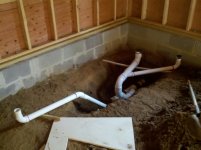
No, Im still in the planning an approach stage.

Retuckpointing will be ineffective, as the slab is poured and no access to interior lower block face
 

joes169

Well-known member
Joined
Sep 19, 2011
Messages
663
Location
WI
Mike,

I would leave the 2x4 bottom plate alone, and just notch/holesaw/or even cut out the extra 2" all together for the entire length of the wall(s) the green-treated sill plate. There's no real advantage to a 2x6 plate for a 2x4 wall, at least not one that I can think of. By doing this, you'll expose half of the 8" wide block wall. The inner web should be about 1.25-1.5" thick, leaving you with about 2.5" to get the hole & concrete in. Shouldn't be a problem. You could just drill a hole & enlarge it with a hammer to the required size, as drilling a clean hole at 2" in the block is going to require a fairly expensive core bit & a bigger roto-hammer to run it. Not to mention, a 2" will be hard to find, say compared to a 3 or 4". As for consolidating the concrete, just get the rod 90% of the way in & give it a "mixing bowl" circular motion a few times. Wet grout is really the most effective at filling completely for this reason. Spending too much time consolidating, or vibrating, will end up making the grout leak into the neighboring cell. IF you plan on filling them all, I guess this really won't be a problem though.

Best of luck,

Joe.
 
OP
M

Mike951

Well-known member
Joined
Aug 24, 2011
Messages
112
Location
Jersey
Joe - Thank for all the info. Another concern I just thought about is at the bottom of each void there is a pile of sandy mortar from it falling in during laying the block....I hope this will not impact my plan too much.
 

slickgt1

Well-known member
Joined
Oct 11, 2010
Messages
1,674
Hi Mike. I talked to my mason about your problem. He said your idea will work, and he has done this as well. He said that once you fill the voids, the wall will lock itself fairly well. Make sure you vibrate the air out very well. He also said to avoid making the grout with the stones, it might be a ***** to fill with them, making huge pockets.

Can you use a shop vac to get the loose mortar out?
 

joes169

Well-known member
Joined
Sep 19, 2011
Messages
663
Location
WI
I wouldn't be too concerned about the sandy mortar droppings at the bottom unless they were more than say 5 or 6 inches thick. Typically, for a wall that height with decent masons & actual mortar, the footing shouldn't even be completely covered.
 
To avoid these ads, REGISTER NOW!
Top Bottom