To avoid these ads, REGISTER NOW!

Filling control cuts

bigred292

Well-known member
Joined
Oct 5, 2010
Messages
377
Location
Rhode Island
I'm FINALLY gonna get around to doing my floor this week(hopefully)
I'm using Neogard Autogard FC polyurethane. I have enough to do 1000 sq ft.
My floor is 24 x 32 with control cuts. Cuts were made with a Stihl concrete saw- joints are roughly 1/4 wide and are around 3/8 deep. My original plan was to put backer rod and top with a good polyurethane caulk(Sikka or similar)
Here's my question- Since I have plenty of material can I just fill the cuts in with coating? The makers specs says to fill it in with caulk but the Autogard will have a rubber like consistency when it cures. I plan on calling Neogard this a.m. but wanted to get other opinions as well.
 
To avoid these ads, REGISTER NOW!

Garage Flooring

ALLIANCE MEMBER
Joined
May 21, 2011
Messages
5,288
Location
Grand Junction, CO
The manufacturer is your authority for this, but in general, I would say know. The products we and others sell for filling joints is designed to be flexible and install thicker than a coating would be
 
OP
B

bigred292

Well-known member
Joined
Oct 5, 2010
Messages
377
Location
Rhode Island
Any thought as which brand to use? And what's the best method to apply?
I did talk to a factory rep and he mentioned the process but I didn't write it down. My plan is to thoroughly clean floor with vac& leaf blower. Grind floor with Edco grinder. Clean out joints with air and then mask off and fill.
What should I do first, prime or caulk. Not sure if the caulk will adhere to primed surface or not.:dunno:
 
OP
B

bigred292

Well-known member
Joined
Oct 5, 2010
Messages
377
Location
Rhode Island
Scotty-thanks for your replies. I spoke again to the factory rep earlier in the day with some basic questions. First time I called him he asked if I was a contractor- I told him that I bought his products on CL and was looking for a few answers to questions about his products. He didn't seem too friendly and gave me one or two word answers.
Today was no different. Very short with me. When I mentioned I had fiber reinforced concrete he said to forget about using his product- I asked about burning it off after grinding and he said "Yea, I suppose that'll work"
All I'm looking for is a little info. I want to do it this week so I really don't have time to order anything online. Going to supply house tomorrow to p/u backer rod and caulk.
I'm putting down AutoGard FC which is a polyurethane- do I use a polyurethane based caulk?
When should I caulk? Before grinding or after? Will the primer bond to the caulk or will it damage it?
Anybody that could help me ?
 

LegacyIndustrial

ALLIANCE MEMBER
Joined
Jun 7, 2010
Messages
7,993
Location
deerfield, IL
We don't use caulk for the center of a floor. It is weak and can fold under pressure from steel jack wheels. Caulk is for the perimeter space/joint only.

I never put polyurethane under epoxy.

Some of the folks here use SIKA for joints. If you do, get the self leveling.

In regards to your factory rep, call his boss and tell them how you were treated. Too many people are treated badly and they never do anything about it.
 
OP
B

bigred292

Well-known member
Joined
Oct 5, 2010
Messages
377
Location
Rhode Island
Seems I'm getting more confused as time goes on:scared:
If I use a urethane self leveling sealant(Sika or similar) do I apply it after grinding the floor or before?
The rep mentioned that I shouldn't get primer on the sealant.
I'm beginning to think that I'm not going to meet my Friday application time. I live in New England and the weather is supposed to be in the 60's for the rest of the week.
 

hardhat

Well-known member
Joined
Oct 24, 2009
Messages
107
The problem with flexible caulk is that it flexes more than your top coat and when you push on it it will eventually crack, then cracking leads to more cracking, peeling up, ect. I would use an expoxy or polyurea joint filler to make this not happen. Grind, prime, fill joints, add topcoat. Never heard of Neoguard but that doesn't mean anything as I'm a novice.
 

dcs Inc

Well-known member
Joined
Dec 13, 2010
Messages
803
Location
Indianapolis, Indiana
Apply your flexable joint sealants AFTER your epoxy... (or whatever) application. Take care and not fill the tooled/saw cut joints in with whatever material you are using. A paint brush helps a lot when applying your epoxy along the tooled joints. A saw cut joint may need to be recut after the epoxy dries.
 

hardhat

Well-known member
Joined
Oct 24, 2009
Messages
107
Apply your flexable joint sealants AFTER your epoxy... (or whatever) application. Take care and not fill the tooled/saw cut joints in with whatever material you are using. A paint brush helps a lot when applying your epoxy along the tooled joints. A saw cut joint may need to be recut after the epoxy dries.

I take it the only recommend way to get a seamless floor under epoxy is to use epoxy gel crack filler/ polyurea/ bondo joint filler?
 

Garage Flooring

ALLIANCE MEMBER
Joined
May 21, 2011
Messages
5,288
Location
Grand Junction, CO
We don't use caulk for the center of a floor. It is weak and can fold under pressure from steel jack wheels. Caulk is for the perimeter space/joint only.

I never put polyurethane under epoxy.

Some of the folks here use SIKA for joints. If you do, get the self leveling.

In regards to your factory rep, call his boss and tell them how you were treated. Too many people are treated badly and they never do anything about it.

In this economy its suicide! In any economy its simply the right way to do business -- take care of the customer.

@OP Sorry I missed your reply. Looks like Scotty and Gene have you very well lined up.
 
To avoid these ads, REGISTER NOW!

dcs Inc

Well-known member
Joined
Dec 13, 2010
Messages
803
Location
Indianapolis, Indiana
I take it the only recommend way to get a seamless floor under epoxy is to use epoxy gel crack filler/ polyurea/ bondo joint filler?

Hardhat, I don't go for a seamless look unless the area is heated. You have way too much movement in expansion/contraction of the concrete in varying temps. If the area is heated then fill the joints before you apply your epoxy with a more rigid joint filler. Grind smooth and then apply your floor covering.
 
OP
B

bigred292

Well-known member
Joined
Oct 5, 2010
Messages
377
Location
Rhode Island
Finally made up my mind(I think)
After reading the replies and searching other forums think I'm going to apply the Autogard FC first and then tape and fill the control joints after the floor has cured.
I do live in New England so are temps can go from 10 below to 105. I do have radiant heat in the floor but will leave the slab at 58 or so.
I have just finished grinding the floor with an Edco grinder and did all of the edges with a hand grinder.Plan was to put it down Friday but now it's calling for rain Friday. Not sure if I'll get prep done today but we'll try.
Thanks again for the advice and help:beer:
 

Markgyver

Well-known member
Joined
Feb 16, 2009
Messages
92
Location
Colorado
Fyi you cant use a urethane traffic coating on slab on grade. It will eventually fail.
If its not on SOG use a urethane caulk like BASF SL2. Install a 4" wide band of primer and detail coat over sealant. prime concrete install your base coat ect.....
 
Last edited:

Ch3No2

Well-known member
Joined
Nov 27, 2009
Messages
356
This is how I have done it a few times now with decent sucess
Hit joints with a grinding pad since soffcut joints flare up when cut
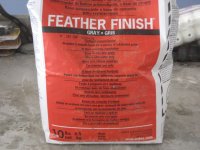
Mask off...Fill with Ardex Feather Finish with a putty knife...it will take a few coats as it slowly fills to the bottom...remove masking tape... and hit with grinding pad for smooth finish
 

Attachments

  • 002.JPG
    002.JPG
    87.3 KB · Views: 45
  • 003.JPG
    003.JPG
    109.2 KB · Views: 46
  • 004.JPG
    004.JPG
    121.6 KB · Views: 48
  • 005.JPG
    005.JPG
    71.1 KB · Views: 40
  • 006.JPG
    006.JPG
    84 KB · Views: 42
  • 001.JPG
    001.JPG
    112.6 KB · Views: 40

RyanB44

New member
Joined
Oct 27, 2012
Messages
1
How does that stand up to expansion. That looks exactly like what I want in my garage. My temps where I live range from 30F in the winter to 115F in the summer. It's California so we have way more summer than winter.


EDIT: Just realized you're in Acton, so how is it holding up to the weather swings? I live in Ridgecrest so the temps are very similar to yours.
 
Last edited:

Ch3No2

Well-known member
Joined
Nov 27, 2009
Messages
356
Just realized you're in Acton, so how is it holding up to the weather swings? I live in Ridgecrest so the temps are very similar to yours.

Ryan...it has gone thru a summer, a winter and another summer and still looks the same as when it was applied even without garage doors
 

pauls340

Well-known member
Joined
Jan 27, 2009
Messages
321
Location
North of Motown
I was in a very nice car restoration shop on Sat. where they joint filled with a $ika-like urethane before they epoxy coated. Over 90% of the joint had cracked epoxy over it. Since all "basic" urethane products from the big box stores are flexible, ShoreA18 to A65, it's going to move at a different rate than the epoxy. I would think in the NEast you're going to have continual movement in your slab so a hard, ShoreA75-90 is not going to move with the concrete. I think this is why many of the epoxy mfg's tell you to just let the epoxy fill most of the joint. Because of this, I still haven't decided which way I'm going.:eyecrazy:
 

Gary S

Well-known member
Joined
Dec 27, 2008
Messages
2,972
Location
Bismarck, ND
How does that stand up to expansion. That looks exactly like what I want in my garage. My temps where I live range from 30F in the winter to 115F in the summer. It's California so we have way more summer than winter.


EDIT: Just realized you're in Acton, so how is it holding up to the weather swings? I live in Ridgecrest so the temps are very similar to yours.


I used a pour in filler, but in my climate, it probably wasn't worth the effort. I see temperatures from -45 to +110, so my slab changes size from winter to summer. In summer, the cracks look full, but in winter, the concrete shrinks enough so the filler is cracked apart and the control cut is still open.
I don't think there is any product that will stretch and compress enough to handle such temperature change, so I might as well just left the cracks unfilled.
 
To avoid these ads, REGISTER NOW!
Top Bottom