To avoid these ads, REGISTER NOW!

Filling control joints (relief cuts) in concrete

lschwarcz

Active member
Joined
Oct 1, 2018
Messages
40
Location
Hillsboro, OR
Hi everyone,

I have a shop that I use for woodworking and to work on cars. There are control joints about 10 feet apart. Since I could easily spill automotive fluids I wanted to fill them with something to make clean up of spills and sawdust easier.

The cuts are roughly 1/4" wide and almost 1.5 inches deep.
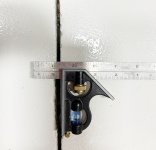
Stress_Relief_Cuts.jpeg

My criteria for a material to fill are:
  • Paintable. I've painted the floor with a grey epoxy paint and I'd like to be able to recoat and have the filler accept the paint too
  • Resistant to damage from stuff like car oil, gasoline, coolant, brake fluid, etc.
  • Not too expensive. I have roughly 240 linear feet of crack to fill!
I keep the shop heated to 55F in the winter and cooled to 80F in the summer so hopefully I should be able to apply it any time of the year.

Any suggestions on types of materials, brands or specific products?

Thanks in advance!
Larry.
 
To avoid these ads, REGISTER NOW!

CapriMikeC

Well-known member
Joined
May 31, 2019
Messages
421
Location
AZ

larry4406

Well-known member
Joined
Jan 27, 2006
Messages
19,562
Location
Northern Virginia
Related thread post
 
To avoid these ads, REGISTER NOW!

mm08822

Well-known member
Joined
Jan 13, 2012
Messages
6,051
Location
NJ
Rake out all the joints while vacuuming.
Possibly rinse the joints with water nozzle and wet vac to pickup water. Blow out joints, let dry.
Consider backer-rod pushed down to leave 1/2" depth. Add Sika flex.
 

Shea

Well-known member
Joined
Sep 19, 2012
Messages
2,867
Location
California
SikaFlex is a flexible crack sealant and joint filler. It's not a crack repair product and does not reinforce the crack. Its primary purpose is to seal joints or cracks against moisture. It's a popular filler for expansion joints because it flexes within the joint between two slabs that contract and expand with temperature.

SikaFlex should not be painted over, and, more importantly, it should not be used to fill joints that will be covered with paint or a coating. The paint or coating will crack due to flex when car tires, rolling toolboxes, or any other item with weight applies pressure to the joint. Lastly, paint will adhere OK, but coatings will not.

The proper materials for crack repairs are 100% solids epoxy or polyurea crack repair products. They are stronger than the surrounding concrete and provide the reinforcement required to REPAIR cracks properly.

Contraction joints are the deep troweled "V" shaped grooves or sawcuts created on the surface of the slab. They create a weakened line at the surface that encourages cracking along the bottom of the groove or cut, rather than across the surface for all to see. They are typically filled with an epoxy or polyurea formula that provides some elongation properties to compensate for any slight expansion or contraction the joint may experience. Once the material has cured, it is typically ground flush to provide a seamless appearance when coated over.
 

ericm

Well-known member
Joined
Apr 17, 2016
Messages
1,963
Location
Southern Oregon
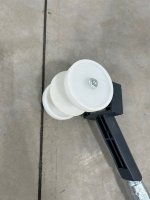
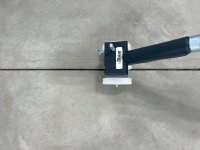
I'm in the process of using Sikaflex for my shop control joints. I got a case of 29oz tubes. To place the backer rod at a consistent depth I'm using a roller device. If it's too deep the Sikaflex will sink into the crevice and leave a void at the top that you will have to fill later if you want it flat.

IMG_1706.jpg

IMG_1707.jpg

My saw cuts are pretty narrow. The smallest roller just fits and 1/4" backer rod needs to compress some to go in. I'm putting it a little deeper than Silaflex's minimum recommendation for a joint this wide but not much deeper.

I'm trying for a flat surface once done, so I'm putting a good tall bead on then once its cured some going back with a floor scraper with sharp blade to cut off the excess to floor level. It works pretty good if you don't accidentally install two blades like I did here


IMG_1708.jpg


Once I figured out my mistake I went back over it with a single blade.
 
Last edited:

dscheidt

Well-known member
Joined
Apr 26, 2017
Messages
2,909
To place the backer rod at a consistent depth I'm using a roller device. If it's too deep the Sikaflex will sink into the crevice and leave a void at the top that you will have to fill later if you want it flat.

The backer rod also serves to ensure the caulk is only bonded in two places, which allows it to move with the two slabs, and makes it less likely to tear. The manufacturer’s recommendations for width to thickness ratio are also important for maximizing flexibility.
 
OP
L

lschwarcz

Active member
Joined
Oct 1, 2018
Messages
40
Location
Hillsboro, OR
I have a shop that I use for woodworking and to work on cars. There are control joints about 10 feet apart. Since I could easily spill automotive fluids I wanted to fill them with something to make clean up of spills and sawdust easier.

The cuts are roughly 1/4" wide and almost 1.5 inches deep.

......

My criteria for a material to fill are:
  • Paintable. I've painted the floor with a grey epoxy paint and I'd like to be able to recoat and have the filler accept the paint too
  • Resistant to damage from stuff like car oil, gasoline, coolant, brake fluid, etc.
  • Not too expensive. I have roughly 240 linear feet of crack to fill!
....

Thanks everyone for your input! I have my solution... it's not necessarily the correct, best solution but it's the one I'll be using :) .

I had painted the floor a few years ago with some epoxy paint but one area is peeling up a bit. This summer I'll grind that area down and recoat with epoxy paint. Once that's dry and fully cured I'll fill the joints with the Sika self leveling Polyurethane Sealant.

I'll use ericm's suggestion of using the backer rod and the tool shown so I don't have to fill the whole seam.

After talking to Sika and Sherwin Williams (I used their epoxy floor paint) neither is sure if the paint will have any issues when in contact with the sealant. But, it seems that both of them think that when the epoxy cures on the flexible sealant it could crack and flake. But, that small 1/4" wide seam would make very small flakes that I could sweep up.

Thanks again everyone!
Larry.
 
To avoid these ads, REGISTER NOW!
Top Bottom