To avoid these ads, REGISTER NOW!

Final tips before putting up dry wall?

tuip

Well-known member
Joined
May 10, 2008
Messages
79
Location
Snoqualmie, WA
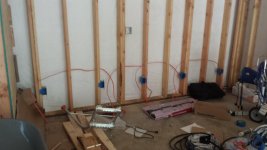
I'm close to finally wrapping up the wiring for the garage .. I went a bit overboard on the outlet numbers but since some will probably end up behind storage having a few extra won't hurt. Before I start putting up dry wall .. does anyone have any final tips on what I should do or check ?

Taking photos / notes of wire height?
Draw circuit diagrams?

Anything else?
 
To avoid these ads, REGISTER NOW!

Kevin54

MEMBER EMERITUS
Joined
Jan 12, 2005
Messages
29,341
Location
Urbana, Ohio
Photos. This will show what side of the outlets your studs are on when the time comes that you need that info. Also take a pic of your wiring if you can. Run any CAT, cable for TV or whatever you need. Then once things are insulated, drywall. Also, any cracks, voids, and so on, fill them with a spray foam first before you put in your batts.

Congrats on getting to the drywall portion of things. Post up some pics for us to see.
 

homebuilt burner

Well-known member
Joined
Dec 8, 2014
Messages
1,763
Location
central Wisconsin
I ran a conduit out of my electrical box inside the wall to an electrical box with intentions of putting a 220 outlet in later. I mounted the electric box so it sticks out of the wall @ 1 1/2" with the idea that if I later wanted to run more circuits I could use it to access the breaker box with out tearing the walls up. Just an idea.

I know what your thinking, "Did I put enough stuff in for later?" I had the same thought before I started drywalling.
 
OP
T

tuip

Well-known member
Joined
May 10, 2008
Messages
79
Location
Snoqualmie, WA
Thanks .. I'll start doing that. I modified my original plans during the installation .. I'm prewiring a few additional coax and networking circuits as well as adding an additional 220V one for a 'possible' future amateur radio amplifier near the work bench area. The pic below shows the work bench area with 10/2 wiring. The first outlet is about a 70ft run from the main panel and I didn't want to have to deal with voltage drop. :)

I'm done drilling holes though .. I'm soooo over drilling holes and having shavings fall down my neck and everywhere.
 

Attachments

  • 20151113_165039.jpg
    20151113_165039.jpg
    135.9 KB · Views: 186
  • 20151021_132248.jpg
    20151021_132248.jpg
    134.2 KB · Views: 230

pattenp

Well-known member
Joined
Jun 4, 2008
Messages
10,175
Location
Virginia - USA
My one tip is not to put outlets low on the wall as you did. I believe in a garage or workshop you should keep them up at 50" to 54"
 

pattenp

Well-known member
Joined
Jun 4, 2008
Messages
10,175
Location
Virginia - USA
Measure and write down the location/height of wiring (or pipes) so if you need to screw/drill anything into the wall you won't hit a wire.

That brings up another thought, use nailing protection plates on each stud where wire passes through. Added insurance.
 

larry_g

Well-known member
Joined
Apr 28, 2007
Messages
16,879
Location
oregon
In the stud bay above the electrical panel I screwed on the wall board so that I could remove it quickly to facilitate its removal for the addition of additional circuits as necessary. I also drilled a few hole in the header to pass wires through in the future.

lg
no neat sig line
 

djjsr

Well-known member
Joined
Sep 4, 2006
Messages
4,796
Location
In the cornfields
Raise your outlets and lay out your drywall so there's no seam on an outlet box. Unless you're a pro at spackling, boxes are a pita.

If you have any problems with water on the floor, put a composite board, maybe 3" or 4" high against the studs as a baseboard, sealed along the bottom. Then put your drywall above it using a J channel on the edge of the drywall.

View media item 54845
View media item 54844
 
Last edited:

Whitworth

Well-known member
Joined
Dec 26, 2011
Messages
2,089
Install blocking in the wall if you plan on hanging shelves or any heavy objects.

Install a vertical raceway (flexy tubing) if you ever plan on a wall hung TV or anything requiring lots of cables.

Pay attention to any holes in the top plate, make sure they're filled to prevent flame travel to the second floor or attic.

Take pics or be aware of any rafter ties, joist hangers or other metal stuff, - can't go thru it with drywall screws and if you screw too close you'll buckle the Sheetrock.

Any framing for the future ? Windows, doors, window AC, - do now and leaves you the (easier) option later on.

And leave behind a bent nail for good luck.
 

CJ7VFR

Well-known member
Joined
Jan 13, 2015
Messages
2,939
Location
Central New Jersey
I thought about that but I will have an overhead reel as well with power.

What about putting a few of the receptacles up higher? You don't have to do all of them if you don't want to, but as others have said, stuff tends to accumulate on the floor up against walls, and this usually covers receptacles.

Take a good look at any room in your house. Where are the receptacles, and where is your stuff? How much stuff do you have on the floor, and how much stuff is there up against the walls that is 4 feet high or higher?

When you are in a garage, and working on a car/project, the last thing you want to do is have to move a bunch of **** that is piled up three feet deep against the wall just to get to an outlet.

I have the same type of hanging reel cord in my garage as you said you have. But that is not always the best thing to plug stuff into. The hanging cord can get in the way, and I can't tell you how many times I needed to plug a work light into one of the outlets in the hanging cord, and then plug in an angle grinder into the wall so I had enough cord length to reach what I wanted to grind in order to keep the hanging cord and light from moving had I plugged them both into the hanging cord.

The most used receptacle in my garage is actually the one I installed in the narrow wall space between the two garage doors.

This space is just wide enough to fit the surface mount box I used to install the duplex receptacle, and it is about 54 inches up from the ground.

It is easy to access, it is above just about everything else that is on the ground, and I don't have to go looking for it or move stuff out of the way to gain access to it.

Just a thought to make life easier.

Jim
 
Last edited:

CJ7VFR

Well-known member
Joined
Jan 13, 2015
Messages
2,939
Location
Central New Jersey
And leave behind a bent nail for good luck.

Where is this from? I have heard about it, but no one has ever been able to tell me the origin of it.

Do you bend a nail and then just leave the bent nail inside the wall, loose and laying there? Or do you hammer a straight nail into a stud behind the wallboard, and then bend it over?

I have a friend who says you should always put a folded up one dollar bill under the rear floor mat of a new car for good luck.

I like these old legends. Their cool!

Jim
 

nadogail

Well-known member
Joined
Jan 23, 2009
Messages
31,959
Location
Coronado, CA
I did not see nail plates over the holes drilled in the studs. Maybe it's because I am looking at this on a small screen.
 

BruceMc

Well-known member
Joined
Jan 17, 2015
Messages
2,166
Location
Fairbanks, AK
What about putting a few of the receptacles up higher? You don't have to do all of them if you don't want to, but as others have said, stuff tends to accumulate on the floor up against walls, and this usually covers receptacles.

I did this in a small shop - in the same bay put in both a high and a low receptacle. The low receptacles were for stuff that stayed plugged in (like a drill press), and the high receptacles were always accessible for temporary plug-ins. It worked out well.
 

Aquamoose

Well-known member
Joined
Jan 28, 2014
Messages
365
It may be a hassle for you at this point but I ran 12/3 wiring for my double outlets at each location. That gives me 2 20 amp circuits on any given location. Excessive? Maybe, but can't hurt to overdo it than find yourself in a "shoulda done that before" moments. Oh and raise the outlets to chest heights. That should be a standard thing.


Sent from my iPhone using Tapatalk
 
To avoid these ads, REGISTER NOW!

pharper

Well-known member
Joined
Aug 17, 2015
Messages
138
Location
Atlanta, GA
Raise your outlets and lay out your drywall so there's no seam on an outlet box. Unless you're a pro at spackling, boxes are a pita.

If you have any problems with water on the floor, put a composite board, maybe 3" or 4" high against the studs as a baseboard, sealed along the bottom. Then put your drywall above it using a J channel on the edge of the drywall.

View media item 54845
View media item 54844

I'll be doing something similar soon and was considering placing the bottom of my boxes at 48", so they'd line up with the top of my bottom sheet of drywall. I figured I'd do less cutting and layout would be easier on the upper sheets. Is that not the case? I'm a total newb when it comes to drywall.

I really like the idea of the composite board at the bottom!
 
OP
T

tuip

Well-known member
Joined
May 10, 2008
Messages
79
Location
Snoqualmie, WA
Thanks btw for all the ideas. I picked up a box of nailplates earlier so that will happen for certain at all the spots. Secondly I reconsidered the outlet locations and will move several of them higher for the reasons brought up. It will mean a little bit more work for me but I'm fine doing so.

I had not thought about the composite board yet and this is a great answer to one of the concerns I had when water could spill. Unfortunately I took at look at how much people charge to put up dry wall and it is a bit outrageous in my area so to save money and keep the wife happy I'll be doing most of it myself. We aren't in a rush to get the garage ready right now so it will have to go a little slower.
 

zmaxmotorsports

Well-known member
Joined
Jan 11, 2013
Messages
11,948
Location
South of omaha
Check for home run for each circuit,Its a ***** to find out you didnt feed something after the sheetrock is taped.
Or so Ive been told anyway!:dunno::spit:
 

padroo

Well-known member
Joined
Nov 25, 2011
Messages
564
Location
Chesterton, In.
Take a straight edge and make sure your studs are in line with each other especially where a counter will be against the wall.
 

ddawg16

Well-known member
Joined
Jul 11, 2008
Messages
21,005
Location
S. California
Start over.

You will NEVER use those outlets down low.

You want them around 50" or higher. Consider what happens when you lean a 4x8 sheet of something against the wall. All of your outlets are now useless.

Should you decide to put up more benches....any outlets on the wall where you want the bench is now useless

What did you do for lights? If the area is large enough, wire it for at least 2 zones. My bottom floor of the garage is 3 zones. It's rare I have all 3 on.
 
OP
T

tuip

Well-known member
Joined
May 10, 2008
Messages
79
Location
Snoqualmie, WA
Noted on the height and I will seriously reconsider that :) I have 2 zones for the lights .. one for the main area where the wife would park the cars and the second one is for the workshop.
 

Aquamoose

Well-known member
Joined
Jan 28, 2014
Messages
365
I should add, check spacing for 48". The first stud at the 48" away from the corner should be CENTERED at 48" then progress from there, on centers. This way, the drywall ends will (and should) be centered on a vertical stud. Most often, the dry walls are installed horizontally and the next sheet is offset by 48", creating only "T" joints. Avoid ends by electrical boxes, window corners, door corners, etc.

Personally, installing drywall is far easier than taping & mudding them. I always get a professional to do it.


Sent from my iPhone using Tapatalk
 

toyotadriver

Well-known member
Joined
Dec 30, 2010
Messages
1,586
Raise your outlets and lay out your drywall so there's no seam on an outlet box. Unless you're a pro at spackling, boxes are a pita.

If you have any problems with water on the floor, put a composite board, maybe 3" or 4" high against the studs as a baseboard, sealed along the bottom. Then put your drywall above it using a J channel on the edge of the drywall.

View media item 54845
View media item 54844


That's an awesome idea! I'm stealing that for sure!!

Thanks!
 

CooperS7777

Well-known member
Joined
Apr 14, 2010
Messages
120
Location
Lakes Region, NH
We just finished up sheet rock in my garage. I took a bunch of pictures, but I also marked the inside of all the boxes with a X on the stud side, and an H for any home run boxes.
 

gtae07

Well-known member
Joined
Mar 6, 2015
Messages
2,973
Location
Fayetteville, GA
Put your outlets up high so they clear a 4x sheet leaning against the wall.
Buy the $10 circuit tester at L/HD and check every single outlet before the inspector comes. Having the inspector come back again because of one loose ground wire is annoying.

I paid someone to do my drywall. They did a better job than I could have and it saved me a month of weekends at least. But, I got a good deal.
 
OP
T

tuip

Well-known member
Joined
May 10, 2008
Messages
79
Location
Snoqualmie, WA
Put your outlets up high so they clear a 4x sheet leaning against the wall.
Buy the $10 circuit tester at L/HD and check every single outlet before the inspector comes. Having the inspector come back again because of one loose ground wire is annoying.

I paid someone to do my drywall. They did a better job than I could have and it saved me a month of weekends at least. But, I got a good deal.


I had a few higher up at the correct height but those were 240V outlets .. I'll move some (can't move all to that height) to about 50". Probably just will set me back 1 or 2 hours which isn't a big deal :)

I did order a circuit tester recently so that one is ready. As far as sheetrock goes .. I thought I had someone that would give me a great deal but he has gotten a bit flaky on contact so I'm not relying on that.
 

Autorotica

Well-known member
Joined
Oct 21, 2012
Messages
526
Location
SE Pa
It may be a hassle for you at this point but I ran 12/3 wiring for my double outlets at each location. That gives me 2 20 amp circuits on any given location. Excessive? Maybe, but can't hurt to overdo it than find yourself in a "shoulda done that before" moments. Oh and raise the outlets to chest heights. That should be a standard thing.


Sent from my iPhone using Tapatalk

I don't know that this is exactly true... Your 2 breakers are sharing a common coming back to the box. I would think if there were two high load devices you could potentially overheat the white wire.

Chris
 

Gotcha640

Well-known member
Joined
Jan 27, 2015
Messages
948
Location
Houston TX
Second the speakers, and I'll suggest ethernet. I put ceiling speakers in my garage a month ago, wired to a small amp I screwed to the rafters and plugged in to the garage door opener outlet. The phone has music playing before the car is all the way up the driveway.

Also, 50" is fine, but I also have 3 outlets 4 inches from the ceiling. When I'm working on a big project in the middle, extension cords get plugged in up there and run on a hook or two in the ceiling to drop in the middle. Sander or router and shop vac, or under hood light, etc. No cord to trip over.

Also nice if you might put a TV out there.
 

Whitworth

Well-known member
Joined
Dec 26, 2011
Messages
2,089
It's true. This is the quick search, I'm sure I can find more info.

http://diy.stackexchange.com/questi...eptacle-with-two-hot-wires-and-common-neutral

The proper setup is to connect the hot 180° from each other. (Hot #1 on buss #1, Hot #2 on buss #2 on the electrical panel)


Sent from my iPhone using Tapatalk

That's interesting. I can see how the neutral will share the current equally, with each buss alternating at 60 hertz. But are there any safety requirements unique to this setup? Such as do both breakers need to be physically strapped together?

Gary
 

Aquamoose

Well-known member
Joined
Jan 28, 2014
Messages
365
Yes, they have to be connected together so when one trips, the other is tripped as well. The neutral will never carry more than either of the loads (20a amps if both breakers each are 20a). I know it may sounds odd but when both hot circuits are used at 20a at the same time, the neutral will read 0 amps since they are out of phase with each other. If only one circuit is using 20a and the other is using 10a, the neutral will carry the difference between the two, which is only 10a. This method is entirely permissible via NEC.


Sent from my iPhone using Tapatalk
 
To avoid these ads, REGISTER NOW!
Top Bottom