To avoid these ads, REGISTER NOW!

Finalizing layout for radiant pex.

Dr_Pippin

Well-known member
Joined
Feb 23, 2023
Messages
101
After months of my project sitting with no progress, a lot has happened in the last 2 weeks and I need to get my pex layout finalized for radiant heat. I initially had used LoopCAD to design it for me, but I really didn't like the layouts it was giving me, so I decided to design my own. My goal was to keep the majority of the runs as straight and simple as possible, rather than all the fiddly loops LoopCAD wanted. Garage is 68' wide and 26.5', 28', or 30' deep depending where you're looking, with garage doors on the left 1/3 and middle 1/3 of the structure, while the right 1/3 will be a workshop area. Something unique I'll be doing from most of the projects I've seen are that I'll be running the supply lines into the slab from underneath through a 4" PVC pipe and running the return lines out from the bottom of the slab through a 4" PVC pipe, separated by about 12' from each other. The lines will all run through the foundation wall and into an unfinished adjacent space in my basement where I will put my manifold and all associated radiant system parts.

Any glaring issues anyone sees with my layout? Lift is marked out and allowed for (Titan Master Series HD2P-9KMSC 9,000lb Clearfloor 2-Post Lift). A total of 12 loops, with the shortest loop as measured in the slab being 129' and the longest 168'. I estimate there will be another 15' of length added onto each loop as it passes into the basement to reach the manifold.

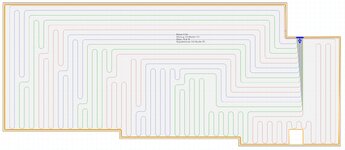
12 loop floorplan - annotated.jpg
 
To avoid these ads, REGISTER NOW!

jack stand

Well-known member
Joined
Feb 29, 2012
Messages
3,339
Location
Lakes Region Maine
I'm no pro, but I did do my install following the drawings of my designer (radiant) and I'd avoid all of those short 90* little corners that you've created to accommodate a little bump out or going around the 2 lift base's.
You making it hard to pipe and probably adding a lot of friction for the pumps.
Show the online plan that you don't like.
 
OP
D

Dr_Pippin

Well-known member
Joined
Feb 23, 2023
Messages
101
I'm no pro, but I did do my install following the drawings of my designer (radiant) and I'd avoid all of those short 90* little corners that you've created to accommodate a little bump out or going around the 2 lift base's.
You making it hard to pipe and probably adding a lot of friction for the pumps.
Show the online plan that you don't like.
I haven't run pex before, but is it that hard to do 90* turns? I'll be attaching mine to the top of my rebar, which is on 12" centers in a 6" slab. I considered skipping those turns you mentioned, but it would necessitate not heating a 2' strip along the door in the middle of the garage (my initial design had a loop running right along the perimeter there, but I removed it to make the runs only jog 1' over instead of 2' over).

Here is one of the LoopCAD designs:

Single zone with mud room excluded v1.jpg

And the other:

Single zone with mud room excluded v2.jpg

One of the problems with both of them is I cannot assign different start/end points consistent with how I'm running into my basement, it only allows me to place the manifold as the start/finish point of the loops. I also don't like that there are such discrete zones that each loop controls, as I worry if one loop failed for some reason I'd lose an area of heat - compared to how I routed the pex runs in my design, if I lose a loop for some reason I still have pretty good heat throughout.


Why so many short loops? Generally they are 300-400ft.

As I understand it, 300' is the longest run you'd want with 1/2" pex. With the layout of my garage being longer and narrower, it just worked out to make straight lines one direction, then turn around and head back the other way. My goal was to limit the number of turns in my design, and to make longer loops I would have been adding more convoluted runs. Is there actually a downside to running shorter runs?
 
Last edited:
OP
D

Dr_Pippin

Well-known member
Joined
Feb 23, 2023
Messages
101
Here, you have to get it approved by the city BEFORE installation. People had systems that didn't work or were inefficient. I know nothing, but the manifold for my garage is in the garage,
That seems like a great idea, but my city didn't say anything about it. Unless they just failed to see the pex marked on my foundation/slab detail.
 

stingry

Well-known member
Joined
Oct 14, 2006
Messages
732
Location
Western Nebraska
A couple things stand out. PEX is very stiff and doesn’t like short 90 degree turns. That ziggy zaggy thing on top is not going to work. You have all the inlet tubing in one area and the return tubing in the other area. Your inlet water is going in 20-30 degrees warmer than the return so the bottom area near the doors is going to be warmer than the top area where the return piping is. The runs need to be nearly the same length so the flow is roughly the same in all the runs. A radiant floor is very forgiving as to where the tubing is placed so precise placement isn’t that critical. I’m speaking from my own experience with my 3600 sq ft shop.
 

jack stand

Well-known member
Joined
Feb 29, 2012
Messages
3,339
Location
Lakes Region Maine
Doc I have a feeling that designing a layout really just follows a handful of rules.
Like
You building's overall insulation.
Your heating load (climate)
Reasonably equal loops with 300' maximum.
The amount of btu's the tube needs to deliver to the slab for the load.
The above probably determines the tubing spacing.
That spacing becomes less critical the closer to the center of the slab.
Perimeter loops may need a "tighter" layout and gets the hot water first (first exposure off of the manifold)
Like I said I'm nothing more than a guy who hired a radiant design company because I didn't know **** about it. 😆
They're pages of detailed full size drawings allowed me to do the complete installation myself more than paying the design fees.
So I have exactly 1 job "under my belt"🤔.
My list above is just common sense and hopefully a pro here will join in to advise.
I only read your reason to have the manifold in the house once, but it seems like its going to add complexity to the build running all that "spaghetti" further than necessary. Having a well insulated supply and return line to a point INSIDE of your shop will be a lot easier installation.
Have you gone "crazy" with slab and exterior wall insulation? I believe this is the biggest (ok maybe one of) factors to worry about. As with any heat source or delivery method, the better your insulation is the less it matters how big, fuel, delivery.
FWIW I put 6x6 wire sheets on my rebar and tied the tubing to it. It's a great guide for keeping everything equally spaced and parallel. 90* or 180* tubing bends you'll find will need lots of tie down opportunities to stay where they need to.
👍
 

Sumboodie

Well-known member
Joined
Mar 20, 2021
Messages
10,699
Location
AK
A couple things stand out. PEX is very stiff and doesn’t like short 90 degree turns. That ziggy zaggy thing on top is not going to work. You have all the inlet tubing in one area and the return tubing in the other area. Your inlet water is going in 20-30 degrees warmer than the return so the bottom area near the doors is going to be warmer than the top area where the return piping is. The runs need to be nearly the same length so the flow is roughly the same in all the runs. A radiant floor is very forgiving as to where the tubing is placed so precise placement isn’t that critical. I’m speaking from my own experience with my 3600 sq ft shop.
Can throttle the loops if needed, though
I haven't run pex before, but is it that hard to do 90* turns? I'll be attaching mine to the top of my rebar, which is on 12" centers in a 6" slab. I considered skipping those turns you mentioned, but it would necessitate not heating a 2' strip along the door in the middle of the garage (my initial design had a loop running right along the perimeter there, but I removed it to make the runs only jog 1' over instead of 2' over).

Here is one of the LoopCAD designs:

Single zone with mud room excluded v1.jpg

And the other:

Single zone with mud room excluded v2.jpg

One of the problems with both of them is I cannot assign different start/end points consistent with how I'm running into my basement, it only allows me to place the manifold as the start/finish point of the loops. I also don't like that there are such discrete zones that each loop controls, as I worry if one loop failed for some reason I'd lose an area of heat - compared to how I routed the pex runs in my design, if I lose a loop for some reason I still have pretty good heat throughout.


As I understand it, 300' is the longest run you'd want with 1/2" pex. With the layout of my garage being longer and narrower, it just worked out to make straight lines one direction, then turn around and head back the other way. My goal was to limit the number of turns in my design, and to make longer loops I would have been adding more convoluted runs. Is there actually a downside to running shorter runs?
300-400 ft area, depending on the setup. Mostly due to pumping losses and heat transfer.
Longer length (within reason)= more heat transferred to slab before returning to boiler.
Also cheaper as you'll use less materials.

I'd reduce the loop amount if you can get them around 300ft vs the 150ish feet you have.

Also no tight bends. 1-1.5ft spacing is typical. Tighter for high heat load expected like poor insulation, cold outdoor temps, frequent air changes (doors opening, ventilation, etc)
 

fitter30

Well-known member
Joined
Jun 23, 2019
Messages
2,981
Location
Peace Valley,mo
Don't like either setup especially the first with all the jogs. The second one is better. Why 12 zone for a garage? 12 zones running 15' from garage to basement is 24 separate tubes x 15' x32 btu's per foot= 11,520 btu's of wasted heat. Design wise usually in front of doors and windows there might be closer loops to help offset the heat loss.
 

Sumboodie

Well-known member
Joined
Mar 20, 2021
Messages
10,699
Location
AK
Don't like either setup especially the first with all the jogs. The second one is better. Why 12 zone for a garage? 12 zones running 15' from garage to basement is 24 separate tubes x 15' x32 btu's per foot= 11,520 btu's of wasted heat. Design wise usually in front of doors and windows there might be closer loops to help offset the heat loss.

I'd run a 1" line from boiler and manifolds in the garage.
Guess I didn't see in the picture that there's a boiler in another building.
 

86turbodsl

Well-known member
Joined
Jul 1, 2005
Messages
6,558
Location
Michigan
Dump the little jogs. I did all 250' loops on mine. Don't forget you have about a 20F delta T from beginning to end. I alternated directions on mine to even out the temps in local areas. I also doubled up the line in the outer 1' of the building, 6" spacing instead of 12". Because edges of the slab are colder. With all same length tubing, my manifolds didn't need flow controls.
 
OP
D

Dr_Pippin

Well-known member
Joined
Feb 23, 2023
Messages
101
First of all, thank you everyone for the feedback. It is really, really helpful.

A couple things stand out. PEX is very stiff and doesn’t like short 90 degree turns. That ziggy zaggy thing on top is not going to work. You have all the inlet tubing in one area and the return tubing in the other area. Your inlet water is going in 20-30 degrees warmer than the return so the bottom area near the doors is going to be warmer than the top area where the return piping is. The runs need to be nearly the same length so the flow is roughly the same in all the runs. A radiant floor is very forgiving as to where the tubing is placed so precise placement isn’t that critical. I’m speaking from my own experience with my 3600 sq ft shop.
Thank you, I'll change the top loop to just an "out and back" loop. I'll then also take that loop along the right edge of my image where I was going to leave a strip along the exterior wall unheated as it will be underneath toolboxes/workbenches. That way I get the total loop length to approximately equal the others.

Doc I have a feeling that designing a layout really just follows a handful of rules.
Like
You building's overall insulation.
Your heating load (climate)
Reasonably equal loops with 300' maximum.
The amount of btu's the tube needs to deliver to the slab for the load.
The above probably determines the tubing spacing.
That spacing becomes less critical the closer to the center of the slab.
Perimeter loops may need a "tighter" layout and gets the hot water first (first exposure off of the manifold)
Like I said I'm nothing more than a guy who hired a radiant design company because I didn't know **** about it. 😆
They're pages of detailed full size drawings allowed me to do the complete installation myself more than paying the design fees.
So I have exactly 1 job "under my belt"🤔.
My list above is just common sense and hopefully a pro here will join in to advise.
I only read your reason to have the manifold in the house once, but it seems like its going to add complexity to the build running all that "spaghetti" further than necessary. Having a well insulated supply and return line to a point INSIDE of your shop will be a lot easier installation.
Have you gone "crazy" with slab and exterior wall insulation? I believe this is the biggest (ok maybe one of) factors to worry about. As with any heat source or delivery method, the better your insulation is the less it matters how big, fuel, delivery.
FWIW I put 6x6 wire sheets on my rebar and tied the tubing to it. It's a great guide for keeping everything equally spaced and parallel. 90* or 180* tubing bends you'll find will need lots of tie down opportunities to stay where they need to.
👍
I've tried to follow those "common sense" design details for the most part as I can see they will pertain to my layout. The biggest deviations are not going to 6" spacing at the perimeter, and even starting my pex run 2' off the right wall in my image as that wall will have tool chests/workbenches along it. Being that I'll be attaching my pex to the top of my rebar I felt rather constrained to working on 12" spacing. How do the workers walk around if you have 6x6 wire sheets on top of the rebar?

To answer the insulation question, I'll be doing 2" rigid foam underneath the slab, framing with 2x6s for the walls for my addition so I can do R-21 batts, furring out the existing garage wall 2x4s to 6" deep so I can get R-21 batts in there, and then blown-in cellulose on the ceiling. So yeah, kinda going crazy with insulation. I'm in Kansas City, where we typically have 5-10 days over 100 degrees and another 5-10 days that get down to around 0 degrees.

I want to do the manifold in the basement as it will allow me to more easily expand my radiant heat system into my house's flooring as a future project. It is the foundation wall between my garage and basement that I'll be mounting the manifold on, so rather than going up from the slab to mount the manifold on the wall I'll be going down from the slab, through an 8" wall, and then mounting the manifold. Maybe it's a crazy idea, but I think it gives me better flexibility going forward for some other projects I want to do.
Can throttle the loops if needed, though

300-400 ft area, depending on the setup. Mostly due to pumping losses and heat transfer.
Longer length (within reason)= more heat transferred to slab before returning to boiler.
Also cheaper as you'll use less materials.

I'd reduce the loop amount if you can get them around 300ft vs the 150ish feet you have.

Also no tight bends. 1-1.5ft spacing is typical. Tighter for high heat load expected like poor insulation, cold outdoor temps, frequent air changes (doors opening, ventilation, etc)
I'll look at my design again and see what I can do for increasing loop length, I'm just not readily seeing a way of doing it with keeping fairly straight runs from one side of the garage to the other and minimizing bends. Doesn't pumping at a slower speed facilitate the same effect as having longer runs?
Don't like either setup especially the first with all the jogs. The second one is better. Why 12 zone for a garage? 12 zones running 15' from garage to basement is 24 separate tubes x 15' x32 btu's per foot= 11,520 btu's of wasted heat. Design wise usually in front of doors and windows there might be closer loops to help offset the heat loss.
You mean you don't like my design or the LoopCAD designs?

The 15' added length I was estimating based on each end of a loop needing 6' or 7' to get from the slab to the manifold, so a total of 12-14' per loop. I didn't think it was really much different than having the manifold mounted 3' above a slab and each loop being 6' longer than planned to allow coming up from the slab and reaching the manifold.

And I think I wasn't clear, but this is an attached garage and the foundation wall I'll be going through is the common wall between the garage and the basement. The basement is conditioned, so any heat lost before reaching the slab isn't really wasted as it's just going to be adding heat to an already heated basement.
I'd run a 1" line from boiler and manifolds in the garage.
Guess I didn't see in the picture that there's a boiler in another building.
Not another building, just on the other side of the foundation wall. The extra 15' per loop I was estimating is from each end of a loop needing 5-6' to reach the manifold. My precise length measurements were takenn from where the pex entered the slab to where it exited the slab.
Dump the little jogs. I did all 250' loops on mine. Don't forget you have about a 20F delta T from beginning to end. I alternated directions on mine to even out the temps in local areas. I also doubled up the line in the outer 1' of the building, 6" spacing instead of 12". Because edges of the slab are colder. With all same length tubing, my manifolds didn't need flow controls.
I'll redesign without the extra jogs and I'll simplify the zig zag top loop. I considered alternating directions for more even heat, but my work area is going to be the right 1/3 of the garage, so I truly would like that floor to be warmer than the rest of the garage. I had even considered dividing the garage into 2 or 3 zones and only heating the work area, but was talked out of it on this forum earlier this year when I asked about basic design ideas.
 

jack stand

Well-known member
Joined
Feb 29, 2012
Messages
3,339
Location
Lakes Region Maine
How do the workers walk around if you have 6x6 wire sheets on top of the
Normally, the rebar is up on 2" bolsters and the mesh is on top of everything. My spacing per my designer's was 18" or 3 squares of the mesh. Keep in mind that I'm in Maine and also 1/2" tube was called for.
Other than more material, I would if the braintrust here would know if there's a performance or efficacy downfall with a closer than necessary spacing?
 

rancherbill

Well-known member
Joined
Oct 18, 2007
Messages
5,335
Location
Foothills County, Alberta, Canada
That seems like a great idea, but my city didn't say anything about it. Unless they just failed to see the pex marked on my foundation/slab detail.
The city started doing it because there were too many systems that didn't work efficiently and effectively. Yours is a larger job, the pex will be in CONCRETE and you can't go back and fix it. So you have to throw more hot water or electricity for pumping to get it to perform. I had mine done by a certified person - I love my system.
 
OP
D

Dr_Pippin

Well-known member
Joined
Feb 23, 2023
Messages
101
Normally, the rebar is up on 2" bolsters and the mesh is on top of everything. My spacing per my designer's was 18" or 3 squares of the mesh. Keep in mind that I'm in Maine and also 1/2" tube was called for.
Other than more material, I would if the braintrust here would know if there's a performance or efficacy downfall with a closer than necessary spacing?
So do the workers walk on top of the rebar/wire mesh? I've never actually watched a slab poured, but I always assumed they stepped around the rebar. As I think about it now, I can't imagine the workers are dainty while pouring concrete, so are probably just stepping on whatever happens to be under their foot. I guess pex is durable enough to be walked on.

Regarding tighter spacing, I've tried to read a lot about spacing and never came across any real downsides besides cost to spacing closer together. I had toyed with the idea of doing an extra loop stapled to the insulation underneath the rebar (effectively a double layer pex layout) in the workshop/lift area, spaced 18-24" apart, just to get a bit more heat there. It'll be a 6" slab, so wasn't too worried about weakening the slab by having more pipe encased in it. But I couldn't find anyone that had done something like that, so decided probably not worth being the guinea pig.
The city started doing it because there were too many systems that didn't work efficiently and effectively. Yours is a larger job, the pex will be in CONCRETE and you can't go back and fix it. So you have to throw more hot water or electricity for pumping to get it to perform. I had mine done by a certified person - I love my system.
Was your person local to you? I'm not completely opposed to paying for the layout and design, but I am trying to do as much of this project myself to keep costs down (framing, roofing, siding, electrical, etc. will all be done by me - just contracting out the concrete work). Just seemed like the layout I'd be paying for would be generated by LoopCAD, which I'd already done myself and didn't like. And from everything I've read, concrete is pretty forgiving due to its mass (I'm sure I'm way overthinking it) and I just need to get some pex in the slab roughly on 12" spacing.
 

stingry

Well-known member
Joined
Oct 14, 2006
Messages
732
Location
Western Nebraska
And from everything I've read, concrete is pretty forgiving due to its mass (I'm sure I'm way overthinking it) and I just need to get some pex in the slab roughly on 12" spacing.
Exactly!!! Basically you are heating the whole slab and the slab is radiating heat to the building. I left a 4 x 8 section without pex for a two post lift. Never did install the lift but you cannot feel any difference in that spot. I stapled the pex directly to the insulation and laid mesh over the top. Much easier than rebar and chairs. My shop is3600 sq ft and not a single crack except in the control joints.
 
To avoid these ads, REGISTER NOW!
OP
D

Dr_Pippin

Well-known member
Joined
Feb 23, 2023
Messages
101
Exactly!!! Basically you are heating the whole slab and the slab is radiating heat to the building. I left a 4 x 8 section without pex for a two post lift. Never did install the lift but you cannot feel any difference in that spot. I stapled the pex directly to the insulation and laid mesh over the top. Much easier than rebar and chairs. My shop is3600 sq ft and not a single crack except in the control joints.
It is great to hear that you don't notice that big of a section unheated. Really makes me feel better about not trying to squeeze pipe into all the little corners, and in fact as I'm re-designing the layout I'm completely omitting one run right through the middle of the garage for ease of layout.
 

rancherbill

Well-known member
Joined
Oct 18, 2007
Messages
5,335
Location
Foothills County, Alberta, Canada
Was your person local to you? I'm not completely opposed to paying for the layout and design, but I am trying to do as much of this project myself to keep costs down (framing, roofing, siding, electrical, etc. will all be done by me - just contracting out the concrete work).
Yes, it was the company installed the boiler and inflow system. I did the pex in the garage but not the house because of time. It is not hard to layout the pex, or do the headers. I even balanced the system and they checked it while they were her for something else. All your loops will require different flows based on lengths and whether they are on the edge.
 

Sumboodie

Well-known member
Joined
Mar 20, 2021
Messages
10,699
Location
AK
Exactly!!! Basically you are heating the whole slab and the slab is radiating heat to the building. I left a 4 x 8 section without pex for a two post lift. Never did install the lift but you cannot feel any difference in that spot. I stapled the pex directly to the insulation and laid mesh over the top. Much easier than rebar and chairs. My shop is3600 sq ft and not a single crack except in the control joints.
I can definitely tell where the pex is routed closely (to/from the manifold) if walking on the floor with socks. Not noticable otherwise though.

My old place they didn't run it close enough to the walls and a foot or so from the wall would get cold in winter. I mostly heated with a wood stove, so didn't bother me much.
 

Firebrick43

Well-known member
Joined
May 12, 2015
Messages
14,091
Location
West central Indiana
I can definitely tell where the pex is routed closely (to/from the manifold) if walking on the floor with socks. Not noticable otherwise though.

My old place they didn't run it close enough to the walls and a foot or so from the wall would get cold in winter. I mostly heated with a wood stove, so didn't bother me much.
Does your mom still stand you in the corner?
 

PoorUB

Well-known member
Joined
Mar 29, 2021
Messages
11,653
Location
Fargo, ND
I have laid a lot of PEX for floor heat. When doing a residential garage we wopuld run the first couple loops at 6" spacing, then go to 12" and if we ran out of tubing the center of the floor got 18" spacing. Never had a complaint.

Keep in mind, you may notice a cooler spot if you walk around in bare feet of get an IR thermometer and shoot the floor, but the spot where the tubing is will be 5-10 degrees warmer than space temp, and the cool spot will be a few degrees cooler.

It is a **** load better than no floor heat and a 40 degree floor in the middle of the winter!
 

Sumboodie

Well-known member
Joined
Mar 20, 2021
Messages
10,699
Location
AK
Does your mom still stand you in the corner?
We had to kneel. Been probably 30 years since I've done that. I'd need a foam kneeled these days, or barely be able to walk right for days after.
Getting old is lovely 😐
 

Sumboodie

Well-known member
Joined
Mar 20, 2021
Messages
10,699
Location
AK
I have laid a lot of PEX for floor heat. When doing a residential garage we wopuld run the first couple loops at 6" spacing, then go to 12" and if we ran out of tubing the center of the floor got 18" spacing. Never had a complaint.

Keep in mind, you may notice a cooler spot if you walk around in bare feet of get an IR thermometer and shoot the floor, but the spot where the tubing is will be 5-10 degrees warmer than space temp, and the cool spot will be a few degrees cooler.

It is a **** load better than no floor heat and a 40 degree floor in the middle of the winter!
For sure.
I've never measured the temp where I said it's warmer, probably 10 or 20*

Played that game in poorly sealed shops on cold days. Freezing while under something on a creeper, dripping sweat when at the workbench but feet freezing.

Even the multi million dollar building at work, I can freeze water bottles if on the floor in the office when it's -40* outside.
 

86turbodsl

Well-known member
Joined
Jul 1, 2005
Messages
6,558
Location
Michigan
I'll redesign without the extra jogs and I'll simplify the zig zag top loop. I considered alternating directions for more even heat, but my work area is going to be the right 1/3 of the garage, so I truly would like that floor to be warmer than the rest of the garage. I had even considered dividing the garage into 2 or 3 zones and only heating the work area, but was talked out of it on this forum earlier this year when I asked about basic design ideas.
Yes, zoning is pointless on an undivided space. As far as your other thinking, it makes sense to me.
 
OP
D

Dr_Pippin

Well-known member
Joined
Feb 23, 2023
Messages
101
I appreciate everyone's input. I think I've finalized my design, with a priority on straight runs and minimal bends. I also shifted my lift posts slightly and made the area without pex for the posts a bit smaller. I will be leaving a strip through the middle without pex, on the comments of you guys saying an area in the middle not heated won't be noticeable. Thanks again everyone for your suggestions and help with my design.

12 loop floorplan v3.jpg

Oh, and the length details - shortest loop is 121' and longest loop is 177'.

Does anyone have suggestions on if I should I go with the Uponor manifold or Bluefin? Price difference is about $500!
 
Last edited:
OP
D

Dr_Pippin

Well-known member
Joined
Feb 23, 2023
Messages
101
Oh, and I think I wasn't clear about where I'm mounting my manifold, so figured I should clarify that. This is a picture taken in my basement of the shared foundation wall between between my basement and garage. I've drawn to scale where the slab/foam/gravel will be in the garage, just on the other side of that wall, and a 4" circle to denote the location of the PVC line I'll have cored through the wall for routing the pex lines.
 

Attachments

  • Foundation chalk drawing.jpg
    Foundation chalk drawing.jpg
    944.2 KB · Views: 25

jack stand

Well-known member
Joined
Feb 29, 2012
Messages
3,339
Location
Lakes Region Maine
Doc is your hot water source in the bsmt?
I'm sure that you've done your homework, but don't short yourself on space. Iirc you had quite a few loops but were planning to 2 holes (supply & return) 👍
I rented a "uncoiler" for my installation, this stuff definitely has a "lay" and by the time you change directions or a bunch of corners it'll really fight you to the extreme where you might have to turn the roll to get it to lay naturally.
 
OP
D

Dr_Pippin

Well-known member
Joined
Feb 23, 2023
Messages
101
Doc is your hot water source in the bsmt?
I'm sure that you've done your homework, but don't short yourself on space. Iirc you had quite a few loops but were planning to 2 holes (supply & return) 👍
I rented a "uncoiler" for my installation, this stuff definitely has a "lay" and by the time you change directions or a bunch of corners it'll really fight you to the extreme where you might have to turn the roll to get it to lay naturally.
Yes, hot water will be in the basement. I have plans to also do some staple up for heating the master bathroom and potentially in-floor radiant for the kitchen when we remodel that next year. Locating the hot water source in the basement will definitely simplify my future plans. This garage was supposed to be finished by now and then this winter the plan was to finish the actual radiant system, but at this rate I'll still be building the garage in the snow....

Here's where all the radiant stuff will be going. The computer and network stuff on the 2x4 framing is just temporarily parked there, I'll move it to a more permanent location in the future. It's 12' between the waste line and the far wall and the ceiling is 9' tall. Sure hoping that's ample space for everything!

Wall location.jpg

Yes, two holes through the foundation wall, one for supply and one for return. Planning on running 4" PVC as the conduit for the pex lines, but need to stop in at Home Depot tomorrow and do a little test to see if I can get 12 pex lines to make the bend of a 4" 90* fitting. If not, I'll do a pair of 45's and move the hole through the wall down a bit more.

Great suggestion for renting an uncoiler. I'd seen them for sale, but didn't really want to spend 300 bucks on one. I'll have to see if I can locate one to rent for a day.
 
OP
D

Dr_Pippin

Well-known member
Joined
Feb 23, 2023
Messages
101
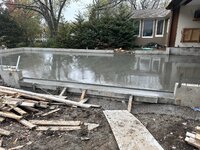
Thanks for the help everyone! Laid out the pex Monday night with a few zip ties, then several more hours Tuesday finishing the zip ties, then many more hours Wednesday and Thursday checking and re-checking every 12" that everything was properly zip tied and all the tails were cut off. Concrete was poured this morning and finished by this afternoon. Pressurized the pex to 60psi on Wednesday afternoon and it's still sitting right at 60 now. Success!! (And for those closely looking at the layout, I did move the pipe running on the left side of the square cutout on the left edge of the image over to the right side of the cutout to avoid having that area not heated)

IMG-4556.jpg
 

Attachments

  • 71994573925--57026C6E-85E9-42C8-888D-78BD84C3F222.jpg
    71994573925--57026C6E-85E9-42C8-888D-78BD84C3F222.jpg
    1 MB · Views: 30
  • IMG-4706.jpg
    IMG-4706.jpg
    1.5 MB · Views: 34

Sumboodie

Well-known member
Joined
Mar 20, 2021
Messages
10,699
Location
AK
Run copper to the garage off the boiler and manifold it in the garage. Might be able to reduce the loops too and use smaller manifolds. ~300ft loops.
 
OP
D

Dr_Pippin

Well-known member
Joined
Feb 23, 2023
Messages
101
Run copper to the garage off the boiler and manifold it in the garage. Might be able to reduce the loops too and use smaller manifolds. ~300ft loops.
Well, the pex is all encased in concrete now, so no changes there at this point. Haha. The manifold is going in my basement on the shared foundation wall between my basement and the garage. So that puts it as close as it could possibly be to the slab.

The pex runs dive down into a 45* PVC tube to direct it horizontally into/through the foundation wall:
IMG-4549.jpg

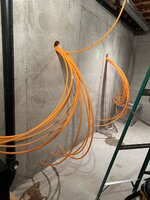
Where the pex then exits into my basement. I'll be putting the manifold between the two holes and a couple feet higher up on the wall:IMG-4557.jpg
 

ConCretin

Well-known member
Joined
Jan 20, 2011
Messages
3,378
Location
Central Maine
I'll be attaching mine to the top of my rebar, which is on 12" centers in a 6" slab.
Nothing to add on your pex layout question but a word of caution regarding your layout. That's a big slab and if you want to avoid random surface cracks, you'll want to cut control joints. Control joints in a 6 inch slab should be 1 1/2" deep so make sure you position your rebar/pex accordingly and tie it down well. You don't want it to float up and get cut.

Edit. Oops. Kinda late to the party. The set up looks great. Hopefully the finished result is too. Congrats.
 
Last edited:
OP
D

Dr_Pippin

Well-known member
Joined
Feb 23, 2023
Messages
101
Nothing to add on your pex layout question but a word of caution regarding your layout. That's a big slab and if you want to avoid random surface cracks, you'll want to cut control joints. Control joints in a 6 inch slab should be 1 1/2" deep so make sure you position your rebar/pex accordingly and tie it down well. You don't want it to float up and get cut.

Edit. Oops. Kinda late to the party. The set up looks great. Hopefully the finished result is too. Congrats.

Thanks! I'm pretty happy with it. I get to start framing this weekend!
 
To avoid these ads, REGISTER NOW!
Top Bottom