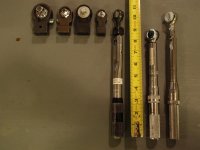
OK, to add to this, I got out my quarter drive clickers.
In the pic, the one on the right is a quite old Utica, made when Utica/Bonney was owned by the Triangle Corporation, and is marked Orangeburg, SC. I have seven of these, I bought one 1/4 and one 3/8 ratchet head for them, and when we attempted to calibrate the first one (calibration room at work), it had NON-linear errors and could not be fixed, we quit and I've never checked the other six. The ratchet head you see is a
72 tooth, and Utica made it by welding a regular ratchet head to their blank head adapter. They make an A and a B size adapters, this is the smaller A size, they are not interchangeable. The hole in the torque wrench for the adapter is round, even though the adapter has flats on it.
The one to the right of the tape measure is my Seekonk. It has a 36 tooth ratchet mechanism and will take replacement kits made for Craftsman and Allen, KD and other Danaher manufactured 1/4" RHFT ratchets.
To the left of the tape is a Sturtevant-Richmont (
www.srtorque.com) with a round head, fine tooth (
60 tooth) ratchet on it. Attachments on these attach with a dovetail and all ratchet heads and open and box end heads and other stuff has the same offset to the middle of the fastener, so the calibration stays the same. Next to the torque wrench are my other ratchet heads, a 1/4 square head that is a
24 tooth ratchet, and square and round head 3/8 and a 1/2 drive head. I have two other interchangeable head S-R torque wrenches so this works out well. One feature of the SR torque wrenches is that they have an adjustment that allows for removing most non-linear errors. The SR model with a permanent ratchet head is shorter, but I don't think you can get it with the fine tooth ratchet.
The Utica only allows the head to be installed one way, I'm not sure if the torque mechanism inside will allow for LH torquing or not. The SR is non-reversible and will not click or torque in the LH direction. If you want to torque LH then you remove the head and flip it over and reinstall it. The tool is marked with arrows to indicate the direction it will torque.
Charles


 Though you actually need a dial type or at least beam style, not clicker. Try hooking up a 1 1/4" socket to a 1/4 torque wrench.


 I've even had people ask me when craftsman sold a raised panel slim wrench before