To avoid these ads, REGISTER NOW!

Finger joint 2x4 wall studs.

To avoid these ads, REGISTER NOW!

K'ledgeBldr

Well-known member
Joined
Aug 22, 2011
Messages
1,925
Location
Johns Creek, GA
I hate them- and have had problems with them falling apart because the fingerjoints didn't get glued well.

Send them back- and tell them NO FINGERJOINT!
 

Bluearmflames

Well-known member
Joined
Apr 1, 2013
Messages
104
Location
Hamburg, PA
Send them back for a load bearing wall. If they are stamped correctly they can be used for load bearing, but they tend to be slightly fragile.
 

Git

Well-known member
Joined
May 18, 2008
Messages
6,894
Location
S Cal
Look up the price of the finger jointed studs versus regular studs in your area and I think you will have your answer
 
OP
I

iSpark

Well-known member
Joined
Sep 12, 2015
Messages
283
Location
Coastal SC
I'm okay with finger joint trim that gets painted, but I'm leery of anything finger joint for structural.

Got to have a talk with the GC.

And yeah, I would imagine finger joint 2x4's are way cheaper. This few however, should have been normal studs.
 
OP
I

iSpark

Well-known member
Joined
Sep 12, 2015
Messages
283
Location
Coastal SC
Hmm
Just talked with GC.
He said they were stronger. :headscrat

Do they make structural finger joint wall studs? More specific, load bearing finger joint studs? I can't see any markings on the studs unless they are all facing down.
 

dogdog

Well-known member
Joined
Nov 15, 2011
Messages
12,711
Hmm
Just talked with GC.
He said they were stronger. :headscrat

Do they make structural finger joint wall studs? More specific, load bearing finger joint studs? I can't see any markings on the studs unless they are all facing down.

They probably lied, probably cheaper with these or whats available. Highly suspicious with your GC's statement.
 

SundayFunday

Active member
Joined
Oct 28, 2018
Messages
44
Location
Mn
Do they make structural finger joint wall studs? More specific, load bearing finger joint studs? I can't see any markings on the studs unless they are all facing down.

Without a grade stamp, that lumber could be anything. I would trust it more if it had a stamp.

Some reading for you if interested:
https://www.wwpa.org/western-lumber/structural-lumber/finger-jointed


Finger-jointing is not rocket science, but there are definitely process checks that need to be done when it's made. I was an engineer on a line that made a few million board feet of finger-jointed lumber per year. We had sensors measure the weight of glue on every joint, the coverage on each joint, the squeeze pressure, the hold time...... It is also very dependent on the accuracy of the cut of the fingers.
 
OP
I

iSpark

Well-known member
Joined
Sep 12, 2015
Messages
283
Location
Coastal SC
I just asked them to be replaced with normal studs for the load bearing wall.

Whether or not the FJ studs is completely fine, I would feel better with normal studs.
 

THE RIP

Active member
Joined
Dec 16, 2016
Messages
39
Location
Washington
I used them 20 years ago when I was a framing sub. We didn't care for them but that's what the GC bought.
 
OP
I

iSpark

Well-known member
Joined
Sep 12, 2015
Messages
283
Location
Coastal SC
GC called me after a round of texting, and said they would swap them out in the morning with normal studs that are rated for load bearing.

I'm just not a fan of finger joints.
 

WNYflyer

Well-known member
Joined
Sep 13, 2009
Messages
2,119
Location
Lockport, NY
Oh yeah, here is the stamp I overlooked.
No clue on the rating.
IMG_6311.jpg


Sent from my iPhone using The Garage Journal mobile app

Never heard of end jointed lumber for structural applications, I learned something new. From my reading since the stamp says "vertical use only" they are acceptable for use where the load they see is primarily compression as in exterior and interior bearing walls. Exterior bearing walls also see bending due to wind loads, etc but it looks like since wind, earthquake, etc. are intermittent loads and not long term the "vertical use only" studs can be used in those applications. Now I wonder if they can be used on exterior non-bearing walls subject to bending due to wind but have minimal compression since it is a non-bearing wall? I would figure they are okay there also.

Of course all the other grade stamps have to be correct for the application and design assumptions.
 

Git

Well-known member
Joined
May 18, 2008
Messages
6,894
Location
S Cal
attachment.php
 

Attachments

  • Tri -  1413.jpg
    Tri - 1413.jpg
    109.3 KB · Views: 771
To avoid these ads, REGISTER NOW!

ace10

Well-known member
Joined
Dec 17, 2017
Messages
1,490
Location
Rural NoVA
Never seen such a thing.
Do you have to avoid the joints when you're running electrical and plumbing?
 

K'ledgeBldr

Well-known member
Joined
Aug 22, 2011
Messages
1,925
Location
Johns Creek, GA
Oh yeah, here is the stamp I overlooked.
No clue on the rating.
IMG_6311.jpg


So, S-Dry is (surface dry- less than 19% moisture content)
#2 is not “stud grade” (on regular dimensional lumber). But, it says for “vertical use only” and makes no designation as to the type of glue.

I would relegate those to interior walls only- then again, as I previously stated- I hate them and will not use them.
 
OP
I

iSpark

Well-known member
Joined
Sep 12, 2015
Messages
283
Location
Coastal SC
I don't know the cost on these but I will try and find out.

As far as electrical and plumbing runs, my guess is the hole size would fall under the same requirement as regular studs and also be allowed in the joint.
The different joint locations on each stud would make a pretty stupid line horizontally if you have to avoid the joint. Some of these "pieces" are just 1 inch long!

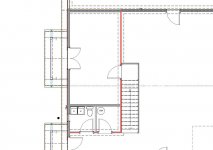
These studs were going to be used on a interior load bearing wall, red in the pic, if it was non-load bearing I probably wouldn't have said anything. As a matter of fact this interior load wall is only one of two walls inside, well 4 technically, that are load bearing internally.

The stairs go to storage above those rooms.
 

Attachments

  • load.jpg
    load.jpg
    59.4 KB · Views: 59

reader2580

Well-known member
Joined
Dec 31, 2014
Messages
14,516
Location
Minneapolis, MN
The builder who built my previous house in 2001 told me he had a client who wanted his house built with finger jointed studs as they are straighter than regular studs. I believe at the time they were more expensive than regular studs.

Today, if I was going for straight I would use Timberstrand lumber.
 

txvwnut

Well-known member
Joined
Jan 1, 2015
Messages
7,603
Location
Bedford, Texas
I think you’ll see FJ studs more at commercial lumber yards over the box improvement stores. When I built my shop I ordered all my lumber from a commercial lumber/building materials supplier. They sent a rep out who looked over my prints and agreed that I had figured the right amount materials and there intended use in the build. When the order was delivered I noticed the 2x4’s were all FJ and cost me about the same as what HD had in stock but were noticeably better quality in regards to straight and flat so I went with them. That was 17 years ago and I haven’t had an issue with any of them in a load bearing setting holding up the second story of my shop.
 

finn

Well-known member
Joined
Mar 27, 2005
Messages
16,208
Location
The UP, God's country
I suspect use of finger joined studs and other engineered products will gradually become commonplace in the construction industry as the old products everyone has historically used become more expensive to the point they are no longer economically feasible to use.

It’s happened before.

PVC and pex have replaced cast iron, galvanized, and copper, dimensional lumber replaced full dimension rough sawn, vinyl replaced cedar siding, and asphalt shingles replaced cedar and slate shingles. Plywood replaced shiplap fifty years ago, and Osb replaced plywood thirty years ago. Romex is, with some local exceptions, universally accepted.

All of these changes met resistance from the old guard who typically resist change, and some, like aluminum wiring, end up being bad ideas and fail.

These changes take time, sometimes generations, but eventually the old school dies off and life continues....
 

Sumboodie

Well-known member
Joined
Mar 20, 2021
Messages
10,669
Location
AK
Look up the price of the finger jointed studs versus regular studs in your area and I think you will have your answer

My walls have those. Assumed it was because it'd make a straighter stud.
 

383 240z

Well-known member
Joined
Dec 4, 2006
Messages
4,295
Location
Findley Twp. Allegheny Co.
The laminated 6x6's that make the structure for my last two pole barns had them. I loved them. Dead straight, the bottom 5' are PT. I liked that the rest wasn't because one of them was a livestock barn.I did not have to worry about the goats chewing on them.

I just spec'ed them for the building I'm doing now. 6x6x22 About 2x the cost of a regular 6x6x22, but I feel it is money well spent
 

CJ7VFR

Well-known member
Joined
Jan 13, 2015
Messages
2,939
Location
Central New Jersey
Exactly. Like for interior kitchen walls where cabinets are going to be hung.

They are not hard to break at the finger joint.

If they are easy to break, then is it wise to hang heavy kitchen cabinets off of them, especially when the cabinets can weigh hundreds of pounds when loaded?

Or does it not matter since the screws for the cabinet will go into the sides of the FJ studs?

Jim
 

ace10

Well-known member
Joined
Dec 17, 2017
Messages
1,490
Location
Rural NoVA
I spoke with a buddy of mine who's a custom home builder. He said saw them and used them twenty years ago in Michigan. But not much since, and not in here in Virginia.

His main concern is with structure collapse during a fire. Which really only applies for residences.
 

K'ledgeBldr

Well-known member
Joined
Aug 22, 2011
Messages
1,925
Location
Johns Creek, GA
I spoke with a buddy of mine who's a custom home builder. He said saw them and used them twenty years ago...


I remember about that same period- there was a tariff war going on and Canada suppliers found a loop-hole. They were drilling a hole about 24" from one end (just like an electrician would do running wire), The stud now became a "manufactured product", not a commodity.
 
To avoid these ads, REGISTER NOW!
Top Bottom