To avoid these ads, REGISTER NOW!

Finishing an attic into living space

Tinkerinmatt

Member
Joined
Oct 21, 2013
Messages
14
Location
Hampstead NC
I know this isn’t garage talk, but I’m looking for help on how to finish my attic space into living space.

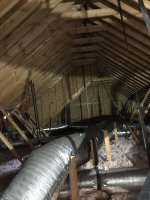
My house has 2x8 trusses holding up the roof, with about 400 sq ft open that I want to use as more living space. The angle 2x4s that come down from the roof hit 2x12 beams that are 2 wide that would be what I use as my floor, and is plenty strong. I would build a floor from those, relocate the duct work a little to the side, and have about 5’ walls on the sides till it hits the angle roof trusses.

My question is insulating the roof. I want to use spray foam, but do I need vents against the plywood? Or just spray directly onto the underside of the roof?
 

Attachments

  • 0BD1E40D-286F-499B-8090-6521676AB159.jpg
    0BD1E40D-286F-499B-8090-6521676AB159.jpg
    100 KB · Views: 217
  • B57C9115-0960-4C41-85BA-B73A43F535DA.jpg
    B57C9115-0960-4C41-85BA-B73A43F535DA.jpg
    96.9 KB · Views: 207
  • 35C19DA9-5030-46D3-A37E-D60A3D58FF73.jpg
    35C19DA9-5030-46D3-A37E-D60A3D58FF73.jpg
    91.3 KB · Views: 198
  • 86EEEBFD-3315-4C59-BDCA-383B06E7AE69.jpg
    86EEEBFD-3315-4C59-BDCA-383B06E7AE69.jpg
    107.2 KB · Views: 187
To avoid these ads, REGISTER NOW!

yeldogt

Well-known member
Joined
Jan 2, 2012
Messages
18,184
You need to determine if the structure can take it --- often dormers are added to increase usable space. The foam is directly applied .... HVAC needs to be redirected
 

engineer2

Well-known member
Joined
Dec 13, 2009
Messages
11,814
Location
Chicago burbs
You probably know this, but check if a second stairwell or exit is required to meet fire code. It may be if this is above the second floor.
 

3onthetree

Well-known member
Joined
Nov 14, 2018
Messages
191
You have a 2x8 rafter roof with purlins, not a truss structure. The purlin braces are splitting the rafter span in two and bear on the sistered 2x12 beams. There is no guarantee that those 2x12 beams can simultaneously support a new 400sf floor diaphragm, as the fact they are beams probably means there is no bearing wall underneath, and those beams were chosen to span over something below and have posts supporting them to the foundation.

With air-impermeable insulation you can spray directly onto the sheathing, but there are different scenarios with kneewalls. If you make the entire area under roof conditioned, no roof ventilation is required. If you have unconditioned kneewall space and a small attic, you need roof ventilation and that should continue behind spray on the angled ceiling of your enclosed room.

There are other issues with capturing this space, like requirements for light+ventilation and emergency egress.
 

dcg9381

Well-known member
Joined
Jun 20, 2018
Messages
11,778
Location
Austin, TX
Spray foam is great. It spray directly on the roof deck. If you have a ridge vent, foam wil make that inoperable (which is what you want). You're going to add knee walls, you'd also foam those walls, basically creating a living space envelope, which is sealed.

The remaining attic probably has perforated eves, which is what you need for the standard insulation that remains. You'd probably add another roof vent on each side to replace the lost ridge vent.

Alternatively, if you enclose the entire attic with foam - which is probably more desirable, you close off that roof vent and any eve venting. You need to be sure to shoot the eves if they are perforated. The house becomes a closed envelope. The insulation on the attic floor is unnecessary (but OK to leave it).

Enclosing the entire attic with foam will improve your HVAC efficiency as the air handler and associated duct work are now in semi-heated (air conditioned) space and the temperature in the attic will be closer to that of inside your home. It's actually a pretty remarkable difference (at least here in Texas).


As others have mentioned - your attic may not have been designed for living space loads. Your roof joists transfer load to your attic deck (as designed currently) - that bracing is almost certainly necessary for those roof joist spans. I'm not saying that it can't be done - knee walls could accomplish the same load transfer, but not sure about that attic deck load.
 

nadogail

Well-known member
Joined
Jan 23, 2009
Messages
31,982
Location
Coronado, CA
Will your local building permit office issue a permit for the work? If the answer is YES, then Go For It.

If they will not issue you a permit, maybe you should look into why and consider how you can overcome their objections.
 

CombatNinja

Well-known member
Joined
Aug 24, 2013
Messages
1,456
That attic does not look like it was conceived as future living space. Have a structural engineer look at your situation. This whole forum can give you armchair quarterback advice but you need a pro to assess the feasibility.
 

matt_i

Well-known member
Joined
Mar 14, 2008
Messages
10,729
Location
SE Michigan
Agree with other comments, looks very similar to a house I owned in ATL around the turn of the millenium with cavernous attic, built mainly for the large soaring 12:12 roof that improved the exterior visual.

Any attic space is going to be a challenge to heat and cool, to the point it may need its own minisplit or air handler. Insulation can help but the radiating heat of the sun is tough to block with insulation.
 

mepstein

Well-known member
Joined
Sep 17, 2010
Messages
1,286
It might need some reinforcement to become a living space but I bet it is still cheap sq/ft compared to adding on. I did mine and added on a 2nd hvac unit but these days I would have done it with a mini split.
 
OP
T

Tinkerinmatt

Member
Joined
Oct 21, 2013
Messages
14
Location
Hampstead NC
Thanks all. The house is mostly single story, with 12’ ceilings in the open living room below that. There is a FROG over the garage, and a guest room over the kids rooms, with steps up to that guest room and full bath, then a door from there that goes into the attic. A second 2.5 ton air handler serves only the FROG and guest room. The kids rooms only have 9’ ceilings on the first floor, so there’s a 3’ rise in the attic where it goes up to the 12’ ceilings, and those 2x12s span that 12’ area. I was thinking of 4 steps to get up there, and finish that roughly 20x20 space into a den/office since I’m losing our guest room/current office with a new baby coming. There are 3 non functional dormer windows in the attic that I’d incorporate into the space.

I agree it’s much cheaper to just finish this space, even if I have to add more beams, than do a full addition, or the planned 24x30 detached garage with an attic loft for the new guest room/office. I was hoping that using spray foam insulation would be good enough for me to extend the 2.5 ton unit ducts into this space, or the main 3.5 ton unit from downstairs since the downstairs heat load would go down dramatically by removing most of the ceiling heat load which is not well insulated.
 
To avoid these ads, REGISTER NOW!

mepstein

Well-known member
Joined
Sep 17, 2010
Messages
1,286
I agree. When I finished my attic space, our master bedroom, which had always been too hot in the summer and too cold in the winter, ended up much more comfortable. It's the furthest room from the furnace and the minimal insulation over the ceiling was never enough.
 

yeldogt

Well-known member
Joined
Jan 2, 2012
Messages
18,184
Have someone do a real heat/cooling load .. even if you have to pay for it. I wish more people understood how important this is ... the vast majority (read almost all) have poorly designed systems with bad ductwork and oversized equipment.

I'm sure you can see the problems with your flex -- plus it's running in an unconditioned space. Seal that up and the whole house will be happy .... get the proper load and you can see exactly what the whole house needs and the individual rooms ... the new ductwork is sized for doing just what is required.

The overall heat load will tell you how much the 6t of cooling is oversized ....

A tight house with foam ... can easily go past 1T per 1000sf. The main part of my house is 4.5T and over 5ksf ... no problem at 100 degrees.
 

K'ledgeBldr

Well-known member
Joined
Aug 22, 2011
Messages
1,925
Location
Johns Creek, GA
Sticking to the “question”-

Applying spray foam directly to the underside of roof decking would be subject to the shingle manufacturer’s warranty (to date).

I’m not a fan of this operation- the biggest negative of this process is roof leaks- most times, you’ll never know you have a roof leak until MAJOR damage has occurred.
 

rjacobs

Well-known member
Joined
Jul 24, 2015
Messages
3,882
Location
Dallas, TX
]

I’m not a fan of this operation- the biggest negative of this process is roof leaks- most times, you’ll never know you have a roof leak until MAJOR damage has occurred.

false...

well true and false...

With closed cell...true...

With open cell...false...

Water will work its way through open cell. MOST spray foam on the bottom of the roof deck is open cell from what I have seen.
 

rsanter

Well-known member
Joined
Dec 22, 2007
Messages
18,521
Location
visalia ca
Need to look at what the floor can handle load wise to see if you can even change that space or if you will have to reinforce
 

justanengineer

Well-known member
Joined
Apr 5, 2011
Messages
7,722
Location
Motor City
Water will work its way through open cell. MOST spray foam on the bottom of the roof deck is open cell from what I have seen.

Wrong. Foaming a roof or wall is the same as putting a sponge against it, closed vs open is just a different density of that sponge. A few drops of water won’t go through either, bucketfuls will go through both. Unless you have a major leak you won’t see it regardless if open or closed cell, the water just sits and rots the decking. I wish I had a nickel for every old house decked with planking that I’ve seen ruined by foam, I actually fell through one ~20 years ago.


Sent from my iPhone using Tapatalk
 

dcg9381

Well-known member
Joined
Jun 20, 2018
Messages
11,778
Location
Austin, TX
Applying spray foam directly to the underside of roof decking would be subject to the shingle manufacturer’s warranty (to date).

I’m not a fan of this operation- the biggest negative of this process is roof leaks- most times, you’ll never know you have a roof leak until MAJOR damage has occurred.

Might read this: https://theroofcrafters.com/shingle-warranty-after-spray-foam-attic-insulation/

Around here, the residences that are done with foam are all sprayed under the roof deck. I call "suspect" on the "shingle warranty" anyway - it's not going to cover labor, might cover the shingles, subject to their inspection, no indications of weather impact, proper roof ventilation (yes, even with existing insulation) blah blah blah... IE - Is the "shingle warranty" valuable anyway? Around here, due to hail, we can't get 20 years out of a roof anyway.

With open cell foam, a leak penetrates the foam. Closed cell is different - less water retention and may make a leak a little more difficult... As indicated a "small leak" might be contained in either case and impact the roof deck, but foam insulation isn't a "negative" to me... Both are valid for residential construction and vast improvements on traditional insulation options.

Around here the HVAC loads are reduced with foam insulation compared to traditional bat.

In terms of structural - you might try a few online calculators and see what you come up with in terms of supported loads, joist spacing, and joist size... It might get you into ballpark. Helps if you know where the supporting walls are.
 

yeldogt

Well-known member
Joined
Jan 2, 2012
Messages
18,184
closed cell foam will not allow water to penetrate ... if you look around at studies the roof temps between the various ways of insulating have little effect.

Open cell can create damp sheathing .... it has to be thick enough.

I have never understood this ... roof leak idea. Properly installed shingle roofs don't leak ? they actually will dry to the outside. So will a cedar roof .. and slate.

It's like when HVAC zoning comes up and people say they like two systems for redunduncy. ??

Regardless of building method ... buildings have to dry.
 

CraigStu

Well-known member
Joined
May 22, 2014
Messages
4,038
Location
Blacksburg, Va
Let's assume you determine that your attic floor joists are in fact strong enough to handle building a room up there. What if those angled 2x4s are basically replaced by knee walls. And then a ceiling is installed. Insulate the knee walls and ceiling conventionally, or use your foam in them. Insulate and drywall the portion of the roof that makes up your angled wall between knee wall and ceiling. There you could use foam board cut to fit between the rafters, or roxul, whatever you prefer. Whatever the dimensions of the rafters are, install insulation that is 2 inches thinner so there is an air gap to the roof. You end up w/ a fully insulated room up there and no worries about the roof being damaged or leaks being invisible as long as you check periodically. And you only have to heat and cool the room vs the entire attic.
 
To avoid these ads, REGISTER NOW!
Top Bottom