

You are using an out of date browser. It may not display this or other websites correctly.
You should upgrade or use an alternative browser.
You should upgrade or use an alternative browser.
Fire Extinguishers
- Thread starter T411
- Start date
Get good rechargeable gear. I have two shops…and keep one by each exit. My thought is I can decide to run or stop and fight. When I weld I keep one near me…a good rule of thumb is to do fire watch for a while after you are done welding. If you are going to be fighting fire on cars/boats get the ones with the proper chemicals. Certain ones will not screw up all the electronics when dischargEd.

Snapped-off
Well-known member
I think mine is a Kidde ABC. Mounted next to the door.
Aaron_W
Well-known member
Get a 5lb or 10lb ABC, base the size in part on your ability to comfortably operate the extinguisher.
ABC will work on ordinary combustibles (paper, wood etc) and flammable liquids. The C means it is non-conductive so safe to use on energized electrical equipment up to around 600v. Safe meaning safe for you, electrical equipment will not enjoy the experience.
Disposables are fine as the recharge and testing for rechargeable types can exceed the cost of buying a new disposable.
Amerex, Ansul, Kiddie are all established brands.
Personally I also like having an old school 2-1/2 gallon pressurized water can extinguisher around when I'm welding or doing other hot work. Water works well for most things that hot sparks or slag from welding might ignite. It is also far less messy than the dry chem ABC type and can be recharged in your shop after use as long as you have water and an air compressor.
ABC will work on ordinary combustibles (paper, wood etc) and flammable liquids. The C means it is non-conductive so safe to use on energized electrical equipment up to around 600v. Safe meaning safe for you, electrical equipment will not enjoy the experience.
Disposables are fine as the recharge and testing for rechargeable types can exceed the cost of buying a new disposable.
Amerex, Ansul, Kiddie are all established brands.
Personally I also like having an old school 2-1/2 gallon pressurized water can extinguisher around when I'm welding or doing other hot work. Water works well for most things that hot sparks or slag from welding might ignite. It is also far less messy than the dry chem ABC type and can be recharged in your shop after use as long as you have water and an air compressor.
rlitman
Well-known member
I've used a 5lb Kidde extinguisher to put out a fire on a neighbor's house. It did the job, but Kidde extinguishers are only budget disposable units. They've had a bad history of recalls with plastic valves. The metal valved models are supposedly better. Amerex, Ansul and Badger are the established quality brands I would recommend.Get a 5lb or 10lb ABC, base the size in part on your ability to comfortably operate the extinguisher.
ABC will work on ordinary combustibles (paper, wood etc) and flammable liquids. The C means it is non-conductive so safe to use on energized electrical equipment up to around 600v. Safe meaning safe for you, electrical equipment will not enjoy the experience.
Disposables are fine as the recharge and testing for rechargeable types can exceed the cost of buying a new disposable.
Amerex, Ansul, Kiddie are all established brands.
Personally I also like having an old school 2-1/2 gallon pressurized water can extinguisher around when I'm welding or doing other hot work. Water works well for most things that hot sparks or slag from welding might ignite. It is also far less messy than the dry chem ABC type and can be recharged in your shop after use as long as you have water and an air compressor.
Anyway, start with a 5lb ABC at a minimum. The 5lb models are generally the smallest ABC extinguishers to include a hose and nozzle, and that makes a huge difference in it's effectiveness. When the dry chemical is picked up via a siphon tube, it is important that the cylinder be held vertically while in use, and that's something that happens naturally when one handle is on the handle, and the other is on the hose.
I like your signage tarmy.Get good rechargeable gear. I have two shops…and keep one by each exit. My thought is I can decide to run or stop and fight. When I weld I keep one near me…a good rule of thumb is to do fire watch for a while after you are done welding. If you are going to be fighting fire on cars/boats get the ones with the proper chemicals. Certain ones will not screw up all the electronics when dischargEd.
Thanks to everyone that responded!
SouthernIllinois
Well-known member
- Joined
- Jan 14, 2024
- Messages
- 1,810
I have 4 Kiddie brand ABC 10lbs spread around the shed.
While I understand Kiddie extinguishers are at the bottom of the totem pole, it is what Menard's carries and they were on sale.
While I understand Kiddie extinguishers are at the bottom of the totem pole, it is what Menard's carries and they were on sale.
mike93lx
ALLIANCE MEMBER
Two is one, one is none.
One by each exit door and one near higher risk areas, like your welding table.
I'm on team disposable for a home shop, unless you have very easy access to someone that services them already
One by each exit door and one near higher risk areas, like your welding table.
I'm on team disposable for a home shop, unless you have very easy access to someone that services them already
Do you have a local place that sells and services extinguishers ?
Id check with them on what they have for sale so it can also be serviced.
Id check with them on what they have for sale so it can also be serviced.
@mike93lx my comments below are not a dig on you, please don't be offended. The things you mentioned are very valid points and something is always better than nothing.Two is one, one is none.
One by each exit door and one near higher risk areas, like your welding table.
I'm on team disposable for a home shop, unless you have very easy access to someone that services them already
This first two lines are true statements. I don't (IMO) like the team disposable part, I have been in many homes when that team lost cause every extinguisher in the area failed on the occupant.
Any service that sells and services fire extinguishers will charge a "non disposable" extinguisher of any brand. I believe in a PWC (pressurized water can) for hot work, and having a 10# pound at each exit door, I also keep a 2.5# (I like Amerex) at the rear door in the house.
Two proven facts I have seen over the years..
1, A trained person can put out more fire with an extinguisher than an untrained person
2. The door is the exit and the decision to fight or flight could well be the most important one you ever make
Personally on "team disposable" I would keep number 2 above strongly in the back of my mind.
rlitman
Well-known member
Indeed. I've said this here a few times before. If the extinguisher is always (and only) kept at the exit, you're always approaching the fire with extinguisher in hand and a clear exit to escape to at your back. Never squander your last opportunity to walk away....2. The door is the exit and the decision to fight or flight could well be the most important one you ever make
Personally on "team disposable" I would keep number 2 above strongly in the back of my mind.
I like the Amerex brand (refillable, brass head, etc) . I have a 10lb ABC dry chemical mounted in garage near entry door, and in basement area in house. I also have a couple small Halotron 2.5lb or 5lb I forget the size (also Amerex) for use on old expensive engines just in case (old porsches).
mike93lx
ALLIANCE MEMBER
All valid points, thanks.@mike93lx my comments below are not a dig on you, please don't be offended. The things you mentioned are very valid points and something is always better than nothing.
This first two lines are true statements. I don't (IMO) like the team disposable part, I have been in many homes when that team lost cause every extinguisher in the area failed on the occupant.
Any place that sells fire extinguishers will charge a "non disposable" extinguisher of any brand. I believe in a PWC (pressurized water can) for hot work, and having a 10# pound at each exit door, I also keep a 2.5# (I like Amerex) at the rear door in the house.
Two proven facts I have seen over the years..
1, A trained person can put out more fire with an extinguisher than an untrained person
2. The door is the exit and the decision to fight or flight could well be the most important one you ever make
Personally on "team disposable" I would keep number 2 above strongly in the back of my mind.
Disposable doesn't mean buy it and forget about it. They should be replaced at some point
Aaron_W
Well-known member
One or more extinguishers is good, but don't overlook the value of good housekeeping and hot work practices.
Covered wastebaskets, proper disposal of combustibles, keeping the shop neat and tidy (no piles of sawdust etc), outdoor work spaces clear of grass / weeds / leaves and don't dismiss the value of a good garden hose.
If you get the opportunity take a class on extinguisher use, many extinguisher servicing companies offer training for businesses and the public. A trained operator is far more effective, but for many the first time they need an extinguisher is also the first time they have used an extinguisher.
Covered wastebaskets, proper disposal of combustibles, keeping the shop neat and tidy (no piles of sawdust etc), outdoor work spaces clear of grass / weeds / leaves and don't dismiss the value of a good garden hose.
If you get the opportunity take a class on extinguisher use, many extinguisher servicing companies offer training for businesses and the public. A trained operator is far more effective, but for many the first time they need an extinguisher is also the first time they have used an extinguisher.
Last edited:
strength_and_power
Well-known member
- Joined
- Apr 26, 2015
- Messages
- 1,515
Good reminder that I have 3 10#res ready for pick up at a service center. They were given to me and I had them all serviced for peace of mind. Good info , going to probably pick up a few more.
teknikfrog
Well-known member
- Joined
- Apr 29, 2023
- Messages
- 216
Anyone here ever called Kiddie on the phone and learned the pronunciation is not what you would expect?
mike93lx
ALLIANCE MEMBER
Its kidd-eh, right?Anyone here ever called Kiddie on the phone and learned the pronunciation is not what you would expect?
I went down this rabbit hole and ended up with cheap disposable ones. Couldn't make the $ work for anything else. With the price difference I can buy plenty of extras and have more stashed around. In my anecdotal evidence of 1 use, the cheap one from the hardware store did fine, and others were only a few steps away if needed.
58Yeoman
Well-known member
A few years ago, Kidde had a recall on a lot of their FE's, and I was picking them up at sales for a buck or two apiece, then contacting Kidde for replacements. They'd send me replacements, then pick up the old ones. I must've had 25 at one time. I trained my wife how to put out small fires with a couple of them.
5 or 10lb belong in trucks or equipment. For a shop bigger is better... atleast the main ones and 5 or 10lbers scattered around.
Have 5 or 6 in my place.
We had a fire in a shop I worked. Very quickly used up 4 large extinguishers.
Have 5 or 6 in my place.
We had a fire in a shop I worked. Very quickly used up 4 large extinguishers.
tncatadjuster
Well-known member
The more the better, wife used three sucessfully on a grass fire headed toward my building. I now keep at least 6 at all times.
PelicanPines
ALLIANCE MEMBER
Every closet has an extinguisher, flashlight... One in the utility room... One on the wall outside that utility room. Big *** one in the kitchen. Four in the garage... One at each corner. Two in the shed... One in the seed shed.
PelicanPines
ALLIANCE MEMBER
Can you tell... I've been through a house fire.Every closet has an extinguisher, flashlight... One in the utility room... One on the wall outside that utility room. Big *** one in the kitchen. Four in the garage... One at each corner. Two in the shed... One in the seed shed.
It's wild...
I was on the Way Back Machine for a 4x4 club I.was in about 20 years ago and the requirements list included a fire extinguisher.
It reminded me to buy one for the Unimog I'm setting up. I have one in all the trucks and equipment, just forgot about that.
Well not even 10 mins later an ad in the Facebook pops up for some overlander crazy expensive fire extinguisher bracket (Like $200... I clicked on it figuring it'd be too much at like $50!)
And now this thread...
Hmmm.
I was on the Way Back Machine for a 4x4 club I.was in about 20 years ago and the requirements list included a fire extinguisher.
It reminded me to buy one for the Unimog I'm setting up. I have one in all the trucks and equipment, just forgot about that.
Well not even 10 mins later an ad in the Facebook pops up for some overlander crazy expensive fire extinguisher bracket (Like $200... I clicked on it figuring it'd be too much at like $50!)
And now this thread...
Hmmm.
There were appx 10,000 employees at the Chemical Plant/Pharma that I worked at, almost 4000 in the plant and almost 6000 across the campus in Research.If you get the opportunity take a class on extinguisher use, many extinguisher servicing companies offer training for businesses and the public. A trained operator is far more effective, but for many the first time they need an extinguisher is also the first time they have used an extinguisher.
We taught classes in burn trays with different types (A, ABC, BC and even some C and D rated extinguishers) available for whatever we were burning in the pans. Every employee was required to go every 3 years, it was an eye-opening experience for many of them. We were governed by IRI as an insured facility and these trainings were mandatory for all.
The First Alert, always on sale at Costco, claim a 10-12 year life expectancy. I'm more comfortable with 5-6 years. I have one at each door and a fire blanket on the workbench pegboard.All valid points, thanks.
Disposable doesn't mean buy it and forget about it. They should be replaced at some point
I also have one on each floor in the house as well as a blanket in the kitchen. And, 1 in each car.
All are labeled with the purchase date and replacement due date.
pcmeiners
Well-known member
Have a 15 lb CO2 as my first choice for a fire, second choice is a 11 lb Halotron ( due to cost), last choice , if I have a choice, are 10lb powder extinguishers. The last choice is the situation where I am not concerned about the dust getting into anything electrical or electronic.... aside from the massive cleanup. Years back I let a 10lb powder release in my parent's house, what a mess, no less I had to open up all electronic devices and remove the dust.
"I get them from work when the tanks themselves expire. I have several around because why the hell not."
Good for you, as you know dry powder extinguishers do not expire, they are filled with nitrogen (thus no internal rust), and the chemical salt does not age. What is there to expire unless the nitrogen leaks?
"I get them from work when the tanks themselves expire. I have several around because why the hell not."
Good for you, as you know dry powder extinguishers do not expire, they are filled with nitrogen (thus no internal rust), and the chemical salt does not age. What is there to expire unless the nitrogen leaks?
Last edited:
bbxlr8
Well-known member
Have had all types over the years and still do in house and shop
FWIW another option worth a look at least
https://elementfire.com/
I recently went to these for old "hard-to-replace" cars. Have some VERY credible backing but outside the traditional.
Have both 50 & 100 sec discharge
FWIW another option worth a look at least
https://elementfire.com/
I recently went to these for old "hard-to-replace" cars. Have some VERY credible backing but outside the traditional.
Have both 50 & 100 sec discharge
toolmiser
Well-known member
Did anyone cover what should be used in a vehicle?
Thanks!
Thanks!
GaryM909
Well-known member
My neighbours kids van interior caught on fire a few years ago. I emptied one of my 20 lb ABC extinguishers on it.
The interior was burnt and it wasn't mine to clean up so all I was worried about was to put it out.
The interior was burnt and it wasn't mine to clean up so all I was worried about was to put it out.
pcmeiners
Well-known member
Did anyone cover what should be used in a vehicle?
Definitely not the common ABC dry powder jobs if you plan on using the vehicle again, everything electrical or electronic will be coated with corrosion producing salt; all that is needed is slight condensation to start the corrosion. CO2 or a halogen based extinguisher would be my choice, halogen based units are frightfully expensive.
On the other hand, if your trapped in your vehicle and have an interior fire, you will have prayers of thanks for having a dry powder unit.
rlitman
Well-known member
Smoke byproducts travel further and faster and do at least as much damage as any powder coming from an ABC (from personal experience remediating both). And the salt spray coming off wet winter roads here is also just as corrosive, yet nobody says to stop salting roads.Definitely not the common ABC dry powder jobs if you plan on using the vehicle again, everything electrical or electronic will be coated with corrosion producing salt; all that is needed is slight condensation to start the corrosion. CO2 or a halogen based extinguisher would be my choice, halogen based units are frightfully expensive.
On the other hand, if your trapped in your vehicle and have an interior fire, you will have prayers of thanks for having a dry powder unit.
Let's be clear here, monoammonium phosphate (the chemical in ABC dry chem extinguishers) becomes phosphoric acid in the presence of water, and we frequently USE phosphoric acid as a cleaning agent and paint prep (I'm a huge fan of Ospho) as well as rust remover. Phosphoric acid washes off easily with water. Smoke condensate does NOT wash off easily.
For vehicles, Purple K could be a decent alternative to deal with a burning puddle of fuel (the most common source as seen on youtube), and yes, CO2 and clean agents work on class B too, but once you've got ANY more involvement (carpet, foam, upholstery, melted wire insulation and every other thermoplastic in your vehicle; cars are almost entirely combustible), what do you plan to turn to?
LopezBart
Well-known member
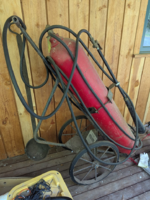
I have a old 110 lb CO2 extinguisher on wheels someone gave me; it's charged and going into the shop. Dates from the 1970s. A bit more practical are the 10 lb ABC extinguishers (Kidee/First Alert/...) often available at Costco; remember to rotate them and feel the powder moving once a year to prevent powder from packing solid
pcmeiners
Well-known member
Disagree as to washing off the phosphate salt off electric/electronic components, it will not happen, but you have a good point as to smoke residue causing damage due to it's nasty composition. Again if you have a fire you which needs a fire extinguisher, the damage is already done, so even a CO2 or or halogen unit is unlikely to save your vehicle from expensive damage.
Last edited:
bas157
Well-known member
One side benefit of the refillable water extinguishers......show up to a water gun fight at a picnic with one and you'll beat anyone (at least until you've dumped 2.5 gal of water on them). I have a range of them, mostly because I found some really good deals on them. Biggest is a 10lb ABC, most are 5lbs or smaller though. ($5 for a 2 pack of small ones on clearance is tough to resist at Home Depot)
I believe you mean Halon...Disagree as to washing off the phosphate salt off electric/electronic components, it will not happen, but you have a good point as to smoke residue causing damage due to it's nasty composition. Again if you have a fire you need a fire extinguisher, the damage is already done, so even a CO2 or or halogen unit is unlikely to save your vehicle from expensive damage.
I recall a product at one time called "Cold Fire" sprayed from an areosol can IIRC. A salesman at work had some, we tested it on different stuff and it worked good w/o the mess of other extinguishers.
Note this was 28 years ago,,,,