
To avoid these ads, REGISTER NOW!

Firing Up an Old Compressor

Bull

Super Moderator
Joined
Dec 12, 2005
Messages
16,189
Location
MA
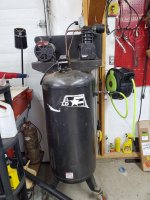
Years ago, I bought this compressor from a fellow GJ member who was clearing out his shop. I haven't had it hooked up for several years because the one outlet in my garage where I could plug it in became inaccessible. I just had a new outlet wired for it.

From a safety standpoint, is there anything that I need t do before pressurizing the tank? I was always good about draining it, but it's old and I certainly don't want to experience a rupture. If tanks have been drained but have sat for long periods of time, does corrosion become sort of a guarantee?

Also, do I need a pressure regulator? The compressor didn't have one when I bought it, and I never installed one.
 

Attachments
  • 20200724_091315.jpg
    20200724_091315.jpg
    117.3 KB · Views: 68
Last edited:
To avoid these ads, REGISTER NOW!

csp

Well-known member
Joined
Mar 23, 2010
Messages
5,719
Location
Franktown, CO
Pressure regulator only if you plan on running air tools that shouldn't see whatever max pressure the compressor will go to.
 

seber

Well-known member
Joined
May 31, 2016
Messages
4,195
Location
Deep East Tx.
Turn it over by hand for a couple of revolutions to get some oil into the bearings. Dry starts are less than ideal.
 
OP
B

Bull

Super Moderator
Joined
Dec 12, 2005
Messages
16,189
Location
MA
Thanks, guys. I feel better about just running it now.

Have any of you ever experienced a ruptured tank, or is it like getting struck by lightning in terms of rarity?
 

seber

Well-known member
Joined
May 31, 2016
Messages
4,195
Location
Deep East Tx.
I've had two ruptured tank in my life. One rusted out and started leaking slowly which got worse until it was unusable. The other got hit while under pressure. The hole was too big for the pump to overcome so I eventually welded that one.
 

The Cobbler

Super Moderator
Staff member
Joined
Oct 24, 2013
Messages
25,836
Location
Niagara Region, Ontario, Canada
you should be fine running it. an oil change wouldn't hurt . check the belt condition & tension .you could run it up to about 60 psi and check for leaks along the bottom welds and tank, but you're probably OK .
regulator is strongly advisable IMO
 
To avoid these ads, REGISTER NOW!

DTE

Well-known member
Joined
Jul 13, 2013
Messages
996
Location
North Carolina
I would want to watch the gauge and make sure it shuts off at a reasonable pressure, and make sure the pressure relief valve works. That is when one will explode.
 

marinusdees

Well-known member
Joined
Oct 30, 2012
Messages
1,325
Location
Edgewood, Washington
I would want to watch the gauge and make sure it shuts off at a reasonable pressure, and make sure the pressure relief valve works. That is when one will explode.

An explosion, by definition, requires a combustible gas. They burst, rupture, whatever you want to say, not an explosion. Can scare the s--- out of you. Or, in a very rare instance, hurt you. I would, it it was mine (it's not) make sure it had oil in it and light it up. If you are really concerned, light it up and drive into town. Come back after lunch.
 

DTE

Well-known member
Joined
Jul 13, 2013
Messages
996
Location
North Carolina
An explosion, by definition, requires a combustible gas. They burst, rupture, whatever you want to say, not an explosion. Can scare the s--- out of you. Or, in a very rare instance, hurt you. I would, it it was mine (it's not) make sure it had oil in it and light it up. If you are really concerned, light it up and drive into town. Come back after lunch.

I do not think I used the word explosion , as it has a different meaning than the word explode. But if the pressure pressure switch should fail to shut it off at a safe pressure and the pressure release valve should not open it will do more than burst. So those would be my concerns with something that has been out of service.
 

matt_i

Well-known member
Joined
Mar 14, 2008
Messages
10,725
Location
SE Michigan
An ASME-certified tank won't explode even if you over pressurize it.

The ducility of the material is very high and the welds are also. This stops a crack from "fast fracturing" which means propagate at the speed of sound in that material, which, for practical purposes its instantaneous.

"Leak before break" is the criteria which is used for higher confidence pressure vessels like propane tanks and vessels holding even more sinister chemicals.
 
OP
B

Bull

Super Moderator
Joined
Dec 12, 2005
Messages
16,189
Location
MA
Now that you've mentioned it, I remember that when it was in service I was experiencing a situation where once it had built up a lot of pressure, instead of just shutting off, the safety valve would release instead, but the compressor kept running. I'm pretty sure that was on this unit and not the portable I have. I am waiting for a new tank drain valve/hose assembly to arrive so I can't test this yet.
 
OP
B

Bull

Super Moderator
Joined
Dec 12, 2005
Messages
16,189
Location
MA
I have that compressor. I'd add the regulator and use it, should be fine.

While working on my Firebird this morning, I happened to notice tucked in a corner of the garage a filter/regulator that must be at least 25 years old, but new in the box. Score!
 

Attachments

  • 20200725_154918.jpg
    20200725_154918.jpg
    101 KB · Views: 12
To avoid these ads, REGISTER NOW!
Top Bottom