OP
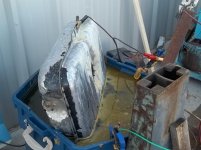
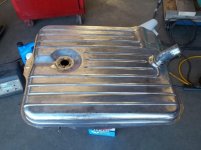
It looks that way, I wasn't trying to remove the paint. Any issues?


Will I live?
Will I live?


I'm about ready to give this a shot on some hossfeld bender dies. I've got a few questions.
1) Is there any harm in doing this with cast? I wouldn't see how but it's worth asking. Works fine on CI
2) Is there a certain ratio of baking soda to water? With Sodium Carbonate (Spa Chem) I use about 1/4 cup per 4-5 gallons of tap water.
3) Can I wire several small parts together or do I need to do each part individually. Every demo I've seen is with only one part. I've never wired parts together, but I have hung multiple parts off of an iron cross bar,
Just curious if you have an electrical explaination as to why less is more? Im my limited understanting this reaction is caused by the current passing through the electrolyte and pulling positively charged particles towards the negatively charged anodes... Ergo, the more current the more rapidly this decomposition of water occurs as more ions are passed from part to anode. It seems the only potential negative to using more current is that it could possible strip the part of deeper set materials.
In my experimentation 50 amps of power cleans far far more quickly than 2 amps of current. If you start with a clear clean bucket you can visibly see the 50 amp current cleaning more rapidly than 2or 10 amps.
Any thoughts? My knowledge in the electrical/ chemical areas are fairly low compared to my knowledge in the mechanical/biological areas... That's my disclaimer
StevenFl.
I'm assuming you aimed that question at me.
I'm basing that comment on what I've seen the professional artifact recovery people doing. They of course are dealing with iron, bronze or brass cannon for instance, and are removing huge thick layers of crud. after a couple of hundred years of being under the sea. Ive also seen examples of coins that came up corroded into a mass and after the treatment they looked damn near new.
My understanding is they are attempting to reconstitute as much of the original metal as possible. to do this the go at it very slowly, and speed is not of the essence. Yes, you can apply more power and get it done faster. The resulting reconstituted metal as I understand it winds up flaking off, and you get thicker layers of the black whatever it is that is left.
The slower I've gone, the less of that black stuff I have seen, and what there is of it cleans off easier in my experience. I don't mind letting the thing run for 6 to 8 hours, if the results are good, who cares?
Just look for a cheap battery charger at a garage sale or CL.
hmm i dont get to hit many garage sales, and craigslist is iffy when i actually need something.
anyone know of any current models i could buy? or would something like http://www.buy.com/prod/pyramid-gol...c-power-supply-pyramid-gold-ps/206160991.html work?
I am trying this for the first time right now . I have four gallons of water , four table spoons of baking soda( will baking soda work?) I have a 12 volt charger with the positve connected to a plate of steel and the negative on the tool. I do not see bubbles or anything happening??
Will this work with baking soda?