

You are using an out of date browser. It may not display this or other websites correctly.
You should upgrade or use an alternative browser.
You should upgrade or use an alternative browser.
Fixing cracked concrete
- Thread starter bmwpower
- Start date
boiler7904
Well-known member
First thing to do is figure out why the pad is cracking. Is it just a crack or has one side moved (either vertically or horizontally)?
My first guess is that it has moved since it was poured most likely due to freeze-thaw cycles and frost heave. The other idea is that the base material under the slab isn't uniform i.e. same material throughout or different amount of compaction and has allowed one side to settle.
The only way that I know of to keep it from cracking anymore is to make sure the base under it is solid and free of voids where water collects, freezes, and expands.
It can probably be patched depending on the size of the crack. Just go to the local home center / lumber yard and pick up a concrete patch material that is rated for exterior use and the size of the crack.
My first guess is that it has moved since it was poured most likely due to freeze-thaw cycles and frost heave. The other idea is that the base material under the slab isn't uniform i.e. same material throughout or different amount of compaction and has allowed one side to settle.
The only way that I know of to keep it from cracking anymore is to make sure the base under it is solid and free of voids where water collects, freezes, and expands.
It can probably be patched depending on the size of the crack. Just go to the local home center / lumber yard and pick up a concrete patch material that is rated for exterior use and the size of the crack.
ron in sc
Well-known member
Check product in link.
http://www.proguardcoatings.com/products.html
I think some of their products are quite impressive. I use Pro Flex to repair a leaking bathroom shower pan. That product is a Flexible Membrane that has two parts, in other words it hardens chemically.
http://www.proguardcoatings.com/products.html
I think some of their products are quite impressive. I use Pro Flex to repair a leaking bathroom shower pan. That product is a Flexible Membrane that has two parts, in other words it hardens chemically.
1320stang
Well-known member
How big is the small pad? As I recall, you have a notch in the corner of your shop for the man door. I'm betting freeze/thaw as well as I'm guessing moisture got under one edge. I'm thinking had you made the shop square and poured that pad outside where three edges weren't against the shop, you'd likely not had a problem as the wall would have been the "hinge". It might have "floated" away from the building though. With it being "held" against two sides there's more force. Did you put any expansion material on those two sides?
1320stang said:How big is the small pad? As I recall, you have a notch in the corner of your shop for the man door. I'm betting freeze/thaw as well as I'm guessing moisture got under one edge. I'm thinking had you made the shop square and poured that pad outside where three edges weren't against the shop, you'd likely not had a problem as the wall would have been the "hinge". It might have "floated" away from the building though. With it being "held" against two sides there's more force. Did you put any expansion material on those two sides?
The pad is probably 2'x3'. It was poured with the rest of the floor so it's approx 8" thick and part of the rest of the floor. There is no expansion material on the exterior edges that I can remember...I'll have to check. The crack goes from one corner of the building to the other, on a diagonal. Sounds like I have an issue with the base under the outside corner.
Can I dig out of the sides, pry up the outside corner to tighten up the crack and then put in the proper support under the slab?
What should I put under slab to keep it from dropping?
boiler7904
Well-known member
bmwpower said:Can I dig out of the sides, pry up the outside corner to tighten up the crack and then put in the proper support under the slab?
What should I put under slab to keep it from dropping?
I don't see why that wouldn't work. I'd pack a free-draining gravel in under the slab once you have it lifted back into position. Gravel will allow moisture to drain away from the slab and prevent it from freezing and thawing repeatedly.
1320stang
Well-known member
And I'll bet the footings run under the walls in that cut out corner, right? I agree with boiler, but I think I'd line the hole with some landscape fabric first before putting in the gravel.
If the crack is such that it travels beyond the line between these corners, you could always saw cut it and pour a new 4" pad along there, just put some expansion material between the two. Yeas, the saw cut will only be good for the first couple inches if you're using a skill saw and some masonary blades, you'll have to use some sweat to get the rest of it with a hammer or rent an electric jackhammer.
If the crack is such that it travels beyond the line between these corners, you could always saw cut it and pour a new 4" pad along there, just put some expansion material between the two. Yeas, the saw cut will only be good for the first couple inches if you're using a skill saw and some masonary blades, you'll have to use some sweat to get the rest of it with a hammer or rent an electric jackhammer.


SC-Eric
Well-known member
If you want to post some pics... I'll make a suggestion...
If you want to post some pics... I'll make a suggestion...
I keep forgetting my Comcast picts don't load for some people...
Attachments

SC-Eric
Well-known member
bump...
Found another one on the garage door apron on the other side of the building, too.
Do you have pics of the garage door apron?
SC-Eric
Well-known member

Do you have pics of the garage door apron?
Nah, but I can take one tomorrow. Same deal, but straight on.
Now, the question is, how to you tint the new filler to match your old concrete?
I don't know if I totally care if it doesn't match. The above crack is under a mat. I just don't want things to get worse.
Still forgetting to get a pict of the one on the garage door apron...
SC-Eric
Well-known member
Based on the first photo, I think you just need to use some IntegraFlex 1921... This is a self-leveling joint filler that will expand and contract with the movement of the concrete. You can request information from Bill here: http://wolverinecoatings.com/html/contacts.html
Based on the first photo, I think you just need to use some IntegraFlex 1921... This is a self-leveling joint filler that will expand and contract with the movement of the concrete. You can request information from Bill here: http://wolverinecoatings.com/html/contacts.html
What's the prep like? Am I going to have to cut out the crack?
What's the prep like? Am I going to have to cut out the crack?
I had cracks in my concrete that I filled before my VCT install. I asked around quite a bit, and bought this at Home Depot.
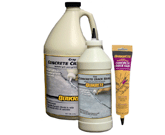
Get the one in the squeeze bottle.
QUIKRETE® Gray Concrete Crack Seal (No. 8640) is a uniformly blended latex emulsion, specially designed to adhere to all concrete surfaces. No mixing is required. Just pour from the bottle. Blends in with the natural color of concrete.
SC-Eric
Well-known member
What's the prep like? Am I going to have to cut out the crack?
If you want it to last forever... cut it out...
You can use a cheap acrylic type like Jason B did... however, you have all seen these types of products before. While you're at the 'big box' store, look at their joints. I'm going to guess that you'll see joints where one side has acrylic caulk stuck to it and the other side doesn't... but... just a bit down the crack... the opposite side is stuck... etc. When it comes to cement... acrylics have their place for a cheap temporary fix. Most have an adhesion rating of 150-300 psi at the VERY best. And, that's OK as long as you are not really trying to hold it together and you want something cheap. You'll get better results under VCT where the glued tile also helps to hold the cracks together and the acrylic really just acts as a filler.
If you want it to last forever... cut it out...
You can use a cheap acrylic type like Jason B did... however, you have all seen these types of products before. While you're at the 'big box' store, look at their joints. I'm going to guess that you'll see joints where one side has acrylic caulk stuck to it and the other side doesn't... but... just a bit down the crack... the opposite side is stuck... etc. When it comes to cement... acrylics have their place for a cheap temporary fix. Most have an adhesion rating of 150-300 psi at the VERY best. And, that's OK as long as you are not really trying to hold it together and you want something cheap. You'll get better results under VCT where the glued tile also helps to hold the cracks together and the acrylic really just acts as a filler.
Cut it out in a V shape, following the curve of the crack?
If you have a concrete surface of any good size you will have cracks. It is just what concrete does. All you can do is minimize it. The rebar perimeter is there to contain the concrete so when it cracks it won't shift out of place. The visqueen (plastic) underlay helps to slow the curing and combined with keeping the top wet the first few days will help reduce the problem as will fiber mesh mixed in with the fresh concrete. The best you can do is put in joints or saw cut them as soon as possible after finishing which controls the cracking by offering a path of least resistance for the potential crack to use.
This is not to say that a good base underneath isn't important because concrete has very poor tensile strength and if the base fails and falls away from beneath the concrete's surface it will also eventually fail. Asphalt also cracks but they are usually not nearly as noticable because the ahphalt is soft and squeezes with pressure to fill the void.
The less water you put in the concrete mix the less it will shrink therefore the potential for cracking is again reduced.
No matter what you do, all you can ultimately do is help to reduce the cracking not eliminate it.
This is not to say that a good base underneath isn't important because concrete has very poor tensile strength and if the base fails and falls away from beneath the concrete's surface it will also eventually fail. Asphalt also cracks but they are usually not nearly as noticable because the ahphalt is soft and squeezes with pressure to fill the void.
The less water you put in the concrete mix the less it will shrink therefore the potential for cracking is again reduced.
No matter what you do, all you can ultimately do is help to reduce the cracking not eliminate it.
Good info offy.
I just put in a 185 ft long drivway that connects to my main driveway. It's 10 feet wide. The norm is expansion joints every 20 feet. I had them do expansions every 10 feet, as I don't want tons of cracks. I chose to do this over the saw cuts, as the expansions don't bother me, and I think it's better as each piece of concrete is fully separate.
When my parents built their house 15+ years ago, my dad had them do the same thing, with expansions every 10-12 feet, etc, and 15 years later, not one crack. Back then they didn't do saw cuts.
So, when I had this new driveway done, I did the same. It amazes me though, how so many 2-3 car garages today are all one section of concrete. It is going to crack no matter what.
I just put in a 185 ft long drivway that connects to my main driveway. It's 10 feet wide. The norm is expansion joints every 20 feet. I had them do expansions every 10 feet, as I don't want tons of cracks. I chose to do this over the saw cuts, as the expansions don't bother me, and I think it's better as each piece of concrete is fully separate.
When my parents built their house 15+ years ago, my dad had them do the same thing, with expansions every 10-12 feet, etc, and 15 years later, not one crack. Back then they didn't do saw cuts.
So, when I had this new driveway done, I did the same. It amazes me though, how so many 2-3 car garages today are all one section of concrete. It is going to crack no matter what.
SC-Eric
Well-known member
Cut it out in a V shape, following the curve of the crack?
Yep... you got it.
Good info offy.
I just put in a 185 ft long drivway that connects to my main driveway. It's 10 feet wide. The norm is expansion joints every 20 feet. I had them do expansions every 10 feet, as I don't want tons of cracks. I chose to do this over the saw cuts, as the expansions don't bother me, and I think it's better as each piece of concrete is fully separate.
When my parents built their house 15+ years ago, my dad had them do the same thing, with expansions every 10-12 feet, etc, and 15 years later, not one crack. Back then they didn't do saw cuts.
So, when I had this new driveway done, I did the same. It amazes me though, how so many 2-3 car garages today are all one section of concrete. It is going to crack no matter what.
updating this from my last post in 2007 above, STILL NO CRACKS in this 185 driveway extension with expansions every 10 feet.
If you want it to last forever... cut it out...
You can use a cheap acrylic type like Jason B did... however, you have all seen these types of products before. While you're at the 'big box' store, look at their joints. I'm going to guess that you'll see joints where one side has acrylic caulk stuck to it and the other side doesn't... but... just a bit down the crack... the opposite side is stuck... etc. When it comes to cement... acrylics have their place for a cheap temporary fix. Most have an adhesion rating of 150-300 psi at the VERY best. And, that's OK as long as you are not really trying to hold it together and you want something cheap. You'll get better results under VCT where the glued tile also helps to hold the cracks together and the acrylic really just acts as a filler.
I think since what I used above was for INSIDE MY GARAGE and not outside on a driveway with rain/snow/elements, that will be ok. You agree on that, right?