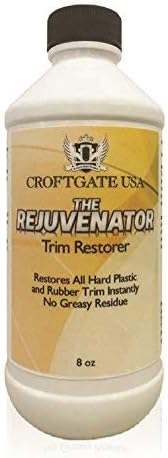
Those trim pieces on a car, and probably the tractor, are often made from talc-filled polypropylene. (It should be marked on the back for recent production to aid eventual recycling.)
Weathering of the polymer lets talc become exposed on the surface, giving the part that characteristic white look, I believe. Getting the polypropylene (PP) close to its melting point allows reflow to cover some of the talc. The freshly-reflowed surface is smooth and glossy, also helping the blackening.
PP is a fairly low-melting thermoplastic, so it lends itself to this kind of thing. The ABS of a thermoformed canoe would probably respond similary -- especially since the scratches likely involve "moving" material more than "removing" material, and the heat reflow will allow some of the moved material to go back where it was.
Blackening talc-filled PP with heat won't be a permanent effect -- it'll weather again, and probably faster than it did the first time.