To avoid these ads, REGISTER NOW!

Flame Straightening 101: The Basics

jmackessy

New member
Joined
Aug 29, 2023
Messages
1
Awesome info! I realize the thread’s a bit old now but figured it’s worth a try..Trying to do exactly the same thing as the example but with 1/2” thick material. Also my setup is oxy-propane.. to clarify, when you talk about quenching/cooling between your heats, you mean cooling after each small upset circle, instead of waiting to cool after running the whole line of small upsets, correct?
Thanks
 
To avoid these ads, REGISTER NOW!

Lassen Forge

Well-known member
Joined
Apr 26, 2014
Messages
15,128
Location
The romantic hills of central Umbria, Italy,
I've heard of it, I've seen old, old school body men do it with a torch, rags, and a bucket of water, but no one ever EXPLAINED it before. (I think it was one of those secrets of the trade, you need the decoder ring before you are admitted entry). This is really cool, thanks!
 
OP
D

dr_clyde

Well-known member
Joined
Jan 7, 2009
Messages
6,440
Location
Holland, MI
Awesome info! I realize the thread’s a bit old now but figured it’s worth a try..Trying to do exactly the same thing as the example but with 1/2” thick material. Also my setup is oxy-propane.. to clarify, when you talk about quenching/cooling between your heats, you mean cooling after each small upset circle, instead of waiting to cool after running the whole line of small upsets, correct?
Thanks
The idea is to work opposite of the welding that distorted the metal in the first place.

You would run your torch the length of where you want to shrink, then cool the plate. If it needs more, run another pass next to it, then cool. Depending on how bad it warped and the geometry of the part it may be just a few inches, or sometimes multiple passes several inches long. The shape of the heat will be dictated by the shape of the part.

Don't run more than one pass in a row without cooling in between passes and don't run the torch over the same spot twice.

As long as you're causing an upset with the torch, it should have a measurable effect. Think of it like pinching a tablecloth or like a mini turnbuckle. You're just pulling in localized spots to counter the weld on the other side.
 

Caa311

Well-known member
Joined
Jan 2, 2016
Messages
762
Location
Virginia
We have had our ship to shore container cranes bent from ships hitting them. We have a guy come and straighten the crane this way, he's a badass!
 

AustroTom

Member
Joined
Dec 29, 2023
Messages
6
The idea is to work opposite of the welding that distorted the metal in the first place.

You would run your torch the length of where you want to shrink, then cool the plate. If it needs more, run another pass next to it, then cool. Depending on how bad it warped and the geometry of the part it may be just a few inches, or sometimes multiple passes several inches long. The shape of the heat will be dictated by the shape of the part.

Don't run more than one pass in a row without cooling in between passes and don't run the torch over the same spot twice.

As long as you're causing an upset with the torch, it should have a measurable effect. Think of it like pinching a tablecloth or like a mini turnbuckle. You're just pulling in localized spots to counter the weld on the other side.
Hello, New here and wanted to chime in:
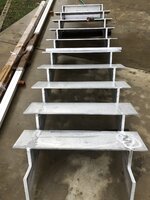
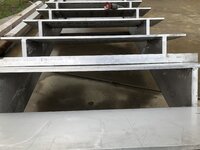
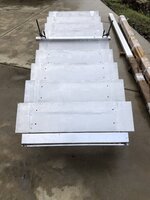
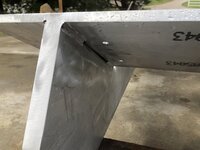
I just tried exactly that, (I'm building some stringer satircases with 1" x 12" stringers and 1/2" tread plates). The tread plates are welded to the stringers from underneath and therefore bend down in the middle. So I tried to heat the weld line on the opposite side (up side), cooled it with a water hose and now the bend is twice as much. Shouldn't I air cool the heated area? (somebody once told me that if you flash cool (water hose), your'e actually stopping the process)? Confused, please help
Thomas
 
OP
D

dr_clyde

Well-known member
Joined
Jan 7, 2009
Messages
6,440
Location
Holland, MI
Hello, New here and wanted to chime in:
I just tried exactly that, (I'm building some stringer satircases with 1" x 12" stringers and 1/2" tread plates). The tread plates are welded to the stringers from underneath and therefore bend down in the middle. So I tried to heat the weld line on the opposite side (up side), cooled it with a water hose and now the bend is twice as much. Shouldn't I air cool the heated area? (somebody once told me that if you flash cool (water hose), your'e actually stopping the process)? Confused, please help
Thomas
You need to cool the opposite side of the the tube the the treads are welded on.
 
To avoid these ads, REGISTER NOW!

Jswain

Well-known member
Joined
Apr 26, 2013
Messages
2,458
Location
Calgary, AB
I will take pics today and post here. Maybe that'll make it easier
Without seeing the pictures, I would probably try heating the middle of the tread on the bottom, and let it air cool.

After seeing the pictures I would do the same. Mark the middle on the bottom of each tread and heat it up similar to the size of the weld to start ie: a 2 inch strip on the front and back of each tread.

Those will be awesome when finished though!
 
Last edited:

AustroTom

Member
Joined
Dec 29, 2023
Messages
6
Attached are the pictures.
 

Attachments

  • IMG_5336.jpg
    IMG_5336.jpg
    760.7 KB · Views: 25
  • IMG_5338.jpg
    IMG_5338.jpg
    496.9 KB · Views: 25
  • IMG_5340.jpg
    IMG_5340.jpg
    701.5 KB · Views: 22
  • IMG_5341.jpg
    IMG_5341.jpg
    626.3 KB · Views: 22
  • IMG_5343.jpg
    IMG_5343.jpg
    460 KB · Views: 24

AustroTom

Member
Joined
Dec 29, 2023
Messages
6
Without seeing the pictures, I would probably try heating the middle of the tread on the top, and let it air cool.

After seeing the pictures I would do the same. Mark the middle on the top of each tread and heat it up similar to the size of the weld to start ie: a 2 inch strip on the front and back of each tread.

Those will be awesome when finished though!
Wait, so what your'e saying is I should heat the "center" of the tread plate?? This will bend the plate down even more because I would "shrink" the upper layer of the plate, no??
When I heated it up yesterday (and flash cooled it), it even bent down further. Was this due to the fact that I didn't heat it up enough and therefore the weld stress pulled it even more? I just dont know how much to heat for the upper material to start shrinking (pulling)

Thank you. They will in the end have a 3" wood tread with glass railing (which I will also have to build the frame for
 
Last edited:

Jswain

Well-known member
Joined
Apr 26, 2013
Messages
2,458
Location
Calgary, AB
Wait, so what your'e saying is I should heat the "center" of the tread plate?? This will bend the plate down even more because I would "shrink" the upper layer of the plate, no??
When I heated it up yesterday (and flash cooled it), it even bent down further. Was this due to the fact that I didn't heat it up enough and therefore the weld stress pulled it even more? I just dont know how much to heat for the upper material to start shrinking (pulling)

Thank you. They will in the end have a 3" wood tread with glass railing (which I will also have to build the frame for
Yes! You are right, I was thinking backwards. Bottom of the tread plate in the middle would be where I would start. I will edit my post to save the confusion

It wouldn't be the first time I heated the wrong side and watched the bend grow tho...lol
 

AustroTom

Member
Joined
Dec 29, 2023
Messages
6
Yes! You are right, I was thinking backwards. Bottom of the tread plate in the middle would be where I would start. I will edit my post to save the confusion

It wouldn't be the first time I heated the wrong side and watched the bend grow tho...lol
No matter where and how i heated it wouldn't straighten so i just took the hammer to it:giggle:.
Pounded them out just outside of the welds and worked like a charm. Not concerned about the dimples since it'll be completely veneered with wood anyway.
Thank you for all your input though.
Thomas
 

kerrynzl

Well-known member
Joined
Nov 8, 2013
Messages
5,054
Location
Tauranga, New Zealand
No matter where and how i heated it wouldn't straighten so i just took the hammer to it:giggle:.
Pounded them out just outside of the welds and worked like a charm. Not concerned about the dimples since it'll be completely veneered with wood anyway.
Thank you for all your input though.
Thomas

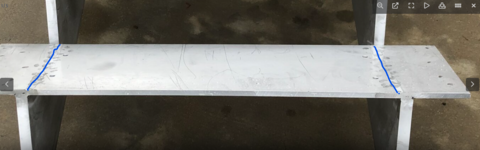
You didn't heat straighten is correctly that's why,

With those stairs you clamp it straight first.
Then heat it along the lines shown [opposite the weld underneath that is pinching together]

Because it is clamped it can only expand to thicken the plate [instead of bending the plate more]
Once cooled the plate will normalize straight [because the now thicker part shrinks and pulls]

heat straightening stairs.png
 

AustroTom

Member
Joined
Dec 29, 2023
Messages
6
You didn't heat straighten is correctly that's why,

With those stairs you clamp it straight first.
Then heat it along the lines shown [opposite the weld underneath that is pinching together]

Because it is clamped it can only expand to thicken the plate [instead of bending the plate more]
Once cooled the plate will normalize straight [because the now thicker part shrinks and pulls]

heat straightening stairs.png
Thank you for your tip. I will certainly try that (although I actually did that as well). I have one more staircase to build.
BTW: the same happend with building the railing frame (Inserts are glass). When welding the 1" x 2" rect. alu tubing as cap rail to the vertical posts the tube obviously bends (shrinks), down towards the weld. Again, I tried heat shrinking, (yes, overbending it back via backwards clamping and heating), but it still didn't want to straighten.
Here is what i did to fix it: I welded the top of the tubing, just as i did underneath to weld to the verticals, and this brought the tube back up in a straight line. Now, of course this means grinding and sanding the upside of the cap rail smooth. But it turns out it is still less work and headache than trying anything else. Anybody agree?
Thomas
 
To avoid these ads, REGISTER NOW!
Top Bottom