To avoid these ads, REGISTER NOW!

Flex in 2 post lift?

Pchris11

Member
Joined
Dec 1, 2018
Messages
6
Location
New york
Hi all im new here but have seen there are a decent amount of intelligent people on these forums so i have come here for help.

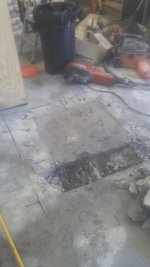
I just installed an atlas bp8000 2 post lift in my garage. I cut 2 2.5 foot squares in my slab and poured 12" footings of 5000psi concrete and let sit for a month. I plumbed both side of each post and it was spot on. When i go to lift my wifes 07 mitsubishi outlander to the first saftey the bubble touches the line as if the posts are being pulled inword. My question is, is this normal? Is there going to be natural flex because of the weight? Or is this a cause for alarm?
 
To avoid these ads, REGISTER NOW!

Jazzman442

Well-known member
Joined
Sep 17, 2013
Messages
553
Location
Tampa Bay area, FL
Do some searching here. The issue I believe is the fact that you cut a small area and poured the cement. There is not enough horizontal area to hold it straight. Was the new pours drilled and rods put in to connect to the existing slab? You probably would have been better off just using the entire garage the way it was. Good luck. Im sure there is a way to fix this.
 

c4cruiser

Well-known member
Joined
Oct 8, 2012
Messages
359
Location
Lacey WA
Wen I installed my 2-post MaxJax, I had cut out two 4'x4' sections and had two 4'x4'x12" deep slabs poured using 5000psi concrete. I had rebar installed that connected the new pour to the old concrete floor. I made sure that the center of the new pour was going to be where the center of the posts would be. I also used 11" long epoxy anchors to secure the lift posts.

After 5 years, I have not seen any indication of the posts moving or any lifting of the post bases once a load is placed on them.
 

sjvicker

Well-known member
Joined
Aug 9, 2014
Messages
600
Location
SW Washington
My BP8000 is on a 10" slab with rebar and it tows in a bit when I'm lifting. Check your anchor bolt torque and you should be good to go.

Most 2 post lifts have the cables up top and the cross bar is in compression when lifting and resists the columns from towing in. If you're still concerned, Greg Smith sells an add on bracket that adds a few anchors to each column.

Sent from my Nexus 9 using The Garage Journal mobile app
 
OP
P

Pchris11

Member
Joined
Dec 1, 2018
Messages
6
Location
New york
Thanks for the responses guys, the footing is not connected to the old concrete and now that you guys mention it i feel stupid for not doing that. I didnt want to use the existing slab because its only 4" thick and i know commercial shops need a min. Of 6" slabs by code (well atleast here in new york). i did put a layer of the wire grid about 4" from the bottom but only put 1 because the manufacturers instructions mentioned to make sure the concrete was free of rebar. I torqued the expansion studs supplied by the manufacturer to the recommended spec of 110 ft. Lbs. I did go on atlas' website and i did find that they have a 47" base plate extention kit like sjvicker said so i think im going to just pull thr trigger and get that. Theres nothing urgent that needs to be done with a lift so i can wait for the brakets to be shipped and itll let the concrete cure alittle more. Thanks again for the replys guy, ill put an update when the brakets are on for anyone else that may run into this problem in the future.
 
Last edited:

gmtech

Well-known member
Joined
May 22, 2018
Messages
85
Location
nc
Wait, instructions said free of rebar??

Sent from my SAMSUNG-SM-G890A using Tapatalk
 

carl_694

Active member
Joined
Jul 6, 2018
Messages
27
Location
SC
Do some searching here. The issue I believe is the fact that you cut a small area and poured the cement. There is not enough horizontal area to hold it straight. Was the new pours drilled and rods put in to connect to the existing slab? You probably would have been better off just using the entire garage the way it was. Good luck. Im sure there is a way to fix this.

If this were the case, wouldn't there be clear evidence of movement in the concrete? Id think you'd see cracking and heaving where it meets the old concrete.
 

PoorOwner

Well-known member
Joined
Feb 10, 2007
Messages
5,032
Location
CA
Did you dig the deeper part outwards below the original slab so when you pour it acts as a “key” and cannot come out? Recommended 6” all around.
You put a level on the concrete and it will tell you if it is moving. But I think it is the metal post flexing a little.
 

3rdgendslmech

Well-known member
Joined
Mar 12, 2017
Messages
499
Location
Maryland
I wouldn't worry about it too much. being how its a base plate lift its probably just flexing a little. Like some of the others have said, if you want to be sure....take a 4' level and span it on the outter most edge of you're new pour. If it lifts it up a little your pad is moving.
 

firebirdparts

Well-known member
Joined
Jun 8, 2016
Messages
10,578
Location
Kingsport, TN
You poured the footers as if it's important to hold the lift up. The slab needs to hold the lift down. So a lot of people have that idea, but it's a very bad idea. Better to cut nothing, or else cut out a big trough all the way across the garage and make a concrete beam under the lift. Again, this new concrete needs to hold the lift down, not up. Holding a car up is the easy part.

Now, that said, of course all loaded beams flex. They have to in order to hold the load. I really cannot see any movement on my lift for what it's worth.
 

trpearcy

Well-known member
Joined
Feb 26, 2014
Messages
277
Location
Western PA
Just to add my .02,
I recently installed a Bend Pac XPR-10AS-168-LP in my garage, and I use it for my auto repair business. Meaning, I use it a lot.
The concrete is about 8-9 inches thick, and the slab it's on is about 40x60. There is a small crack (both sides are still level), about 15 ft away from the lift, behind it. The concrete is about 30-40 years old. No idea what the PSI is on the concrete, or what's inside it. I assume there's rebar, but I'm not 100% positive. I mounted the lift, and drilled the holes myself, and I've lifted everything from a 1 ton dulley, to a 75hp tractor, to Subarus, to a 1950 Chevy Deluxe.
I'm just trying to give all the information here, and background story.
So, when I was installing the lift, I got it as close to level as I could. And then when i bolted it all down, It was very very very slightly off plumb. Such a small amount that I didn't worry about it, because I worried if I added more shims it would make it worse. Also, I worked for years in a dealership with 14 lifts, and when they installed new ones, they didn't ever get them truly plumb. They got them close and called it good, and I never saw a lift at that dealership fail for being off-level.
So, to the main point:
When I lift anything heavier than a car, or if I don't get it exactly correctly racked, then I can stand next to the lift looking so I can see both posts, and I can see a tiny bit of flex in it. Not sure why, but it does it. I assume it's just a matter of the steel having a certain amount of tolerance in it, and It's probably supposed to be that way. Like the guy above me said, it's gotta have a certain amount of movement in it.

Anyways. Long story, but I just wanted to throw that in and say, It's probably no big deal.
 

Jlbc212

Well-known member
Joined
Dec 7, 2013
Messages
1,530
Location
Northeast MA
If you have ever been on a long span bridge, stuck in traffic you can feel the steel flex. Steel has elasticity. Observe the springs used to counterbalance an overhead door and see how much steel can flex without breaking. When a vehicle is raised up on a lift the weight of the vehicle exerted upon the lift arms tends to pull the top of the lift posts inward toward each other. Some degree of movement (flexing of the steel) shouldn't be cause for alarm. The vertical steel posts should be able to flex without failing. In addition, many lifts have a cross-bar fastened to the top of the lift posts. This cross bar helps to keep the lift posts straight, resisting the inward movement of the lift posts. I would keep an eye on the concrete bases under the lift posts. The concrete bases also have to work to resist the inward pull of the vertical lift posts. Unless you see some actual detectable movement of the concrete bases, such as the outer extremity of the base rising above the adjacent concrete floor or cracks in the surrounding concrete floor, you should be okay.
 

Strouty

Well-known member
Joined
Mar 21, 2010
Messages
38,209
Location
Southern Maine
That is a Base Plate lift, you shouldn't have done anything to your concrete, especially if you had close to 4". Did the manufacturer recommend the size you cut out or did you just do that on a whim? The lift will definitely flex, especially since this one is not connected at the top.

Also for people questioning flex, remember this, steel is just a hard form of rubber, if it doesn't bend it breaks. In other words, it flexes and that is a good thing.
 
Last edited:
To avoid these ads, REGISTER NOW!

jetlag

Well-known member
Joined
Feb 26, 2008
Messages
114
Location
Centralia,Wa
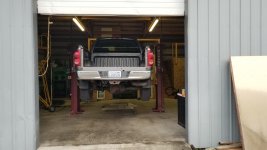
I've got a couple of magnetic angle indicators, I've hung both of them on my two post lift, and even with my Ram 2500 diesel 4-door pickup, there's NO movement in the columns. I'm trying to teach my two boys to work on their own cars, I'd never put them underneath a lift that had visible deflection in the columns. These lifts are safe when installed and used correctly, most failures are operator error, or improper installation.
 

Attachments

  • mohawk with truck.jpg
    mohawk with truck.jpg
    134.4 KB · Views: 107
OP
P

Pchris11

Member
Joined
Dec 1, 2018
Messages
6
Location
New york
-The 2.5 foot square was on a whim
-I have seen to many pictures and heard to many horror
stories about putting lifts on 4" slabs
When lifting the car there is no movement in the actual base, and there are no cracks in the concrete. If lifted the car multiple times and had the car sit on the lift for roughly 2 hours and saw no movement in that level.
 
OP
P

Pchris11

Member
Joined
Dec 1, 2018
Messages
6
Location
New york
Before i dismantle, cut out and redo the footings what do you guys think of the extension bar that would also connect the base plate to the existing slab?
 
Last edited:

mrobins297aaa

Well-known member
Joined
Sep 20, 2010
Messages
3,283
Location
south east michigan
Before i dismantle, cut out and redo the footings what do you guys think of the extension bar that would also connect the base plate to the existing slab?

I think this is by far your easiest fix .........if one is even required.
But it would give you peace of mind, and besides if those concrete pours you put in there do end up moving there would be no way to move them back
 

Mr. Roboto

Well-known member
Joined
Dec 11, 2012
Messages
2,159
Location
New Hampshire
For reference, I have a BP9000. I modified my concrete to add two 4.5 foot x 4 foot pads. Each one is 12" deep, with an additional 4" of compacted stone at the bottom bringing total excavated depth to 16" Each also has a rebar matt at the bottom, is pinned into the surrounding slab, and keyed under it 6 inches.

Below are a few pics. The photos always make them look shallower than what I described above for some reason.

Bottom line, I have no measurable deflection. If you're getting some deflection, I'd suspect it's from the lift. When I compared them in the showroom, there were several structural differences between the BP8000 and BP9000 that swayed me away from it. If your deflection was from your footings, I would think you'd have cracking in the concrete by now. But it's tough to say without seeing it.

attachment.php


attachment.php
 

Earp69

Well-known member
Joined
Sep 20, 2016
Messages
859
Roboto how do make sure the rebar isnt in the way of where the studs for your lift will be?
 

Mr. Roboto

Well-known member
Joined
Dec 11, 2012
Messages
2,159
Location
New Hampshire
The pins up top do not protrude out far enough in to where they would hit the post, and the matt at the bottom is deeper than you have to drill. You can either 1) not drill down deep enough to hit it or 2) use a rebar cutting bit. and drill through it, which is sometimes easier said than done. The only real reason to drill all the way through is to have the ability to knock a failed anchor down through the hole and be able to insert a new one.
 

minytrker

Well-known member
Joined
Sep 19, 2012
Messages
1,376
Location
Brenham TX
For reference, I have a BP9000. I modified my concrete to add two 4.5 foot x 4 foot pads. Each one is 12" deep, with an additional 4" of compacted stone at the bottom bringing total excavated depth to 16" Each also has a rebar matt at the bottom, is pinned into the surrounding slab, and keyed under it 6 inches.

Below are a few pics. The photos always make them look shallower than what I described above for some reason.

Bottom line, I have no measurable deflection. If you're getting some deflection, I'd suspect it's from the lift. When I compared them in the showroom, there were several structural differences between the BP8000 and BP9000 that swayed me away from it. If your deflection was from your footings, I would think you'd have cracking in the concrete by now. But it's tough to say without seeing it.

attachment.php


attachment.php


Thats how I would do it if I had to go that route. That looks completely safe to me. A smaller 2.5 ft square not attached to other slab would scare me.
 

PoorOwner

Well-known member
Joined
Feb 10, 2007
Messages
5,032
Location
CA
Op there is a document around here that is from Mohawk tells you how to dig, key and tie. This time maybe best to do something bigger.

Don’t know if your level bubble will be different after doing that. but it seems nothing is holding your footers to your slab right now. And imagine all that weight sitting on a 2.5 x 2.5’ feet concrete pier just jammed in a hole.
 

SickSpeedMonte

Well-known member
Joined
Feb 28, 2017
Messages
81
Location
MD
Do the posts go back to plumb when you let the car down?

Does the level read plumb near the bottom with a load on the lift?
 

rburke65

Well-known member
Joined
Nov 10, 2007
Messages
12,349
Location
Canfield, Ohio
Roboto how do make sure the rebar isnt in the way of where the studs for your lift will be?

You make a template of the bottom of the lift and position the template to where the posts will be located. Then position the rebar to miss the holes in the template. Now, when ya drill, you'll have not to worry about hitting the steel.
 
OP
P

Pchris11

Member
Joined
Dec 1, 2018
Messages
6
Location
New york
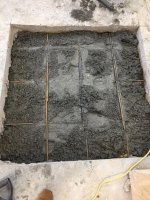
So it bothered me once someone posted that the purpose of footing is to keep the lift down opposed to conventional footing keeping something up, and someone else said hes having his sons start to learn how to work on cars. Since im going to have friends use the lift and god forbid i have my wife help with something i wouldnt want inadequate footings so i decided to bite the bullet and cut up my slab and break out the footing i made. i ended up doing 2- 4'x4'x12" deep footings, its not as nice as mr. Roboto's footings, but since i had the bolts in the ground i made marks where there going to be so i just made my rebar anchors that go into the existing slab miss the bolts. I did a welded wire grid 3" from the bottom and then #4 rebar into existing slab. I did 3 in each direction and tie wired them together where they crossed. I used satcrete 5000 plus (80 lb. Bags) and it came out to 30 bags per footing. So i figured even if the anchoring doesnt do anything the footing alone weighs 2400 lbs. Of dry concrete (i dont know what that relates to when water is added) so im sure it weighs even more so thats a decent amount of counter weight. i feel alot more confident in these footings. I figured the $700 mistake fixed now is cheaper then the 10s of thousands when a car falls and the post goes through the wall. Not even going into bodily injury/death part.
 

PoorOwner

Well-known member
Joined
Feb 10, 2007
Messages
5,032
Location
CA
So it bothered me once someone posted that the purpose of footing is to keep the lift down opposed to conventional footing keeping something up, and someone else said hes having his sons start to learn how to work on cars. Since im going to have friends use the lift and god forbid i have my wife help with something i wouldnt want inadequate footings so i decided to bite the bullet and cut up my slab and break out the footing i made. i ended up doing 2- 4'x4'x12" deep footings, its not as nice as mr. Roboto's footings, but since i had the bolts in the ground i made marks where there going to be so i just made my rebar anchors that go into the existing slab miss the bolts. I did a welded wire grid 3" from the bottom and then #4 rebar into existing slab. I did 3 in each direction and tie wired them together where they crossed. I used satcrete 5000 plus (80 lb. Bags) and it came out to 30 bags per footing. So i figured even if the anchoring doesnt do anything the footing alone weighs 2400 lbs. Of dry concrete (i dont know what that relates to when water is added) so im sure it weighs even more so thats a decent amount of counter weight. i feel alot more confident in these footings. I figured the $700 mistake fixed now is cheaper then the 10s of thousands when a car falls and the post goes through the wall. Not even going into bodily injury/death part.

sounds good, let us know if the lift still flex the level bubble after you're done.
 
OP
P

Pchris11

Member
Joined
Dec 1, 2018
Messages
6
Location
New york
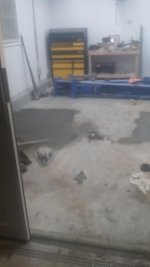
Hey everyone dont know if anyone cares or not but i waited the suggested 28 days satcrete suggests to allow the concrete to cure to 5000psi and lifted my wifes car again and had almost no flex what so ever. So needless to say it was a smart move to repour the footing. It was a $700 mistake (including tool rentals, (home depot makes you buy the blade for the concrete saw so thats $100 right there) and materials) but its a huge peace of mind knowing its above what almost all lift manufacturers suggest. It was a back breaking 3 days but in my opinion absolutely well worth it. Sorry for the blurry pictures my phones camera is pretty scratched.
 

Attachments

  • 20181204_105447.jpg
    20181204_105447.jpg
    41.1 KB · Views: 76
  • 20181204_114914.jpg
    20181204_114914.jpg
    35.9 KB · Views: 72
  • IMG_36551.jpg
    IMG_36551.jpg
    141.5 KB · Views: 79
  • 20181205_172417.jpg
    20181205_172417.jpg
    30.3 KB · Views: 71
  • 20181204_123559.jpg
    20181204_123559.jpg
    45.2 KB · Views: 69

James168

Member
Joined
Jan 8, 2019
Messages
13
Location
Garage
Hey everyone dont know if anyone cares or not but i waited the suggested 28 days satcrete suggests to allow the concrete to cure to 5000psi and lifted my wifes car again and had almost no flex what so ever. So needless to say it was a smart move to repour the footing. It was a $700 mistake (including tool rentals, (home depot makes you buy the blade for the concrete saw so thats $100 right there) and materials) but its a huge peace of mind knowing its above what almost all lift manufacturers suggest. It was a back breaking 3 days but in my opinion absolutely well worth it. Sorry for the blurry pictures my phones camera is pretty scratched.

What did you end up using for securing the lift? Wedge anchors or epoxy with rods
 
To avoid these ads, REGISTER NOW!
Top Bottom