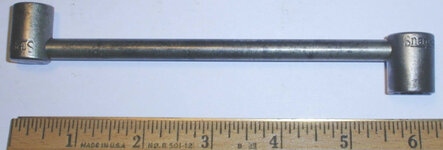
I prefer the ones with an open end on the opposite end.
I prefer the ones with sockets at both ends, because you can straighten the wrench after breaking a fastener free and easily roll the unused socket in your fingertips to spin off the fastener.
Of course that only works when you have space, and most commenters above are treating these as special-purpose tools for difficult access. But in Nordic countries like my mother’s Finland, this style of wrench is common and used as a general-purpose wrench. You see them even in households whose tool collection fits in a shoebox. Maybe someone knows why they’re so popular up there?
This reminds me that in France another peculiar style of wrench is very popular: the
clé à pipe (literally “pipe wrench”, with the “pipe” meaning the sort for smoking tobacco). Google
Facom 76 if you’re not sure what I’m talking about. They’re practically the standard wrench type in France and found everywhere. They’re very strong and I see some merits to them, but I have no idea why they are common in France but barely known in neighbouring UK where similar conditions and machines prevail.
These geographic oddities interest me. Did you know that until fairly recently, 3/8″-drive sockets and handles barely existed in many European countries? They just jumped from 1/4″- to 1/2″-drive. Even today, few mechanics in, say, Romania (my wife is Romanian) have 3/8″-drive tools.
I have some of these and like them but so far haven't run into anything they can do that I couldn't do with another tool.
I take your point, but in Finland people might just as easily ask why they would need a deep-offset ring spanner / box wrench when they already own these flex-head socket wrenches. And in France people might ask the same when they have their
clés à pipe. So it all depends on your default assumptions.