To avoid these ads, REGISTER NOW!

Floating Slab with stem wall footing questions

Jayhem

Active member
Joined
Feb 14, 2017
Messages
44
Location
Central Virginia
I'm planning a perimeter footing and 5 course block stem wall on my 26x40' build for 2 reasons: A. to deal with a 2.5' of off grade on my site from left to right. B. because I want 1-2feet of concrete wall above my slab so I can spray things off in there in summer without damaging my stud walls and drywall.

Questions:

1. Most footing and stem wall garage designs continue the footing and wall under the Overhead Garage Door opening(s) just below the slab. Why? Won't your compacted base and the slab be adequate at the door opening?

2. I'm having the top soil removed first and sub soil compacted first and then the backhoe will dig my footing trenches. Should I bring in my gravel base for my slab and compact it BEFORE pouring the footings and building my stem wall or after?

Thanks!
 
To avoid these ads, REGISTER NOW!

torched

Well-known member
Joined
Feb 20, 2013
Messages
49
Location
Colorado
First off I'm not a concrete guy but I've never seen a stem wall extended under a garage door. The whole concept is for the slab to rise and fall especially in areas with very expansive soils. If you poured the slab on top of a stem wall in only one place it would effectively create a situation where part of the slab was floating while the other half was fixed resulting in cracked garage floor.

With regards to compacting your base I would do it after you poured your stem walls.
 
OP
J

Jayhem

Active member
Joined
Feb 14, 2017
Messages
44
Location
Central Virginia
First off I'm not a concrete guy but I've never seen a stem wall extended under a garage door. The whole concept is for the slab to rise and fall especially in areas with very expansive soils. If you poured the slab on top of a stem wall in only one place it would effectively create a situation where part of the slab was floating while the other half was fixed resulting in cracked garage floor.

With regards to compacting your base I would do it after you poured your stem walls.

that's what I was thinking. If the stem wall was just under the slab at the door opening it would be more likely to crack at that location but I'm no concrete guy either. If I can end my footings and stem wall where I planned to for the OH door rough opening that would save me a lot of extra concrete and work (18' worth). The thing I'm worried about though, is that the slab will be about 18" above original grade on the left side of the door opening so without a footing there I'll have to build up my ramp and compact it just as well as I do under the slab to prevent settlement cracks in that corner.

This is what my grade looks like along the front with the stem wall built under the door opening to just under the slab bottom.

garage%20OH%20door%20opening%20grade%20footwall_zpsfb9zujjo.jpg


As for compacting my aggregate base with the walls already built, I was worried the machine could crack a wall if it hit one accidentally, plus it would have a lot less room to move around being enclosed in the walls.
 
Last edited:

Radix2

Well-known member
Joined
May 28, 2014
Messages
1,853
Location
the thumb!, MI
First off I'm not a concrete guy but I've never seen a stem wall extended under a garage door. The whole concept is for the slab to rise and fall especially in areas with very expansive soils. If you poured the slab on top of a stem wall in only one place it would effectively create a situation where part of the slab was floating while the other half was fixed resulting in cracked garage floor.

With regards to compacting your base I would do it after you poured your stem walls.

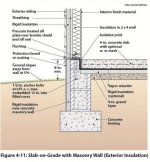
Hmmm. I'd say the typical construction for a block stem wall foundation that has siding on the outside has a 8 in wide block below grade switching to 6in block above grade - the slab then sits on or is poured above the 2in lip between the 2. So the slab is supported by the foundation all the way around not just at the garage doors.

If a brick ledge is used, then the offset is to the outside and the slab either floats everywhere except the doors or is pinned at the perimeter.

You really want proper frost protection and drainage below your interior slabs such that there is no "float" going on. Very seldom that it would all rise and fall at the same rate such that it wont crack up.
 

Attachments

  • foundation.jpg
    foundation.jpg
    41.2 KB · Views: 137

Radix2

Well-known member
Joined
May 28, 2014
Messages
1,853
Location
the thumb!, MI
As for compacting my aggregate base with the walls already built, I was worried the machine could crack a wall if it hit one accidentally, plus it would have a lot less room to move around being enclosed in the walls.

there is no other way to do it. How do you propose to build a block wall without digging next to it in your compacted base.

dig and pour footers.

Build stem walls

backfill and compact base

pour slab.
 

lakeroadster

Well-known member
Joined
Jan 19, 2015
Messages
5,166
Location
Central Colorado
Hmmm. I'd say the typical construction for a block stem wall foundation that has siding on the outside has a 8 in wide block below grade switching to 6in block above grade - the slab then sits on or is poured above the 2in lip between the 2. So the slab is supported by the foundation all the way around not just at the garage doors.

In the diagram above the stem wall is supporting the slab.

That's not a floating slab. Any settling at all in the sub-grade would lead to cracking in the slab.

My 1st garage was built as shown below, and the next two were similar, except they had poured stem walls. But the stem walls never supported the perimeter of the slab.

The stem wall / cap block was clearly vissible around the inside perimeter of the garage.

At the overhead doors, no cap block, slab pours to face of foundation block.

 
To avoid these ads, REGISTER NOW!

Radix2

Well-known member
Joined
May 28, 2014
Messages
1,853
Location
the thumb!, MI
In the diagram above the stem wall is supporting the slab.

That's not a floating slab. Any settling at all in the sub-grade would lead to cracking in the slab.

My 1st garage was built as shown below, and the next two were similar, except they had poured stem walls. But the stem walls never supported the perimeter of the slab.

The stem wall / cap block was clearly vissible around the inside perimeter of the garage.

At the overhead doors, no cap block, slab pours to face of foundation block.

no disagreement, I guess the comment is that around here at least, the slab is not floating and that block offset is typical.

In other places it may be different. I was responding to the post that said he had never heard of a stem wall under the floor, whereas I'd say it was typical. My experience is that what the OP was saying is not unusual.

every design has it quirks. and every one has problems if the subgrade is not well compacted and dry
 

torched

Well-known member
Joined
Feb 20, 2013
Messages
49
Location
Colorado
Ok, I now understand your need for the stem wall at the front. If it were me I would probably pour a stem wall there but I would also have a control joint 2 or 3 feet inside the door running parallel with the stem wall. This way if there is any expansion or settling the stem wall won't act as a fulcrum on the entire slab.
 
OP
J

Jayhem

Active member
Joined
Feb 14, 2017
Messages
44
Location
Central Virginia
there is no other way to do it. How do you propose to build a block wall without digging next to it in your compacted base.

dig and pour footers.

Build stem walls

backfill and compact base

pour slab.
Good points. Makes sense. Around here #57 granite is used under slabs in a 2-4" layer and lightly compacted (you can't really compact granite, just settle it). All slabs are either floating or monolithic with integral footings. We have a frost depth of like 2-4 inches and insulated garages, even without heating sources rarely get below freezing at the slab surface. Frost is not my concern with the stem wall, keeping lateral movement of groundwater out and my slab 6" above grade at the door openings is my concern.


In the diagram above the stem wall is supporting the slab.

That's not a floating slab. Any settling at all in the sub-grade would lead to cracking in the slab.

My 1st garage was built as shown below, and the next two were similar, except they had poured stem walls. But the stem walls never supported the perimeter of the slab.

The stem wall / cap block was clearly vissible around the inside perimeter of the garage.

At the overhead doors, no cap block, slab pours to face of foundation block.

^This is the way I want mine done. The sub-grade is more likely to settle than the footings which in my case are sitting on solid sandstone bedrock.

Ok, I now understand your need for the stem wall at the front. If it were me I would probably pour a stem wall there but I would also have a control joint 2 or 3 feet inside the door running parallel with the stem wall. This way if there is any expansion or settling the stem wall won't act as a fulcrum on the entire slab.

I'm going to put a stem wall at the front but I'm not going to rest my slab on it, I'm going to leave a small gap between slab and then pour my garage entry apron over the stem wall with a control joint at the slab and then control joints every 10' inside the garage.
 

wssix99

Well-known member
Joined
Mar 2, 2011
Messages
5,155
Location
Chicago, IL
1. Most footing and stem wall garage designs continue the footing and wall under the Overhead Garage Door opening(s) just below the slab. Why? Won't your compacted base and the slab be adequate at the door opening?

The foundations will be dug so they will not heave and move up on you. Gravity holds them down - but there is not much to constrain them in side-to-side movement. You need the continuous footing to make sure your walls around your garage door opening don't move!


2. I'm having the top soil removed first and sub soil compacted first and then the backhoe will dig my footing trenches. Should I bring in my gravel base for my slab and compact it BEFORE pouring the footings and building my stem wall or after?

After pouring the footings. If you don't do that, you'll loose the compaction at the edges of your wall. Just put some boards or plywood over the garage door areas of the footing and you can drive equipment over it.

Depending on how high your ceiling is and how you are situated for the slab pour, you can even do this once your ceiling is on. (This will allow you better control of the slab curing process by keeping it out of the wind.)

131104FirstInteriorBackfill-vi.jpg
 

wssix99

Well-known member
Joined
Mar 2, 2011
Messages
5,155
Location
Chicago, IL
^ Good points above regarding terminating the slab above the foundation. I've seen many examples of contractors extending the slab over the foundation. This limits the number of pours, but (IMO) its a recipe for potential cracks.

Fortunately, we had a number of pours at the house, so we were able to pour a separate "sill" directly over the foundation wall, between the floating floor and the driveway to isolated the floating floor from the foundation from the driveway. (The sill is isolated from the driveway by an expansion joint and from the floating floor by 1" foam.)

We used the 1" of foam to isolate the sill from the floor as we have radiant heat and I don't want to have that heat escape. We used a heat knife to carve out the top bit of the insulation after the pour and used this slab gasket to fill the gap: http://www.pavepatch.com/slabgasket...y-p-164.html?gclid=CNOAzevwq9ICFZ23wAodG3wEPw

^ It's held up wonderfully and is perfect for the application.
 
OP
J

Jayhem

Active member
Joined
Feb 14, 2017
Messages
44
Location
Central Virginia
The foundations will be dug so they will not heave and move up on you. Gravity holds them down - but there is not much to constrain them in side-to-side movement. You need the continuous footing to make sure your walls around your garage door opening don't move!


After pouring the footings. If you don't do that, you'll loose the compaction at the edges of your wall. Just put some boards or plywood over the garage door areas of the footing and you can drive equipment over it.

Depending on how high your ceiling is and how you are situated for the slab pour, you can even do this once your ceiling is on. (This will allow you better control of the slab curing process by keeping it out of the wind.)

Thanks for the tips! I'd rather do the pour before the stud walls or roof is on as it will be easier to get the concrete truck in there since the garage is 40' deep and there is no access from the sides, the truck will pretty much have to back over my garage door opening stem wall which will be 6" below grade at the garage opening. I might throw a steel plate over the area after compacting some stone dust to keep the truck from cracking the stem wall, even though if they do it won't really hurt much under the door opening.
 
To avoid these ads, REGISTER NOW!
Top Bottom