
mikepelchy
Active member
I have an older house where the original foyer had porches on the north and south sides that were converted into indoor space very crudely. Over the past couple of years I torn out the old porch on the south side and replaced it when frost wall, floor joists at floor level and then we ended up putting in an 8ft sliding glass door into the back yard. On the north side I ended up doing a frost wall and slab on grab so the stairs to get to the main floor would be inside versus outside and when I did the slab I did put two loops of pex in the slab, which I used give or take an 8" spacing. We currently had 1500w electric baseboard heater out there that is turned on high from fall to spring and some days it just keep up well and there is some ambient heat coming from main portion of the house from where the foyer opens up into the kitchen. I have thought about running some duct work from out forced hot air furnace out there but that won't be an easy task due to the layout of the basement and all of the other utilities that are in the way.
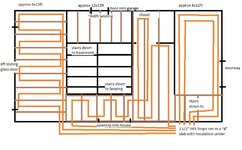
Based on my crude math, the electric baseboard heaters use 1080kwh which puts me at about $80/month max on the electric bill and I would say they get turned on in late Sept/early Oct and are on until end of May, so looking at about 8 months of use. I did a rough sketch of the layout of the foyer as the flooring is more of less broken down into 3 different sections, its not to scale and I didn't go count the rafters and spacing to figure out the loops exactly, this was just to try and get the thoughts out of my head. As previously stated, I did do insulation under the concrete slab with 2 loops of 1/2" pex (probably could have just been one) on 8" spacing. The idea for the two other sections of floor would be to run loops of pex under the floor using aluminum heat sinks and then putting in some insulation to keep the heat up. I am tossing around the idea of possibly using a point-of-use electric water heater to do radiant heat, with a 4 way manifold that had adjustable flow valves so it could be fine tuned a little. My thought would be to have a line-voltage thermostat mounted in the foyer to control the pump and then the hot water heater would just do its own thing automatically. I did seem some pretty simple setups in the floor heat setup topic that forcing me to consider doing this. The shopping list I included isn't inclusive, I kow I would need an expansion tank and pressure relief vavle plus all of the heatsink peices and some more pex tubing. I am thinking I could get the system up and going just heating the slab for now and then add the two other loops as time permits.

Based on my crude math, the electric baseboard heaters use 1080kwh which puts me at about $80/month max on the electric bill and I would say they get turned on in late Sept/early Oct and are on until end of May, so looking at about 8 months of use. I did a rough sketch of the layout of the foyer as the flooring is more of less broken down into 3 different sections, its not to scale and I didn't go count the rafters and spacing to figure out the loops exactly, this was just to try and get the thoughts out of my head. As previously stated, I did do insulation under the concrete slab with 2 loops of 1/2" pex (probably could have just been one) on 8" spacing. The idea for the two other sections of floor would be to run loops of pex under the floor using aluminum heat sinks and then putting in some insulation to keep the heat up. I am tossing around the idea of possibly using a point-of-use electric water heater to do radiant heat, with a 4 way manifold that had adjustable flow valves so it could be fine tuned a little. My thought would be to have a line-voltage thermostat mounted in the foyer to control the pump and then the hot water heater would just do its own thing automatically. I did seem some pretty simple setups in the floor heat setup topic that forcing me to consider doing this. The shopping list I included isn't inclusive, I kow I would need an expansion tank and pressure relief vavle plus all of the heatsink peices and some more pex tubing. I am thinking I could get the system up and going just heating the slab for now and then add the two other loops as time permits.