To avoid these ads, REGISTER NOW!

Floor heat with anchor/pull pots?

orangeracer

Active member
Joined
Jul 31, 2012
Messages
39
Location
Nort Central, Iowa
Iv been doing a lot of searching and am thinking about putting radiant floor heat in my new pole barn I'm thinking of using the 2" foam and stapling the pex directly to that then pour 6" of 4000psi concrete with wire mesh for more strenght. I was originally wanting to put in a few anchor/pull pots for some frame straighting, is this a alright to do with the pex ran throughout the floor or will i end up having issues. Thanks.
 
To avoid these ads, REGISTER NOW!

Racecarl

Well-known member
Joined
Oct 25, 2008
Messages
474
Location
McCook, NE
The wire mesh will not help appreciably with concrete strength. Mesh's function is to control/minimize cracks. Rebar is what gives concrete additional strength.

My floor is 6" thick and has both rebar and mesh in it. I made my own floor pulls from 7" square tubing. The square tube has rebar welded to it, which is tied into the rebar 'grid' in the floor. The 2' X 2' rebar grid is placed 4" from the top of the floor. The mesh is wired to the rebar grid, and the 1/2" pex for radiant heat is tied to the mesh with nylon zip ties. I routed the pex around the floor pulls and I anticipate no problems.

I am not sure how to install the anchors after pouring the floor. I am not familiar with commercial anchors. Knowing my luck, especially hitting water lines unintentionally, I opted to place the floor pulls before pouring the concrete.
 

tdkkart

Well-known member
Joined
Jun 17, 2006
Messages
6,887
Location
Eastern Iowa
Installed before or after the poor will not cause any issues. I suppose you might decide, just for giggles to make the concrete a bit thicker in the area of the pots if you planned ahead, but that's not even neccesary. Pull pots are installed in finished floors every day with no special considerations whatsoever.
Missing the pex when you drill is a no brainer, turn on the heat for 1/2 an hour and get out your infared heat gun. If you're really lazy pour some water on the floor, you'll find the lines within a few minutes.(I've suggested isopropal alcohol for this job before, but got my *** chewed, so I won't tell you to use that to find your lines faster.)
 

Sureshot

ALLIANCE MEMBER
Joined
Jan 3, 2011
Messages
3,134
Location
Bridge Creek, OK
I did my floor in two pours. Put in the sump and some large pipe collars etc in one small pour. Then did the floor and pex in a seperate large pour.
 

billydotcom

Member
Joined
May 15, 2012
Messages
5
"The wire mesh will not help appreciably with concrete strength. Mesh's function is to control/minimize cracks. Rebar is what gives concrete additional strength."


Arent cracks a sign of weakness aka a lack of strength? Just curious on that, therefore I believe Wire Mesh is a good idea for this job and strengthening the floor pre-pour.

What size mesh were you looking to use here? Stainless Steel? Galvanized? I wouldnt use anything too fine - I would definitely not go any finer than a 6 x 6 wire mesh - measurement guide can be seen here: ( http://www.bwire.com/index.html )

I think that if lack of cracks is what you are looking for then mesh should be the way to go.
 

custom1

Well-known member
Joined
Jan 8, 2008
Messages
307
Location
Pa
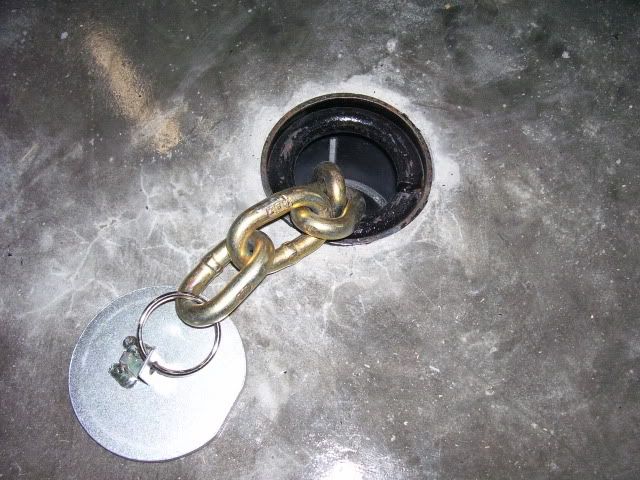
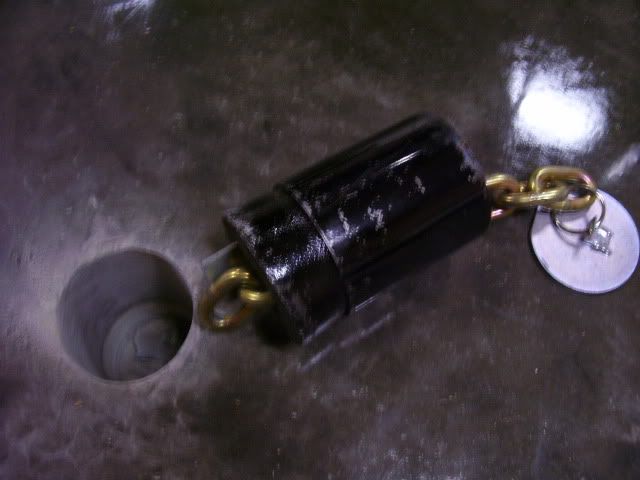
I used these floor pots from autobodytoolmart.

100_0890.jpg


100_0894.jpg


I used 2 layers of door cut-outs for insulation . I drilled a 3" hole in the top layer and inserted a short length of pvc pipe where each pot would be. My concrete guys finished the floor around the pipes. I thought that would be a problem and was going to try and set the pipes so the tops of them would be right at the finished floor height. But the concrete guys said that was not necessary and they could easily finish around them. I put in 14 pots so it looked pretty interesting on pour day. The finished floor ended up a tiny bit raised at each pot because they had to hand trowel close to them. As the floor set up they went around and gave each one a turn with a strap wrench so they wouldn't stick. The next day I pulled the pvc the rest of the way out and had perfect holes to put the pots in. I let the floor get hard for week or two before I put them in.

I have not finished the heating system yet, so I can't report on that. I put down 6" mesh and tied the pex to it. Made it very easy to layout the pattern. They used zip strips for the control joints so we didn't have to get a saw near the pex.

I don't do any heavy frame pulling, but have used the pots to pull some light stuff like core supports and such. They work pretty well. The floor is about 4 years old now and doesn't have any cracks at all.

100_0875.jpg
 

tdkkart

Well-known member
Joined
Jun 17, 2006
Messages
6,887
Location
Eastern Iowa
Arent cracks a sign of weakness aka a lack of strength? Just curious on that, therefore I believe Wire Mesh is a good idea for this job and strengthening the floor pre-pour.


First, concrete cracks, that's about the only thing you can be sure it will do.
You can jump through all kinds of hoops to stop it, but most will be unsuccessful.

2nd, if you think a few strands of #10 wire adds any appreciable strength to concrete you are sadly mistaken. When concrete wants to move it laughs at that dinky fence wire. Vertically the wire does not have enough strength to do anything, and sheers right along with the concrete. Laterally there's nothing on the wire for the concrete to grip, it readily slides on the wire.
I've busted up more slabs than I've poured, fence wire doesn't last long in a slab.

My concrete guy says, "the only good reason to put wire in your concrete is to hide it, and save having to take it to the scrap yard or bury it."

It does work well for tieing tubing to, if you want to crawl around on the ground to do it. Stapling with an upright stapler is much faster and easier.
 

Charles (in GA)

Well-known member
Joined
Jan 11, 2006
Messages
12,489
Location
50 mi south of Atlanta
"The wire mesh will not help appreciably with concrete strength. Mesh's function is to control/minimize cracks. Rebar is what gives concrete additional strength."


Arent cracks a sign of weakness aka a lack of strength? Just curious on that, therefore I believe Wire Mesh is a good idea for this job and strengthening the floor pre-pour.

What size mesh were you looking to use here? Stainless Steel? Galvanized? I wouldnt use anything too fine - I would definitely not go any finer than a 6 x 6 wire mesh - measurement guide can be seen here: ( http://www.bwire.com/index.html )

I think that if lack of cracks is what you are looking for then mesh should be the way to go.

As most concrete men will tell you, there are two kinds of slabs, those that are cracked, and those that will crack. Its just the nature of the beast, as the concrete shrinks as it cures.

Charles
 

tdkkart

Well-known member
Joined
Jun 17, 2006
Messages
6,887
Location
Eastern Iowa
The mesh I was planing on using is (http://www.menards.com/main/buildin...5-x-150-reinforcing-mesh/p-1479879-c-5642.htm) do i really need a rebar grid through my hole building or could i u the mesh then use the rebar as a reinforcement around the anchor/pull pots? Thanks.


If I had to pick, I'd leave out the mesh out and use rebar only, in fact that's what I did when I poured mine. Yes, It wouldn't hurt to put in a couple more pieces around the pots.

Remember, a large percentage of pull pots, and lifts, are installed are in buildings that were never intended to be used as body shops or general auto shops at all. Rarely do you hear of issues. It's a good idea to make preparations in advance if you can, but it's rarely necessary.
The service station in town is in a building that's pushing 100years old, I'd guess the floor is at least 1/2 that old. The 2 post Bendpak lift was installed there about 5 years ago with no modifications to the floor whatsoever, and has full size trucks on it everyday with no issues.(btw, the floor has a TON of slope in it also, over 1" of shims under the inside of each post)
 

tdkkart

Well-known member
Joined
Jun 17, 2006
Messages
6,887
Location
Eastern Iowa

kert

Well-known member
Joined
May 31, 2009
Messages
371
Location
Franklin, MI
If you insist on mesh, Menards sells flat wire panels that are 4 or 5ft by 10ft that would work much better than the rolled wire that will not want to lay flat worth a damn.

I'll second the flat sheets You can also get them in 8'x16' sheets, but will probably have to go to a masonry supplier and dither have them delivered or have a flatbed trailer to haul them. yes the sheets are more expensive, but all you have to do is lay them in and you're done. With the rolls you have to fight and fight to get them to lay flat
 
To avoid these ads, REGISTER NOW!

BadgerBoilerMN

Well-known member
Joined
Aug 4, 2011
Messages
837
Location
Minneapolis
"My concrete guys finished the floor around the pipes. I thought that would be a problem and was going to try and set the pipes so the tops of them would be right at the finished floor height. But the concrete guys said that was not necessary and they could easily finish around them. I put in 14 pots so it looked pretty interesting on pour day. The finished floor ended up a tiny bit raised at each pot because they had to hand trowel close to them."

You had it right. Never trust the concrete man...completely.
 

BadgerBoilerMN

Well-known member
Joined
Aug 4, 2011
Messages
837
Location
Minneapolis
Iv been doing a lot of searching and am thinking about putting radiant floor heat in my new pole barn I'm thinking of using the 2" foam and stapling the pex directly to that then pour 6" of 4000psi concrete with wire mesh for more strenght. I was originally wanting to put in a few anchor/pull pots for some frame straighting, is this a alright to do with the pex ran throughout the floor or will i end up having issues. Thanks.


With a six inch slab I would consider setting #3 bar at 3" and wiring PEX to the raised bar for better slab strength, crack control, improved radiant floor response times and slightly lower design water temperatures (lower operating cost).

This is a common practice in commercial garages heated with slab-on-grade radiant floors.
 
OP
O

orangeracer

Active member
Joined
Jul 31, 2012
Messages
39
Location
Nort Central, Iowa
what kind of pattern would I want to use for rebar such as spacing?

Will having the PEX at the bottom make my temperature fluctuate more throughout the heating season or just increase the time it takes to get it going the first time every year? I was planing to put at the bottom so it would be a more difficult to drill into. I'm planning ahead for a 2 post lift but I want the option to add any thing I may decide I need in the future.
 

BadgerBoilerMN

Well-known member
Joined
Aug 4, 2011
Messages
837
Location
Minneapolis
Tube placement will effect response time and required water temperature, but both are dictated by the insulation and climate.

The best way to keep the PEX safe in a slab, is to know where it is. A CAD drawing and careful installation is generally the rule. I am not sure what you will anchor with a 4 inch floor anchor. To go deeper would still be risky.

The other option is to block out anchor areas. It is a rare steel building that actually requires the amount of PEX typically installed e.g. 12" o.c. Most can can heated to design with a third the tube use and sometimes less depending on the outdoor and indoor design temps.
 

tdkkart

Well-known member
Joined
Jun 17, 2006
Messages
6,887
Location
Eastern Iowa
What type of pattern or spacing did you use with the rebar?

I don't have a picture on this computer, we used 1/2" rebar, 12-16" centers on chairs. I know we moved some pieces around to clear a couple obstacles so it didn't all end up perfectly spaced.
 
OP
O

orangeracer

Active member
Joined
Jul 31, 2012
Messages
39
Location
Nort Central, Iowa
I've decided to go with in floor heat and purchased my foam now I need to figure out the PEX i've gotten a quot from Menard's and blue ridge and both seem to have different opinions on the way it should be done.

What is the difference between the 1/2 PEX at 300 foot loops and 5/8 PEX at 500 foot loops?

I'm planing on using a outdoor wood boiler for my heat source dose anyone have any experience with doing this? can I use the same water or do I have to have to do separate systems?

The building is 40'x64' with 14' side walls, R30 ceiling R19 wall and 2 1/2 foam under the slab. location is in north central Iowa (Webster City). I am planing on running the system full time during the winter. I was also planing on doing the office area on a different zone.
 

Attachments

  • shop sketch.jpg
    shop sketch.jpg
    4.6 KB · Views: 31

kvom

Well-known member
Joined
Feb 1, 2008
Messages
820
Location
*******, GA
On my build I planned for a 2-post lift and routed the pex around the pad locations. When I bought a lift (different from the one I had planned on) the feet were a bit larger. I did the water on the floor deal and also used a laser thermometer, but the pex locations were anything but obvious. I did pray a bit when they were drilling for the anchors.
 

BadgerBoilerMN

Well-known member
Joined
Aug 4, 2011
Messages
837
Location
Minneapolis
Menard's is really known for radiant floors...or was that lawn furniture... I forget?

Perhaps a little professional design help and a specification to help you sort out the options.

1/2" PEX will heat any building in N. America but 5/8" PEX will require a smaller manifold.

Wood boilers take a little more design help than most people get when it come to radiant floor heating. You don't want to run the open wood boiler water through the finer parts of a radiant floor heating system.
 

raspy

Well-known member
Joined
Dec 16, 2010
Messages
103
Location
Wellington, Nevada
I've decided to go with in floor heat and purchased my foam now I need to figure out the PEX i've gotten a quot from Menard's and blue ridge and both seem to have different opinions on the way it should be done.

What is the difference between the 1/2 PEX at 300 foot loops and 5/8 PEX at 500 foot loops?

I'm planing on using a outdoor wood boiler for my heat source dose anyone have any experience with doing this? can I use the same water or do I have to have to do separate systems?

The building is 40'x64' with 14' side walls, R30 ceiling R19 wall and 2 1/2 foam under the slab. location is in north central Iowa (Webster City). I am planing on running the system full time during the winter. I was also planing on doing the office area on a different zone.


I generally use 1/2" PEX (5/8" OD). But in my place I used 3/4". This is 7/8" OD.
The benefits are you can use longer loop lengths and the tube wall is much thicker, so it's much stronger to hold up during the pour.

My grid is #3 bar on 12' centers, both directions. Slab is minimum 6" thick.

Just lay out your tubing in a logical serpentine pattern. No more than 300' for 1/2", but 200" is better. An extra pass at 6" in front of exterior doors and in front of the kitchen sink is nice. 6" spacing in bathrooms is nice, but 12" in general areas is a good spacing. 9" performs a bit better, but is harder to pour and requires more bar. All tube should be tied directly to bar and not draped along on it's own spacing. In other words, set your rebar at your tube spacing and stay with the bar. Sometimes you'll even need to add a piece of bar here and there, as you go.

Do your office area by going in and out through the door. You can have a separate thermostat or just a separate loop which can be tuned later for the best balance.

I used 2" blue board slab edge insulation, but none under the slab itself.

All tubing was tied with rebar ties and the rebar was tied wherever it crossed.

My 3/4" PEX entered the slab through 1" conduit 90s. 1/2" PEX uses 3/4" conduit 90s.

Set the top manifold runner at about 30" above the finished slab.

Pressurize the system at 100 PSI for inspection and during the pour.

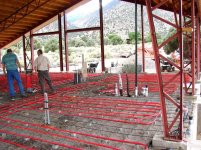
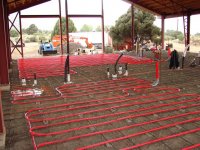
I've added a couple of pictures of my layout.
 

Attachments

  • DSC00513.jpg
    DSC00513.jpg
    154.1 KB · Views: 56
  • DSC00441.jpg
    DSC00441.jpg
    151.5 KB · Views: 54

BadgerBoilerMN

Well-known member
Joined
Aug 4, 2011
Messages
837
Location
Minneapolis
I generally use 1/2" PEX (5/8" OD). But in my place I used 3/4". This is 7/8" OD.
The benefits are you can use longer loop lengths and the tube wall is much thicker, so it's much stronger to hold up during the pour.

My grid is #3 bar on 12' centers, both directions. Slab is minimum 6" thick.

Just lay out your tubing in a logical serpentine pattern. No more than 300' for 1/2", but 200" is better. An extra pass at 6" in front of exterior doors and in front of the kitchen sink is nice. 6" spacing in bathrooms is nice, but 12" in general areas is a good spacing. 9" performs a bit better, but is harder to pour and requires more bar. All tube should be tied directly to bar and not draped along on it's own spacing. In other words, set your rebar at your tube spacing and stay with the bar. Sometimes you'll even need to add a piece of bar here and there, as you go.

Do your office area by going in and out through the door. You can have a separate thermostat or just a separate loop which can be tuned later for the best balance.

I used 2" blue board slab edge insulation, but none under the slab itself.

All tubing was tied with rebar ties and the rebar was tied wherever it crossed.

My 3/4" PEX entered the slab through 1" conduit 90s. 1/2" PEX uses 3/4" conduit 90s.

Set the top manifold runner at about 30" above the finished slab.

Pressurize the system at 100 PSI for inspection and during the pour.

I've added a couple of pictures of my layout.

This "advice" is, nearly all, made up nonsense. Look to your supplier or a professional designer for proper radiant floor design assistance. You will save money, time and have a safer work environment.

As a simple example; no manufacturer of PEX tubing recommends a 100 psi test pressure while pouring the slab. It is considered unsafe and indeed it is.

Here's another tidbit. If your tubes touch or lap one another, your wasting tube.

Good reliable information is available if you care to look into it.
 
Last edited:
To avoid these ads, REGISTER NOW!
Top Bottom