

You are using an out of date browser. It may not display this or other websites correctly.
You should upgrade or use an alternative browser.
You should upgrade or use an alternative browser.
Floor quality
- Thread starter Billp1964
- Start date

Jinks
Well-known member
While creating your post click the "Go Advanced" button at the bottom of the screen. In the "Advanced" screen look at the top center for the "paper clip" symbol. When you click that you will get a screen that will allow you to "Browse" & "upload" pictures from your computer. They will attach to your post. I think you need at least 5 posts before you can post pictures.
I recently had my garage floor coated with CTM epoxy base coat and CTM PACT 8000 polyaspartic top coat. I am not happy with the finished product due to some inconsistencies in the finish. Contractor has agreed to recoat the top coat. It's been a couple weeks so he says he will scuff it and wipe the whole floor down with acetone prior to recoat. Does anyone know if this process guarantees good adhesion or will the new top coat be more susceptible to failure?While creating your post click the "Go Advanced" button at the bottom of the screen. In the "Advanced" screen look at the top center for the "paper clip" symbol. When you click that you will get a screen that will allow you to "Browse" & "upload" pictures from your computer. They will attach to your post. I think you need at least 5 posts before you can post pictures.
LegacyIndustrial
ALLIANCE MEMBER
I recently had my garage floor coated with CTM epoxy base coat and CTM PACT 8000 polyaspartic top coat. I am not happy with the finished product due to some inconsistencies in the finish. Contractor has agreed to recoat the top coat. It's been a couple weeks so he says he will scuff it and wipe the whole floor down with acetone prior to recoat. Does anyone know if this process guarantees good adhesion or will the new top coat be more susceptible to failure?
This is how its done.
Sent from my iPhone using Garage Journal
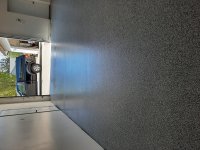
Here is a couple photosThis is how its done.
Sent from my iPhone using Garage Journal

LegacyIndustrial
ALLIANCE MEMBER
Looks good, some slight back-rolling issues. Sometimes the PAP cures a little fast. Anothet clear can fix that.
Sent from my iPhone using Garage Journal
Sent from my iPhone using Garage Journal
The second photo is actually of a repair. After the first application the last 5 feet had less top coat on it. My sock feet would catch on it (no aggregate). Contractor (who has been really cooperative) said he could repair it so he taped off that end and recoated that section. This was done within 24 hours of the initial application. As you can see now I have a section that is shinier than the rest. It's actually what I wish the entire floor was. We discussed options and maybe recoating the entire floor which he had never done before. I also pointed out at that time that I had hoped the floor would be a little shinier and more uniform (not the flakes the topcoat finish). He stated that it is difficult to not have any inconsistencies with polyaspartic. Is this true? Instead of doing the whole floor he ended up doing the last 5 feet again with some fine aggregate hoping to knock down the sheen. He scuffed it and applied acetone to entire area before recoat. The result is the same. Shinier at that end. I haven't talked to him yet after the second attempt, but as I stated before, he has been really good about doing what he can to make it right. I'm thinking a recoat is necessary. If we do recoat will it be hard to make that end match the rest of the floor?A second coat of clear should correct this. Looks like not proper backrolling technique
LegacyIndustrial
ALLIANCE MEMBER
In our experience from our Installation Division, 'spot' touching up never works and always 'shows' the difference. Normally if there are issues we would redo the entire space as needed.
On point. Do it all or waste your time.
Sent from my iPhone using Garage Journal
Thanks. Is it diffucult for an experienced installer to get a uniform finish with polyaspartic on a full flake floor?On point. Do it all or waste your time.
Sent from my iPhone using Garage Journal
SolarColumbia
Well-known member
I don't think that's true. I did my 825 sq ft with poly and I have many inconsistencies but I'm a beginner and was working by myself.
Thanks, I will probably end up accepting it as is due to the risk of it possibly having more issues as result of recoat. It doesn't sound like the contractor has confidence that it will be better. There doesn't appear to be any integrity issues, just appearance.No, it should be easy to get a uniform finish. We carry a slower curing polyaspartic which is very forgiving if that is of concern.
So now I have 2 different sheens on the floor. If they recoat the entire floor will that even out? Or will it get even shinier in the area that has already been recoated?Thanks, I will probably end up accepting it as is due to the risk of it possibly having more issues as result of recoat. It doesn't sound like the contractor has confidence that it will be better. There doesn't appear to be any integrity issues, just appearance.
SolarColumbia
Well-known member
They'll have to scuff the surface before recoat and it should all look the same once done.
LegacyIndustrial
ALLIANCE MEMBER

In our opinion is should be ok. Just make sure they prep the clear coat properly before recoating the entire thing. No way to 100% guarantee a finish but with a light prep and cleaning of the surface the new coat should even things out.