To avoid these ads, REGISTER NOW!

Flooring Options for a Previously-Coated Floor

BradH

New member
Joined
Jan 7, 2008
Messages
3
Location
Memphis, TN
I've been lurking on this forum for many years and always come away with some great information and ideas. There are so many variables in choosing the right garage floor, and I'm hopeful that by listing mine the community here can help me choose the right direction for my garage. Here's what I'm working with:


  • 1,000 square foot attached 4-car garage in Dallas, Texas
  • The house was built in 1990, and I'm guessing the garage floor was coated when the house was new with an unknown product.
  • The current floor coating has failed, with multiple areas where it's worn off completely, flaked off, or just generally looks terrible.
  • I use my garage for general to advanced car repairs & maintenance and detailing, so it's a real garage, not a showroom. I don't do any welding or fabrication.
  • The sides have a 45 degree concrete slope up to the framing/drywall. The front edge has a ~2" step up and raised area closest to the house.
  • Looking for a "permanent" flooring solution. I.e., we plan on staying in this house for a good long while, and I don't want any possibility of having to redo the floor.
  • I'm looking for a cost-effective floor solution. It's a higher end house, but I don't have an unlimited budget for the garage remodel.

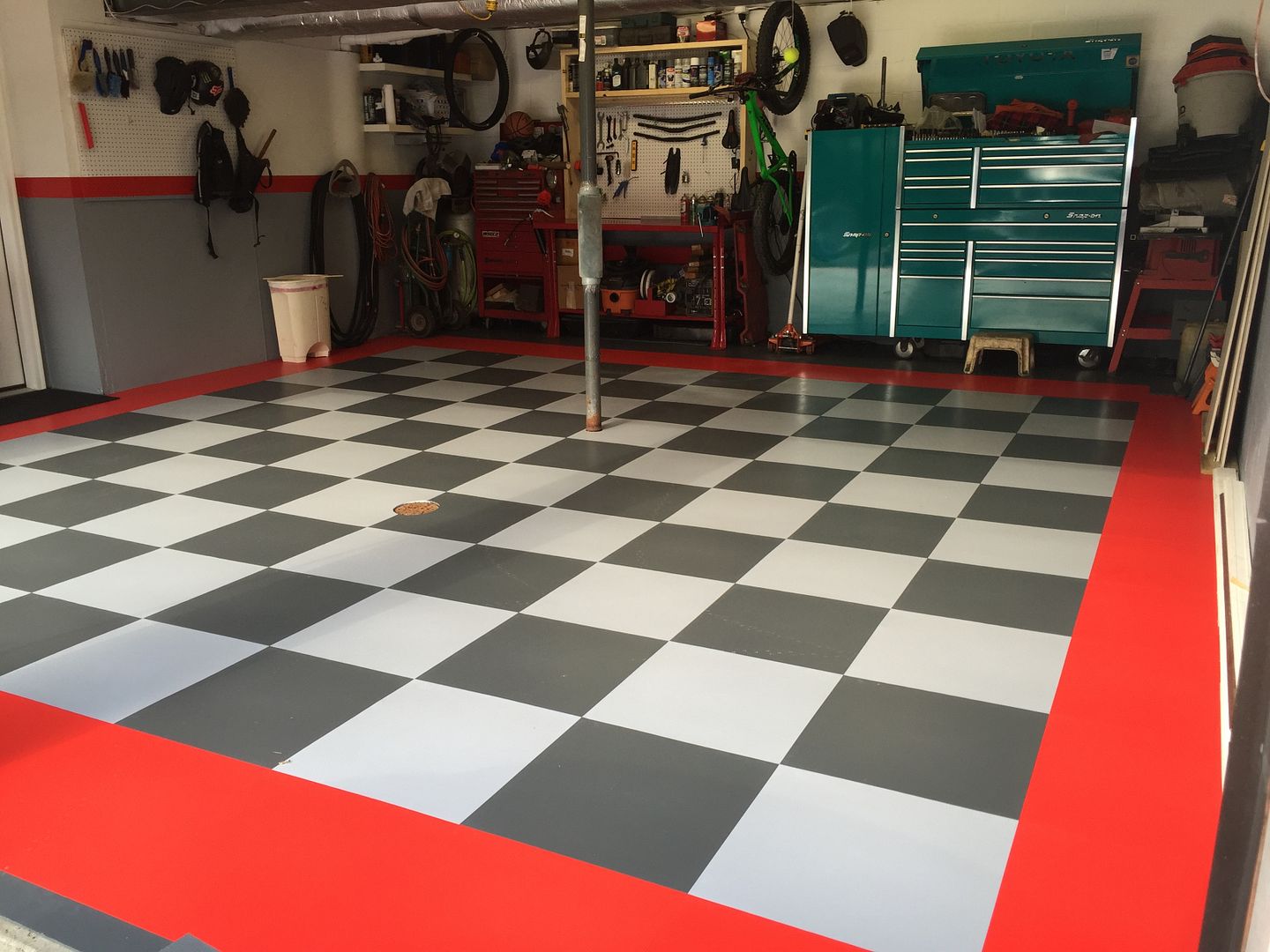
I DIY epoxy painted the garage in our first house on a new slab and liked the look. In our last house, I did black & white checkerboard Armstrong VCT, and loved it for about the first six months. I should have epoxy coated it, but with my use, the floor started to stain and generally look poor even with diligent maintenance. The VCT is just too maintenance intensive and, honestly, I quickly tired of the look.

That leaves epoxy (either DIY or pro-installed), porcelain tile, or polish/seal.

Given the fact the floor has a failed coating, what prep will need to be done for any of these options? There are quite a few rough areas and cracks to deal with. If I go with tile, how do I deal with the step/raised area and the 45 deg slope?

What would you do and why? How much should I weigh the prep labor to get the floor into shape against the finished look?

Thanks for your help!
 

Attachments

  • IMG_0689.jpg
    IMG_0689.jpg
    141.2 KB · Views: 58
  • IMG_0688.jpg
    IMG_0688.jpg
    168.7 KB · Views: 57
  • IMG_0687.jpg
    IMG_0687.jpg
    145.9 KB · Views: 60
To avoid these ads, REGISTER NOW!

SunsetsAndFriends

Well-known member
Joined
Sep 10, 2012
Messages
753
Looks like enough of the coating has come up that you could do a basic moisture test. Place a 4 mil or thicker plastic sheet 18"x18" on the floor and tape all four sides with duct tape. Leave for 24 hours. If you see water droplets on the underside of the plastic or the concrete is darker under the plastic, then you have higher levels of moisture.
 

Shea

Well-known member
Joined
Sep 19, 2012
Messages
2,867
Location
California
Besides the moisture test (assuming things are OK), grinding the floor is going to be the next best step. It will remove the remainder of the coating and prep the floor for all three options. It's best to do the crack repairs first before grinding.

The angled sides and step up for porcelain are not a big issue, just more cutting involved. Terminate the tiled floor edge at the line where the floor angles up. You can then cut tile to fit on the sloped edge. 1/8" grout lines work well for garage floors. You will need to cut small pieces to lay against the face of the raised edge.

There are some pro tile setters that may be able to chime in and suggest the best way for the top edge of the raised floor to meet up with the smaller tile applied to the face of the raised area.
 

Armorpoxy

Well-known member
Joined
Aug 18, 2013
Messages
3,735
Location
NJ
A good epoxy system like our Armorclad would be a good choice. Grind and use the primer and you will have a floor like a car dealer!
 
Last edited:
To avoid these ads, REGISTER NOW!

MouldsPI

Member
Joined
Jan 13, 2016
Messages
10
Hi Brad,

Please check out http://exeliausa.com/! Exelia is a cost-effective interlocking floor tile that is extremely durable and is definitely a "permanent" solution for your home. It's extremely easy to install. It's a DIY process and I myself have completed a project around 3,000 sq.ft with 2 other people and completed the task in about 2.5-3 hours with just a rubber mallet. Exelia is also chemical resistant, which is perfect for your situation (car repairs, maintenance and detailing).

Check out one of our customer's completed project:

IMG_0234_zpsazbaavcs.jpg

IMG_0302_zpsukygsget.jpg

IMG_0303_zpsdmdugdm0.jpg


We also have an ongoing sale right now, so please take a look!

Goodluck with your project.

Cheers.
 

Garage Flooring

ALLIANCE MEMBER
Joined
May 21, 2011
Messages
5,288
Location
Grand Junction, CO
I've been lurking on this forum for many years and always come away with some great information and ideas. There are so many variables in choosing the right garage floor, and I'm hopeful that by listing mine the community here can help me choose the right direction for my garage. Here's what I'm working with:


  • 1,000 square foot attached 4-car garage in Dallas, Texas
  • The house was built in 1990, and I'm guessing the garage floor was coated when the house was new with an unknown product.
  • The current floor coating has failed, with multiple areas where it's worn off completely, flaked off, or just generally looks terrible.
  • I use my garage for general to advanced car repairs & maintenance and detailing, so it's a real garage, not a showroom. I don't do any welding or fabrication.
  • The sides have a 45 degree concrete slope up to the framing/drywall. The front edge has a ~2" step up and raised area closest to the house.
  • Looking for a "permanent" flooring solution. I.e., we plan on staying in this house for a good long while, and I don't want any possibility of having to redo the floor.
  • I'm looking for a cost-effective floor solution. It's a higher end house, but I don't have an unlimited budget for the garage remodel.

I DIY epoxy painted the garage in our first house on a new slab and liked the look. In our last house, I did black & white checkerboard Armstrong VCT, and loved it for about the first six months. I should have epoxy coated it, but with my use, the floor started to stain and generally look poor even with diligent maintenance. The VCT is just too maintenance intensive and, honestly, I quickly tired of the look.

That leaves epoxy (either DIY or pro-installed), porcelain tile, or polish/seal.

Given the fact the floor has a failed coating, what prep will need to be done for any of these options? There are quite a few rough areas and cracks to deal with. If I go with tile, how do I deal with the step/raised area and the 45 deg slope?

What would you do and why? How much should I weigh the prep labor to get the floor into shape against the finished look?

Thanks for your help!

Besides the moisture test (assuming things are OK), grinding the floor is going to be the next best step. It will remove the remainder of the coating and prep the floor for all three options. It's best to do the crack repairs first before grinding.

The angled sides and step up for porcelain are not a big issue, just more cutting involved. Terminate the tiled floor edge at the line where the floor angles up. You can then cut tile to fit on the sloped edge. 1/8" grout lines work well for garage floors. You will need to cut small pieces to lay against the face of the raised edge.

There are some pro tile setters that may be able to chime in and suggest the best way for the top edge of the raised floor to meet up with the smaller tile applied to the face of the raised area.

Hi Brad,

Please check out http://exeliausa.com/! Exelia is a cost-effective interlocking floor tile that is extremely durable and is definitely a "permanent" solution for your home. It's extremely easy to install. It's a DIY process and I myself have completed a project around 3,000 sq.ft with 2 other people and completed the task in about 2.5-3 hours with just a rubber mallet. Exelia is also chemical resistant, which is perfect for your situation (car repairs, maintenance and detailing).

Check out one of our customer's completed project:

IMG_0234_zpsazbaavcs.jpg

IMG_0302_zpsukygsget.jpg

IMG_0303_zpsdmdugdm0.jpg


We also have an ongoing sale right now, so please take a look!

Goodluck with your project.

Cheers.


The first thing you need to do is decide what type of floor you want to go back with and badly you want to do it. If you really want an epoxy, then yes. moisture test, grind the floor and prep it. Add a good primer, coat and seal with a urethane.

I would stay away from adhesive tiles. Porcelain is a good option is are PVC tiles and Polypropylene tiles. The nice thing about these products is it eliminates much if not all of the prep.

A grind and polish or grind and seal is a great floor. In this case though, your going to have to start with a removal tool and depending on what you use and the finish you want, there will be anywhere from a couple to several grits that have to be used.
 

Corsair4360

Well-known member
Joined
Nov 7, 2013
Messages
63
Location
Logan, Utah
My two cents. First grind and finish work great, IF your concrete is not grease stained thoroughly, you have a company skilled in its use (not DYI) and you live in an area where the good finishes are still available (aka not in California and other states with similar restrictions in finishes). My very good friend has a 80 year old building that was a car dealership / repair building. Half of it was a shop for many years and the concrete is oil contaminated down much farther than grinding will ever touch. The other side was done in epoxy 25+ years ago, and it is still good, although failing to adhere in many places now after heavy auto repair use. The grease stained side is a mess, the coating peeled up, it has been redone in several places and still is not great.
 

bilie

New member
Joined
Jan 12, 2016
Messages
2
Looks like enough of the coating has come up that you could do a basic moisture test. Place a 4 mil or thicker plastic sheet 18"x18" on the floor and tape all four sides with duct tape. Leave for 24 hours. If you see water droplets on the underside of the plastic or the concrete is darker under the plastic, then you have higher levels of moisture.
o.png

yes, I agree with you
 
To avoid these ads, REGISTER NOW!
Top Bottom