To avoid these ads, REGISTER NOW!

Fluid velocity

koditten

Well-known member
Joined
Apr 10, 2008
Messages
5,528
Location
Midland, Michigan
I Have just started up my radient floor system. Three loops of 250' pex, 1/2" diameter. I Installed sight gauges before and after the headers. I wanted to be able to see the fluid being pumped thru the system. I am using a Taco 007 pump to curculate the fluid in and out of my water heater.

My question is how fast will the fluid appear to be moving past the sight gauge window? WhenI look at the sight gauge the fluid is just bearly moving. I actually have to shine a flashlight on the gauge to see the fluid moving. I know the pump is moving the fluid because I can see the little floaties that is present in all water stop moving when I shut the pump off.

This brings me to another question. If this fluid is moving this slow and it is exceptable for pump durability, I can not see how an infloor system will ever deplete a 40 galllon water heater of hot water.

Any insight from the GJ team will be greatly appreciated.

Thanx
Kirk
 
To avoid these ads, REGISTER NOW!

Friartuck

Well-known member
Joined
Apr 13, 2007
Messages
123
Location
Monmouth County, NJ
Kirk, How did you arrive at the decision to use the TACO 007? Yes its a good selling pump for circulating water in 1 or 1 1/2 inch sized pipe, but may not be right for your application (smaller pex tubing in long lengths). One of the common complaints I've seen from folks is that the circulator pump doesn't have enough push for long lengths of Pex tubing. The term I've seen is Head Capacity or Head Range. The TACO 007 is rated for 10 feet whereas larger TACO pumps (TACO 0014 or 0015) have Head Range of 20 feet. Think the name "007" refers to this Head range. See Pexsupply.com for explanation.

See Discussion at:
http://www.radiantdesigninstitute.com/page46.html
 
Last edited:
OP
K

koditten

Well-known member
Joined
Apr 10, 2008
Messages
5,528
Location
Midland, Michigan
I am glad you asked about the pump size. The reason I used this pump was because they were all out of the higher head pumps. I was told by the "tech" at Menards that 007 unit will "most" likely work for your purpose. I was hoping I could get lucky using this pump. It looks like I am going to have to get a larger pump before I start getting too deep into the system.
 

stewart

Well-known member
Joined
Aug 3, 2009
Messages
72
Location
long island NY
Take one of your wifes instant read meat thermometers from the kitchen. Measure the temp of your tubing just before it goes into the floor. Then measure the temp at the tubing just out of the floor. If its 180 in and say 130 out the pumps not flowing enough. A plumber can give you a more detailed analysis knowing these temps.
 
OP
K

koditten

Well-known member
Joined
Apr 10, 2008
Messages
5,528
Location
Midland, Michigan
Of course I am shooting for the 10-15 degree temp change. Because I am using a water heater for the heat source I only have 105 degree input to the system.

I left the circulator running for 36 hours and saw no change in the discharge temp. Still around 46 degrees, the same as when I started. I think that I have a flow issue as previously pointed out.

The water heater never came on in the time that I was watching the system work. (I only spent 5 hours watching the system, had to head to work).

I have digital temp gauges before and after the headers so I can see my exact delta T.

I am going to head back to Meanards on Saturday and see if they have a higher head pump as recomended above. If this is not the sulution I can always take the pump back.

Keep me informed of your ideas as they come in.

Thanx Team GJ

Kirk
 

tdkkart

Well-known member
Joined
Jun 17, 2006
Messages
6,887
Location
Eastern Iowa
You're saying you ran the system for 36hrs and the discharge never rose at all??
And the heater never came on?? The water heater should have definitely come on if you were dumping 46* water into it, should have come on in just a few minutes.

Are you SURE you're actually moving water?? Even if the pump was woefully small it should have moved SOME water into your water heater and cooled it enough to make it come on.

Is your input header warming up?? if you have 105* water going into the header it should be warm to the touch in just a few minutes.
You should see some temp rise in the return header also.

You might try shutting off 2 of your loops, this will raise the flow in teh remainig one and you should start seeing something happen.
 
OP
K

koditten

Well-known member
Joined
Apr 10, 2008
Messages
5,528
Location
Midland, Michigan
Yep, the temp never came up. I can only measure the header temps. supply warm, return cold. My slab was 46 degrees F. Like I said, the water does not appear to be moving more than a crawl. My estimated speed of the water is about 2-4 inches a second at best. I definately need more flow.

Also to clear up any confusion, This is my second in floor system install, but my first using a water heater and designing it myself. If I wanted to go the pro route I would have from the start. I knew there was a wealth of info available on this site. I wanted to do this system stem to stern on my own with the GJ help. If it works great, if not I will persue other options.

I will keep my changes posted as I find time to work on them.

Thanx

Kirk
 

z28snksknr

Well-known member
Joined
Jul 8, 2009
Messages
1,827
Location
Turnersville, NJ
I would agree that you need a higher head pump. Just to flesh out why (I'm bored at work):

Pumps operate on a "performance curve" which is a graph of fluid flow on the x-axis (gal/min) vs. differential head (usually in feet or psi) on the y-axis. Basically, the more resistance in a hydraulic circuit, the more head is required to get things moving. As a result, flow is reduced since the energy into the pump remains constant.

When designing a system, you should be calculating your circuit resistance and desired flow rate before you buy a pump. The goal would be to find a pump that exceeds your required flow rate at the required head gain for the system. There are online calculators that will calculate your head loses for a given pipe run. You can always throttle back a larger pump with a gate valve on the outlet, but you'll never get more out of a smaller pump unless you boost the inlet pressure or lower the outlet pressure.
 

nate379

Banned
Joined
Feb 2, 2009
Messages
7,279
Location
Palmer, AK
Where does this 10-15* temp change come from??

My setup will have 130* supply and the return is is usually around 100*, though if the floor is cold (like in the garage) the return temp may only be 70-80*

The manifolds are wide open at 2 gpm.

Of course I am shooting for the 10-15 degree temp change. Because I am using a water heater for the heat source I only have 105 degree input to the system.

I left the circulator running for 36 hours and saw no change in the discharge temp. Still around 46 degrees, the same as when I started. I think that I have a flow issue as previously pointed out.

The water heater never came on in the time that I was watching the system work. (I only spent 5 hours watching the system, had to head to work).

I have digital temp gauges before and after the headers so I can see my exact delta T.

I am going to head back to Meanards on Saturday and see if they have a higher head pump as recomended above. If this is not the sulution I can always take the pump back.

Keep me informed of your ideas as they come in.

Thanx Team GJ

Kirk
 
Last edited:
To avoid these ads, REGISTER NOW!

redsky49

Well-known member
Joined
Jan 21, 2009
Messages
582
Location
near the coast in eastern North Carolina
A lot of guessing going on here, myself included. This is just one example of how difficult it is to diagnose a system via the internet.

Have you attempted to balance the system? Are all three loops the same length, number of fittings and bends, the same heat requirement, etc.?

Is your single pump on the primary loop, circulating between the distribution header and the heat source? How are you proportioning the flow to the various loops? Are you pumping through the heater or sucking through the heater? What actuates the pump -- is it running continuously? What activates the heater? Header temp or loop/space temps?

I am reading your first post as describing a domestic water heater as source of heating hot water. This is certainly not recommended. The issue is not the storage capacity of the water heater, but the heating capacity. The setpoint of 105 degrees for the heater will likely never satisfy your heating requirements, though this can only be confirmed by calculation. Can you adjust the leaving temperature any higher, say 120 degrees?

On a closed system, one that is not open to the atmosphere, the only head pressure you will encounter will be the friction loss of the tubing (and the header, valves, heater, etc.). Vertical lift does not come into play.

Here is the cutsheet for the Taco pump:

http://www.taco-hvac.com/uploads/FileLibrary/101-029.pdf

This pump is a small circulator with very modest flow and head capacity.

The first question you should be asking is what is the flow rate requirement (gpm) as determined by the heating calculation. The calculated heat loss, plus a small warm up factor, divided by 500 x delta tee (generally 20 degrees), equals your flow rate or gpm requirement.

Then you must calculate the head for the installed system as noted above. Only then can you select the proper pump. You need the gpm, head and maximum operating temperatures to accurately choose the pump.

Once you have the correct pump, you have solved one, and only one, piece of the puzzle.

As for flow rates, anything up to about 5 or 6 fps would be acceptable, if indicated by calculation. This is a standard range based on friction loss. The 4 fps maximum speed listed in jklingel's post above is generally used for piping applications above grade, particularly plumbing supply piping. For 1/2" tubing, 4 fps = about 2.9 gpm, 6 fps = about 4.2 gpm. If you can keep flow rates low, say 3-4 fps, that would be a good design point, but you may have to go higher based on the supply water temp. Again, perform a load calc.

There is no substitute for an experienced set of eyes on site. If possible, contract an experienced engineer or heating designer for an hour's consultation. You will likely get your money's worth and more.

As always, offered only as opinion
 
Last edited:

tdkkart

Well-known member
Joined
Jun 17, 2006
Messages
6,887
Location
Eastern Iowa
There is no substitute for an experienced set of eyes on site. If possible, contract an experienced engineer or heating designer for an hour's consultation. You will likely get your money's worth and more.

Or for that matter just another set of eyes period.
Which is another prime reason for putting one's location in your profile. One of us could be just around the corner, willing to help, and not even know it.
 

tdkkart

Well-known member
Joined
Jun 17, 2006
Messages
6,887
Location
Eastern Iowa
sounds like air... lets have a pic.

daye


This is a very good possibility, air is very hard to get out of these systems if you are not careful, pumps will not push air, and it is entirely possible that the only movement he is seeing in the system is thermal-syphoning.

Yes, a few pictures would help.
 
OP
K

koditten

Well-known member
Joined
Apr 10, 2008
Messages
5,528
Location
Midland, Michigan
I finally got my flow I needed. I put in a larger pump and things really took off. I am fairly sure I had had a huge slug of air as well. When I turned it on the pinwheels in my flow gauges really took off. As I was watching it a huge slug of air went thru the gauge. I did not see this happen with the smaller pump.

I am kind of disapointed in the weather around here. Of course the the day time temps would go up to the low 40's and drop at night to the 20's. I was hoping to run the system while we had nightly temps in the teens. I was looking forward to experimenting with my new heat system. Kind of defeats the purpose to run the system when I am comfortable with 50* inside the building.

As for the pictures you guys asked for, you need to cut me some slack. I'm kind of a knucle dragger when it comes to getting pics on the internet. I don't do it enough for it to come naturally like it does for some.

As for my profile, I remember indicating that I was from the central Michigan area when I registered to the GJ group. I guess that stuff didn't get put in my profile. I'll be honest, may or may not go and update my info.

Anyways, I really appreciate the help. Now it is time to work on my controls. I got the water heater and the pump running manually just to see if it would work and it looks like it will. I really like tinkering around and using stuff that was considered scrap and using it for alternate purposes. Of course if this turns out to be rediculously expensive to use for heat I will be going a more conventional route. The only thing it has really cost me so far is the time experimenting to make it happen, and to me that is the fun part.

Thanks again GJ team
Kirk
 

Friartuck

Well-known member
Joined
Apr 13, 2007
Messages
123
Location
Monmouth County, NJ

Attachments

  • random_photos_012.jpg
    random_photos_012.jpg
    80.4 KB · Views: 45
  • random photos 011.jpg
    random photos 011.jpg
    84.7 KB · Views: 16
  • random photos 013.jpg
    random photos 013.jpg
    72.9 KB · Views: 11
Last edited:

72Tunaboat

Well-known member
Joined
Sep 25, 2008
Messages
71
Location
Snohomish,WA
What's up with the bypass loop? that ball valve should be at least partially closed. :headscrat

I don't see the need for the 'flow meters' on the supply and return.

There is a possibility of air getting trapped on the return piping, above that flow meter.
 
Last edited:
OP
K

koditten

Well-known member
Joined
Apr 10, 2008
Messages
5,528
Location
Midland, Michigan
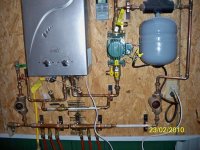
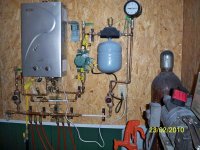
The bypass loop is for getting all the air out of the floor tubing without worrying about the water heater.

as for air getting trapped above the flow meter there is a ball valve to bleed that out. The flow path is counter clockwise in case you were wondering.

As for the flow meters I have no idea what brand they are. They were left over from a demolition job years ago. I agree you don't need them, but I sure to like them. they are rated for 125 psi. It is very nice to see how much air is moving thru you system.
 
To avoid these ads, REGISTER NOW!
Top Bottom