To avoid these ads, REGISTER NOW!

Fluke 88V vs HF Multimeter

oldtools

Well-known member
Joined
Sep 15, 2008
Messages
2,706
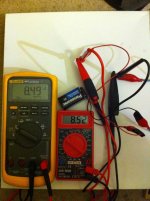
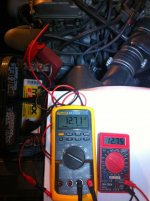
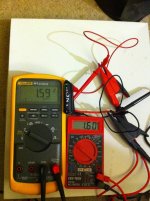
I just bought a brand new automotive Fluke 88V (~$400). I also got a bunch of free cheapy HF multimeter (~$5), so I decide to see how accurate the HF meter is. Quality wise, the two are mile apart but I don't expect a $5 meter to have the same quality as a $400 meter anyway. I want to see if the HF DC voltage and resistance is good enough for automotive use (I did do one AC voltage test). This is only a few test samples, but I am surprise how accurate the HF meter is. Of course the Fluke has alot more function and digit range than the HF. In all the test so far, the HF is different from the Fluke reading by less than one percent. I say the cheapy HF meter is good enough for automotive use.

AA battery (1.2V): Different by 0.63%
9V battery: Different by 0.35%
12.7 battery: Different by 0.31%
120 AC: Different by 0%
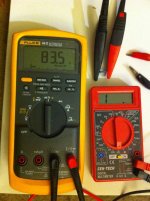
80 ohm resistance: Different by 0.12%
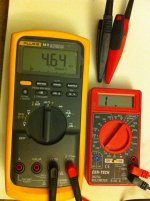
4.6 kilo ohm resistance: Different by 0%
 

Attachments

  • Fluke 88 vs HF_1.2VDC.jpg
    Fluke 88 vs HF_1.2VDC.jpg
    146 KB · Views: 147
  • Fluke 88 vs HF_9VDC.jpg
    Fluke 88 vs HF_9VDC.jpg
    145.3 KB · Views: 128
  • Fluke 88 vs HF_12.7VDC.jpg
    Fluke 88 vs HF_12.7VDC.jpg
    140.5 KB · Views: 131
  • Fluke 88 vs HF_120VAC.jpg
    Fluke 88 vs HF_120VAC.jpg
    146.4 KB · Views: 130
To avoid these ads, REGISTER NOW!
OP
O

oldtools

Well-known member
Joined
Sep 15, 2008
Messages
2,706
Here are the resistance.
 

Attachments

  • Fluke 88 vs HF_83 Ohm1.jpg
    Fluke 88 vs HF_83 Ohm1.jpg
    146.3 KB · Views: 90
  • Fluke 88 vs HF_83 Ohm2.jpg
    Fluke 88 vs HF_83 Ohm2.jpg
    146.1 KB · Views: 84
  • Fluke 88 vs HF_4.6 Kilo Ohm1.jpg
    Fluke 88 vs HF_4.6 Kilo Ohm1.jpg
    145.6 KB · Views: 76
  • Fluke 88 vs HF_4.6 Kilo Ohm2.jpg
    Fluke 88 vs HF_4.6 Kilo Ohm2.jpg
    146.3 KB · Views: 76

franzdom

Well-known member
Joined
Sep 7, 2009
Messages
3,136
Location
NC
Good enough unless it blows up in your face, but that is much more likely with higher voltage than automotive use.
 

xtremek

Well-known member
Joined
Apr 13, 2012
Messages
11,603
Location
St. Johns, Mi
For auto use, cheap meters will work fine. You don't get many things lower than .3 ohms resistance, so accuracy isn't essential. For electronics, that's a different story. Worked in a warranty/tech help call center for ABS on trucks, tractors and trailers. Used to tell the trailer guys, "Go down to your local chain store and spend $10 for a digital multi. It'll do everyting you'll ever need."
 
OP
O

oldtools

Well-known member
Joined
Sep 15, 2008
Messages
2,706
Does it beep when you test for continuity?

Unfortunately, the $5 HF does not come with a continuity function. That is a disappointment. Oddly enough, it has functions to test transistor and small battery conductance that even higher end model does not have. The $20 HF meter has continuity function.
 

nanofrog

Well-known member
Joined
Mar 1, 2012
Messages
1,323
The HF meters are fine for automotive use, but not recommended for AC work, especially mains AC (precious little to no protection which can cause them to explode in your hand; demonstration videos of this are on youtube).

88V has features/functions the HF doesn't of course (and highly useful ones at that), and would be safer, such as an over-current situation (accidentally put more than 20A on the meter for more than 30sec).

Fluke offers useful accessories too for automotive work for that meter, such as an inductive pickup for RPM measurements IIRC. So I'd use the Fluke where the HF cannot perform the function since the accuracy required isn't that high (i.e. think of it as disposable - break it, and you're not out much if any funds if you got it free as part of another HF purchase).

So both can be useful under a hood IMHO...

I use mine mostly for electronics though, so I have different models.

BTW, UEi seems to make good meters at a better price/performance ratio that can take a beating in the field if you want a better meter as a backup (blow a fuse in the Fluke and don't have any spares, and the HF won't work <missing function> or is broken).
 

mrb

Well-known member
Joined
Dec 31, 2008
Messages
3,734
i used to use some of those $5 hf meters until I discovered they always show ~100 ohms for anything 75-150 ohms... (dont know if it was all of them or just the two i had)
 

stock z/28

Well-known member
Joined
Dec 17, 2006
Messages
298
I'm certainly no expert, but one of my main concerns with low end testers is the input impedance, and the risk of damaging an electronic circuit by putting too much load on it.

Any opinions on that aspect?


Thanks

Jeff
 

fatboy621

Active member
Joined
May 3, 2012
Messages
39
Location
Central Ohio
I guess the HF one would be ok for low voltage AC and for just about anything on a car. Would I use it on 480 volts, no way in hell. I have seen what can happen when things go wrong. I have several different flukes at home and work. I trust my life to them, you'll never catch me with a cheap meter in my hands.
 
OP
O

oldtools

Well-known member
Joined
Sep 15, 2008
Messages
2,706
I'm certainly no expert, but one of my main concerns with low end testers is the input impedance, and the risk of damaging an electronic circuit by putting too much load on it.

Any opinions on that aspect?


Thanks

Jeff

Yes, impendance is important in a multimeter (the higher the better). I can't find the impedance spec in the HF manual. Even the cheap one come with pretty high impedance (alot higher than the analog meter).
 

nanofrog

Well-known member
Joined
Mar 1, 2012
Messages
1,323
I'm certainly no expert, but one of my main concerns with low end testers is the input impedance, and the risk of damaging an electronic circuit by putting too much load on it.

Any opinions on that aspect?
As mentioned, most meters are designed with a high impedance, which is what you want for electronics (prevents damage). As per the HF's input impedance, I'm not sure either (not listed in the manual <.pdf here>).

There are instances where you'd need a low impedance though (i.e. for electric motors), and some meters offer this function (might be listed something like LoZ). But it's not available in the HF meters being discussed here.
 

shoturtle

Well-known member
Joined
Jan 15, 2012
Messages
4,395
Location
Frankfurt AM
When dealing with 12v it is not a big deal. And for simple measurement with ac no biggie. When dealing with 15k amp ac or dc. Hf will not pass muster.
 

Givl Reggin

Banned
Joined
Oct 11, 2008
Messages
936
Location
Hawaii, USA
The real question is which is the more accurate? Since you only have readings from two meters there is no way to determine the one that is more accurate. You may assume the less expensive is less accurate, but we don't really know.
 
To avoid these ads, REGISTER NOW!

nanofrog

Well-known member
Joined
Mar 1, 2012
Messages
1,323
The real question is which is the more accurate? Since you only have readings from two meters there is no way to determine the one that is more accurate. You may assume the less expensive is less accurate, but we don't really know.
I'd trust the Fluke's readings, even without it having a recent calibration, before I'd trust the HF in terms of accuracy. The reason for this, is Fluke's have a reputation for retaining their calibrations for long periods of time. It's also a more accurate meter (better tolerances in it's specifications).

That said, the HF can still be useful if it's just in the ballpark so to speak (small and disposable if it gets broken). Another factor, is it's not a big deal if you loose $5 vs. a $400+ Fluke (though it might be repairable, reducing the financial loss).

But it's good to have a second meter to check things against when there isn't a reference to test it against.
 

t1r2u3s4t

Well-known member
Joined
Oct 30, 2011
Messages
250
Since you have several HF's, I would try to compare them all. If they are consistent then I'd trust them over the Fluke. Just my 2c...
 
OP
O

oldtools

Well-known member
Joined
Sep 15, 2008
Messages
2,706
When dealing with 12v it is not a big deal. And for simple measurement with ac no biggie. When dealing with 15k amp ac or dc. Hf will not pass muster.

I would only use it for 12V and 24V system. I would not use it in hybrid vehicle where voltage can be 300V or higher.
 

shoturtle

Well-known member
Joined
Jan 15, 2012
Messages
4,395
Location
Frankfurt AM
Can not go by measuring a bunch of hf meters to compare. As they might all be off. The only way to know is to test them against a calibration meter. For automotive 12v the accuracy is not that critical vs doing a hot tap of 2 400amp live lines and you need to be within .005 volts not to arch.
 
Last edited:

pipsters

Well-known member
Joined
Sep 1, 2010
Messages
4,899
Location
USA
I bought this one from HF for some basic HVAC troubleshooting...anyone know how it performs?

http://www.harborfreight.com/5-in-1-digital-multimeter-98674.html

image_12926.jpg
 

Danglerb

Well-known member
Joined
Sep 6, 2007
Messages
9,736
Location
SoCal
AC isn't a simple thing to measure unless you are talking strictly sin waves and even then various frequencies may alter what you see.

HF meters are "ok", but the cheapo ones have the worst probes I have ever seen on a non toy. Its easy to spend $100 just on good leads and attachments for automotive use, but I've found "ok" quality leads on ebay for around $10 shipped, and upgraded all my cheap meter leads.
 

Danglerb

Well-known member
Joined
Sep 6, 2007
Messages
9,736
Location
SoCal
I bought this one from HF for some basic HVAC troubleshooting...anyone know how it performs?

http://www.harborfreight.com/5-in-1-digital-multimeter-98674.html

image_12926.jpg

My guess is that you will find something that looks and specs exactly the same sold much higher as a trade related brand.

Most of the Centech stuff is like that, looks, specs, same as some much higher priced branded unit.

Look at the Protek 6300 for $70.
http://www.hometech.com/hts/products/tools/meters/pk-6300.html
 

richfinn

Well-known member
Joined
Jan 29, 2011
Messages
4,809
Location
Leeds, Yorkshire, England
Does the HF meter have a backlight?

or the Millisecond function for fuel injector duration?

Min/Max measurement capture?

Not really a valid comparison unless you show both sides of the coin and show us what the Fluke can do that the HF cant. What do you actually get for $400 with the 88 ?
 
OP
O

oldtools

Well-known member
Joined
Sep 15, 2008
Messages
2,706
There were several threads asking whether the HF $5 meter is good enough for simple automotive use like measuring DC voltage and resistance. Since the accuracy is pretty good compare to the Fluke 88V, I say it is good enough for simple automotive use. If it is 10% to 20% off, I would say no. I never said it is as good as the Fluke 88V or has the same amount of functions. If it does, I would not buy the Fluke 88V. If you think your Fluke 289 is good, it is no match to the Gossen Metrawatt Metrahit 27I (German).

http://www.newark.com/jsp/search/pr...a=X&ei=EPnTT8ysKoTW2AX3stmmDw&ved=0CDEQgwgwAA
 

Skin

Well-known member
Joined
Feb 24, 2010
Messages
11,713
Location
Boston
A good DMM doesnt cost much (less than $100). Why completely cheap out?
 

Danglerb

Well-known member
Joined
Sep 6, 2007
Messages
9,736
Location
SoCal
A good DMM doesnt cost much (less than $100). Why completely cheap out?

Because I buy one heck of a lot more things than a DMM and $40 vs $400 starts to add up fast to some real money.

No serious regular user of a meter is going to make a HF $3 his main tool. I don't think anybody should have one as a main meter, but something vs nothing in the junkyard bag etc its perfect for.

The way I look at it is how many times a day, week, or month do I use something, and how is the best available better than what I have?

Good example is my Craftsman 82369 AC/DC clamp DMM. I use it more than any other meter for auto use due to the DC current clamp, and its a cheap meter, but anything materially better is in the land of Fluke or more, and I just don't need it vs spending the money on other stuff.
 

richfinn

Well-known member
Joined
Jan 29, 2011
Messages
4,809
Location
Leeds, Yorkshire, England
There were several threads asking whether the HF $5 meter is good enough for simple automotive use like measuring DC voltage and resistance. Since the accuracy is pretty good compare to the Fluke 88V, I say it is good enough for simple automotive use. If it is 10% to 20% off, I would say no. I never said it is as good as the Fluke 88V or has the same amount of functions. If it does, I would not buy the Fluke 88V. If you think your Fluke 289 is good, it is no match to the Gossen Metrawatt Metrahit 27I (German).

http://www.newark.com/jsp/search/pr...a=X&ei=EPnTT8ysKoTW2AX3stmmDw&ved=0CDEQgwgwAA

Thats not what the title of this thread implies.

Maybe you should change it to "HF Meter Ok for basic automotive but dont risk it on 110/240 ac unless you wanna die"

:lol_hitti
 

Lotek

Well-known member
Joined
Dec 9, 2007
Messages
9,098
Location
Los Angeles, Ca.
"Simple automotive use"? Hah, try measuring injector resistance, when the difference between a good injector and a bad one is 18 vs 14 ohms, or measuring a parasitic draw, where good is 24ma and bad is 36ma, or capturing a voltage drop in a starter cable, I could go on. I've seen too many misdiagnosis caused by cheapo meters and/or cheapo leads to even consider it. Might as well use a test light.
 
Last edited:

Stephenw

Well-known member
Joined
Dec 21, 2006
Messages
1,911
Location
Utah
The test leads can make a big difference.

You can put two Fluke meters side by side and get different readings too.

We have our meters, oscilloscopes, and other test equipment calibrated annually.
 

redwrench60

Well-known member
Joined
Sep 10, 2011
Messages
6,062
Location
East Tennessee
It seems like automakers have replaced "broken" with "intermittent" so I use the min/max record feature alot on my Fluke 87. I connect to suspect circuit, set on record, put meter down and massage harnesses, wiggle connectors, tug terminals. When the meter "beeps" I know I just found my "intermittent". I also use it for overnight parasitic draw testing to see if a module mistakenly "wakes up" at some point and stays powered up too long.

Also a true rms meter is needed for those ac voltage signals on speed sensors as they are not a fixed signal and require high accuracy measurment that a non true rms (averaging) meter cannot provide.

I use the hold feature when I can't read the meter and make measurements at once. Crawl under dash, take reading listen for beep, crawl out from under dash and read captured reading. Easy.

I also need a fast meter that captures and shows a fast changing signal, the more I see the more I solve.

If you want to measure simple fixed voltages or ohms cheap meters are fine but I need more.
 

chevelle67

Well-known member
Joined
Apr 7, 2009
Messages
418
Location
Campbellsport, WI
The HF meter isn't a true RMS meter making it useless on freq drives ect but if it's just 12vdc stuff it would be usefull to the occasional weekend tech
 
To avoid these ads, REGISTER NOW!
Top Bottom