To avoid these ads, REGISTER NOW!

Fluorescent lighting safety question

freemanbrian12

New member
Joined
Dec 16, 2013
Messages
1
This is my first post and I'm glad I found this great resource.

I recently got 3 four bulb 48" T12 light fixtures that I will be converting to T8. They were originally mounted in a suspended ceiling.

My question is: Will these be safe to mount flush to my garage ceiling? I don't see why they wouldn't be, but heat is my main concern.

Thanks
 
To avoid these ads, REGISTER NOW!

Kevin C

Well-known member
Joined
Aug 4, 2011
Messages
1,653
Location
Portland OR
Any UL approved ballast will have a thermal safety on it to prevent it from getting hot to the point of creating a hazard.

From a practical standpoint, the warmer the ballast runs, the shorter the lifetime and the bulbs them selves have an optimal temperature range.

Without knowing anything about the fixture, its pretty close to impossible to predict if it will have a thermal problem. You might get lucky and find that a new high efficient ballast doesn't not need a lot of cooling... The only way to know for sure is to buy a ballast and measure its temp.

If it runs warm, it wont last as long. An aluminum heat spreader might be enough to solve any heat issues. In general, avoid putting insulation above the fixture.
 

JoeFin

Well-known member
Joined
Sep 13, 2013
Messages
717
Location
NorCal - where the Rednecks Race
Since you are converting them to t-8 you'll be replacing the ballast. Most the savings from electronic ballast come from eliminating the same components that created all the heat.

Do your homework, look for an electronic ballast rated for a 10C rise and you'll be fine
 

2ManyProjects

Well-known member
Joined
Jul 18, 2013
Messages
757
This is my first post and I'm glad I found this great resource.

I recently got 3 four bulb 48" T12 light fixtures that I will be converting to T8. They were originally mounted in a suspended ceiling.

My question is: Will these be safe to mount flush to my garage ceiling?

"Safe", by what yardstick?

I can tell you this much: It's a safe bet that, being troffer-type fixtures designed for drop-in installation in suspended ceilings, they are neither designed nor rated for direct surface mounting, let alone insulation-contact. From that, it follows that they will NOT dissipate heat as well when so-mounted, as they would if installed in the manner they were designed for. Whether any of this is a serious PRACTICAL problem is anyone's guess -- and "guess" is all we can do.

Here's a somewhat ominous counter-thought... If it turns out that it DOES create a problem, and your garage (or house) burns down as a result, will your Homeowner's insurance still pay off, once the adjuster and/or investigator finds out about your "creative" approach to electrical installations? Granted, this is admittedly something of a longshot; but it is NOT outside the realm of possibility.

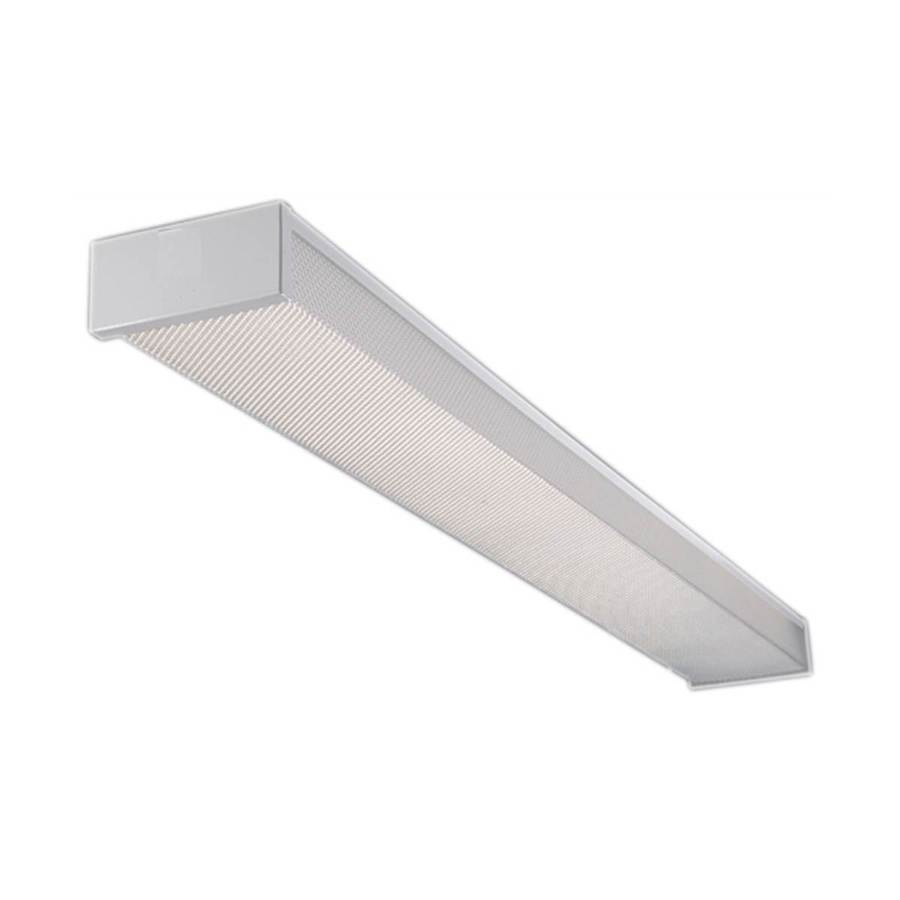
More practically... By the time you go to the trouble and expense to "convert" these fixtures, and STILL wind up with a "kludged at best" finished product, you would near-certainly be better off buying and installing some inexpensive fixtures which are really designed for surface mounting, such as:

http://www.homedepot.com/p/Lithonia-Lighting-2-Light-Utility-Light-3348-2L32W-WRAP/100654395
92eeea00-35d4-4de6-9cd6-11e57dd051fc_300.jpg


http://www.homedepot.com/p/Lithonia...hite-Fluorescent-Light-Fixture-3324/202192968
39000172-ebf4-4c9c-8544-fe78d1fd119c_300.jpg


http://www.lowes.com/pd_163697-337-WP232RLU_0__?productId=3181895
080083518647.jpg


http://www.lowes.com/pd_336745-13537-336745_0__?productId=3686312
037949005377.jpg


http://www.lowes.com/pd_384285-337-WP217RNKLLU_0__?productId=50077497
080083615506.jpg


jdsac

Well-known member
Joined
Mar 2, 2011
Messages
565
I used troffer lights suspended about 1- 1 1/2" inches from the truss & mounted
90 degrees (sideways) to the truss. That way the ballast area is between the trusses (heat). Using the new small electronic ballasts the ballast area gets aprox 20 degrees over ambient temp measured with an IR gun. The air gap & ballast location seems to work.
 
To avoid these ads, REGISTER NOW!

JoeFin

Well-known member
Joined
Sep 13, 2013
Messages
717
Location
NorCal - where the Rednecks Race
"Safe", by what yardstick?

I can tell you this much: It's a safe bet that, being troffer-type fixtures designed for drop-in installation in suspended ceilings, they are neither designed nor rated for direct surface mounting, let alone insulation-contact. From that, it follows that they will NOT dissipate heat as well when so-mounted, as they would if installed in the manner they were designed for. Whether any of this is a serious PRACTICAL problem is anyone's guess -- and "guess" is all we can do.


Being the self proclaimed expert you are 2many - perhaps you can cite the UL, IEEE, or NEC codes regulating thermal protection on fluorescent lighting he would be violating. Some thing other then your typical "Its common sense" answer you like to use since your advising some one how to spend their money

Waiting in nervous anticipation for this one
 
Last edited:

cparcell

Well-known member
Joined
Nov 21, 2013
Messages
77
Location
hillsboro ohio
i just bought 15 2x4 troffers with electric balast t8 triple bulb setup, i will be flush mounting them in my ceiling between the truses with a 2x4 built frame from truss to truss. i can say at no point do i fear that the will be a spot for ignition in my garage. yours being t12 magnetic ballast will produce more heat but you can reduce the heated area with some heat mat or heat shielding if you are concerned. i will not be laying insulation directly over mine as my shop is already insulated in the roof and walls. i did double my insulation on the shop walls and will batt insulate the rest of the ceiling but those wholes where the troffers will drop down.
 

Kevin C

Well-known member
Joined
Aug 4, 2011
Messages
1,653
Location
Portland OR
The label of a ballast will have some good info on it. Some older magnetic ballasts did not have temperature protection. Combine that with the lower efficiency and heat from failing bulbs and you can have a problem.

Any off the shelf ballast you purchase should have a UL / NRTL logo on it. (NRTL is nationally recognized test lab)

Significant things to look for:

Residential or commercial:

High frequency electronic ballasts have to meet FCC part 18 rules for EMI.

In those specs there are two categories, residential and commercial. Residential ballasts have tighter EMI standards.

EMI might matter if you are trying to listen to very weak radio station. I have a commercial fixture in my home shop... No noise issue's.

Why would you ever use a commercial ballast? They have power factor factor correction.

Power factor might matter if you have a lot of lights on one circuit. Both will draw a similar amount of power, but the apparent power is higher on a residential ballast. Basically, you can't run as many lights on one circuit.

Ballast factor: Ballasts come in several ballast factors. That controls how brightly the lamps are lit. I recently upgraded a fixture that had a .87 ballast factor with a unit that has a factor of 1.2. It was a pretty dramatic difference and helped out in an area with wide fixture spacing. With florescent lights, ballast factor is not a major factor in lamp life (On off cycles and starting method is a factor).

On the label you should see a "Class P" rating. That indicates that the ballast will shut down if its temperature goes above 105°C.

If a fixture overheats it shuts off... Tested by UL.

View media item 34159
http://www.garagejournal.com/forum/showthread.php?p=3542550#post3542550

Ballast Upgrade Post
 
Last edited:

JoeFin

Well-known member
Joined
Sep 13, 2013
Messages
717
Location
NorCal - where the Rednecks Race
1 more point of contention I was wishing would be explained more thoroughly

Fluorescent fixtures are NOT inherently forbidden from being in contact with insulation or sheetrock or Boxed / Frenched into the ceiling

Fact is MOST if not all commercial grade fluorescents carry the IC rating, which means it is code compliant to be in contact with insulation.
 
To avoid these ads, REGISTER NOW!
Top Bottom