To avoid these ads, REGISTER NOW!

Flush or Surface Mounted Subpanel and how to transition through drywall?

RickDel

Active member
Joined
Nov 24, 2011
Messages
39
Hello, I'm planning to install a subpanel in my attached garage. I have 200amp service and I want to put a 100amp subpanel in my attached garage, approx 60' away so I can run a plasma cutter and air compressor. Like I said, I'm still in the planning phase, but not sure how to wire this. I think I'm going to use 1-1-1-3 Al SER across the ceiling in my unfinished basement, up through the floor plate and between a pair so studs in my garage.

My biggest question at this point is whether to do a flush or surface mounted subpanel??? And how to make the transition through the drywall and into the conduit look professional.

I'm haven't purchased anything, but is it normal to feed the SER into the back of a subpanel or will I need to enter from the top or bottom? I don't know how to transition from behind the drywall to the conduit. Thus my main question, should I surface mount or flush mount? And either way, how do I transition through the drywall and into the conduit? (I'm thinking a junction box but not sure).

Can you guys offer any suggestions?

Thanks - Rick
 
To avoid these ads, REGISTER NOW!

ard

Well-known member
Joined
Feb 16, 2015
Messages
4,391
Location
Sierra Foothills... California
Welcome!

Couple of comments. WHne you run the SER in the basement, tuck it up out of the way- that way if anyone ever finishes the basement they don't need to re-route that cable.

Sub-panel: Design preference. Either way is fine. Importantly how do you plan on wiring everything ELSE? Surface EMT or will you be running behind the Sheetrock. If you are running EMT on the surface, put the panel on the surface. You can run the cable into the back of the panel, use a clamp. Done.

You can also come up into the wall cavity, then through the wall below the panel, into an LB, then up into the bottom of the panel.

SO, you running the rest of the wiring surface or in the wall?
 
OP
R

RickDel

Active member
Joined
Nov 24, 2011
Messages
39
ard, Thanks for the reply!

I was going to tuck the SER as much as possible, but due to water pipes and duct work I'll need to run against my floor joist for half the run.

I want to run the EMT on the surface of the garage walls. So, SER up through the back of the panel and then EMT off the sides / bottom of the panel for the circuit branches (only planning to have two 50amps receptacles).

Do you see any advantage to running through the back versus coming through an LB (either above or below the panel)? And what about feeding going through the top versus the bottom?

Lastly, I read some people talking about mounting panels half in / half out of the wall. Do you think I should consider that too? (haven't picked up my panel yet, so not sure that's even an option)

Thanks Again!
 

-Brent-

Well-known member
Joined
Dec 23, 2009
Messages
4,709
Location
Utah
I want to run the EMT on the surface of the garage walls. So, SER up through the back of the panel and then EMT off the sides / bottom of the panel for the circuit branches (only planning to have two 50amps receptacles).

Do you see any advantage to running through the back versus coming through an LB (either above or below the panel)? And what about feeding going through the top versus the bottom?

I'd go surface mount, if you stick the the top part of the quote.

I'd think the only advantage(s) of coming through the back is neatness/aesthetics (from the outside viewpoint) and one less fitting to buy.

There are some really knowledgeable folks in this section. They helped me a ton and, in fact, I should have taken their advice more seriously because I had to learn the hard way on a couple items when wiring my shop.

Best of luck to you! And please share your progress and pics of your work. Those threads are always helpful down the road.
 

ddawg16

Well-known member
Joined
Jul 11, 2008
Messages
21,005
Location
S. California
I'm a big fan of flush....You don't have to use conduit to protect the wire....and it looks a whole lot better.

If you plan ahead, you will never have to go back into the wall to run wire.
 

Want2race

Well-known member
Joined
Nov 8, 2008
Messages
217
PLus 1 for flush.

I dont see the point of drywall if you are going to run conduits etc on top ... Opinions will vary though
 

NWOhioChevyGuy

Well-known member
Joined
Feb 20, 2007
Messages
1,930
Location
Buckeye Hill (Morenci, MI)
As I understand it this is an already finished garage you are adding a panel to correct?
Top or bottom feed would depend on the panel, I would assume.

However if you want to have your circuits out the bottom I would top feed it with an LB for ease of mounting & running wire. However this requires a few extra feet.

IF it were me I would: A) Surface Mount B) Bottom feed with LB & C) run my circuits to the left or right of the panel if only two were being run.
 

ard

Well-known member
Joined
Feb 16, 2015
Messages
4,391
Location
Sierra Foothills... California
ard, Thanks for the reply!

I was going to tuck the SER as much as possible, but due to water pipes and duct work I'll need to run against my floor joist for half the run.

I want to run the EMT on the surface of the garage walls. So, SER up through the back of the panel and then EMT off the sides / bottom of the panel for the circuit branches (only planning to have two 50amps receptacles).

Do you see any advantage to running through the back versus coming through an LB (either above or below the panel)? And what about feeding going through the top versus the bottom?

Lastly, I read some people talking about mounting panels half in / half out of the wall. Do you think I should consider that too? (haven't picked up my panel yet, so not sure that's even an option)

Thanks Again!


Never heard of the half and half...sounds like the worst of both worlds... ;)

Id run it into the back, cleaner. No need for an LB it sounds like. (If the wall cavity was inaccessible- cross blocking, something else- and you were just punching through it, then sure put a LB and turn onto the surface.

My shop is run with EMT in the walls, all flush. But I had the luxury of building it from scratch.
 
Last edited:

Norcal

Well-known member
Joined
Mar 16, 2008
Messages
13,753
Never heard of the half and half...sounds like the worst of both worlds... ;)

Id run it into the back, cleaner. No need for an LB it sounds like. (If the wall cavity was inaccessible- cross blocking, something else- and you were just punching through it, then sure put a LB and turn onto the surface.

My shop is run with EMT in the walls, all flush. But I had the luxury of building it from scratch.

It is the worst of both, I would mount it in the wall & add a 1" or 1 1/4 PVC chase to the attic for future changes, in 24 years only added 2 circuits to the panel because I bought a welder, could have used the existing one for a buzz box but did not. (11 years ago bought a MillerMatic 251.)
 
OP
R

RickDel

Active member
Joined
Nov 24, 2011
Messages
39
Thanks guys.. Lots of good advice!! (I would have replied sooner, but my instant email notification isn't working)

I bought my Square D QO 100amp subpanel today.

I might try to feed it from the back, but just depends if I can fish the SER through the hole (probably going to be hard). If I do, do you think I'll need some type of bushing or protection when the SER crosses the drywall? It will by secured at the box but I'm not sure if still need some protection there.

This is probably my best option:
IF it were me I would: A) Surface Mount B) Bottom feed with LB & C) run my circuits to the left or right of the panel if only two were being run.

Probably irrelevant, but do you guys put your LB's near the sub or closer to the floor and run some conduit up and into the box? I won't be able to bend any large conduit (if necessary).

BTW, you'd be surprised how hard it is to find pictures of surface mounted subpanels on the internet. I see a lot of pics, but most are close ups and you can't see the conduit.

For the guys suggesting Flush mount. I'm not opposed to that, but I"m definitely doing surfaced mounted EMT, so how would I bring the conduit out of the box? I assume I'd have to use junction boxes or cut and patch drywall.

I don't mind the EMT. It's only going to be two short runs and I kinda like the look in the garage.

Last thing, my run is approx 60' from my main to the sub. EVERYTHING I've read says I need to use #3 Copper or #1 Aluminum. I stopped by the electrical supply store to get a price and the salesman said I only needed to use #2 aluminum. I'm going to try to get an answer from an inspector, but what do you guys think?

Thanks Again! - Rick
 

Norcal

Well-known member
Joined
Mar 16, 2008
Messages
13,753
Thanks guys.. Lots of good advice!! (I would have replied sooner, but my instant email notification isn't working)

I bought my Square D QO 100amp subpanel today.

I might try to feed it from the back, but just depends if I can fish the SER through the hole (probably going to be hard). If I do, do you think I'll need some type of bushing or protection when the SER crosses the drywall? It will by secured at the box but I'm not sure if still need some protection there.

This is probably my best option:


Probably irrelevant, but do you guys put your LB's near the sub or closer to the floor and run some conduit up and into the box? I won't be able to bend any large conduit (if necessary).

BTW, you'd be surprised how hard it is to find pictures of surface mounted subpanels on the internet. I see a lot of pics, but most are close ups and you can't see the conduit.

For the guys suggesting Flush mount. I'm not opposed to that, but I"m definitely doing surfaced mounted EMT, so how would I bring the conduit out of the box? I assume I'd have to use junction boxes or cut and patch drywall.

I don't mind the EMT. It's only going to be two short runs and I kinda like the look in the garage.

Last thing, my run is approx 60' from my main to the sub. EVERYTHING I've read says I need to use #3 Copper or #1 Aluminum. I stopped by the electrical supply store to get a price and the salesman said I only needed to use #2 aluminum. I'm going to try to get an answer from an inspector, but what do you guys think?

Thanks Again! - Rick

#2 AL is only good for 90A.
 
OP
R

RickDel

Active member
Joined
Nov 24, 2011
Messages
39
n20junkie, do you run your cables in the walls or external? If externally, how do you transition out of the panel and through the drywall? Thanks
 

BreeStephany

ALLIANCE MEMBER
Joined
May 19, 2012
Messages
851
Location
Oregon
If you are doing surface mounted EMT, definitely SURFACE (accidentally wrote flush originally... stupid brain) mount your panel, as it will all look cleaner in the end.

I know you said you just bought your panel, but by chance did you buy an unpunched can, or did you buy a can that already has knockouts in it?

The reason I ask, is because if you are doing surface mount conduit, being able to place your conduit exactly where you want will make things look much nicer in the end, rather than having to go with a can that already has knockouts in place.

As for where the SER enters the back of the box, use an SER cable clamp with the clamp portion on the outside / back of the box and the locknut on the inside of the box. Put a plastic bushing on the inside after the locknut.

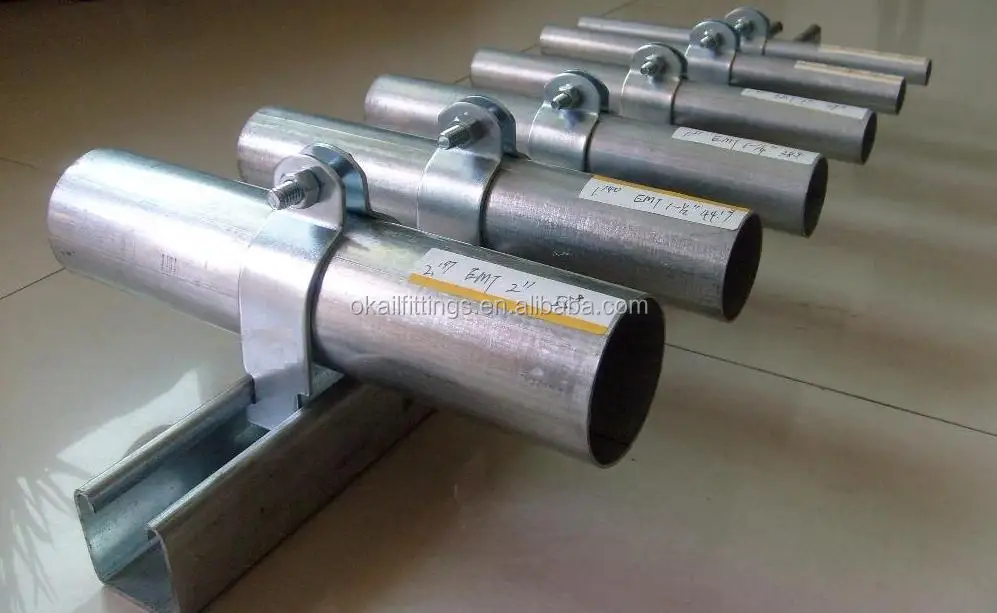
When you run your conduits out of the panel, I highly recommend using unistrut and unistrut clamps for clamping them. The added benefit of using unistrut at the panel is that you more than likely won't have to do offset bends into the panel and have clean runs up, down or sideways out of the panel.

When it comes to LBs or other fittings, I try to keep fittings to a minimum and would much rather place a bend than use an LB, mostly for ease of pulling conductors, but also because it will end up looking a lot better once its all done.

For conduits up to 1", I highly recommend bending the conduit with a bender, rather than using any prefabricated 90's, anything over 1", prefabbed 90's are fine, as you will likely not have too many runs over 1". Conduit benders are cheap and there are a lot of good resources out there to help you figure your offsets and how to use your bender.

Just my two cents.
 
Last edited:
To avoid these ads, REGISTER NOW!
OP
R

RickDel

Active member
Joined
Nov 24, 2011
Messages
39
I know you said you just bought your panel, but by chance did you buy an unpunched can, or did you buy a can that already has knockouts in it?

If I understand correctly, the box is stamped but no holes yet. There's stamped holes on all sides.

use an SER cable clamp with the clamp portion on the outside / back of the box and the locknut on the inside of the box. Put a plastic bushing on the inside after the locknut.

Will Do!

I highly recommend using unistrut and unistrut clamps for clamping them.

I found a couple pics online, but still researching this.

I try to keep fittings to a minimum and would much rather place a bend than use an LB

If I go flush, than I think I can make a clean entry without the LB. I've just got to figure the exit from behind the drywall to the EMT.

or conduits up to 1", I highly recommend bending the conduit with a bender

I already have my benders and I'm ready to waste some conduit. haha....

Thanks
 

homebuilt burner

Well-known member
Joined
Dec 8, 2014
Messages
1,763
Location
central Wisconsin
I mounted mine flush to the drywall. then I ran a short piece of conduit and mounted a pulling box/junction box that sticks through the drywall. That way if I want to add circuits later I can drill a hole in the pulling box to run the conduit through or put a 220 outlet in it.
 

rharman

Well-known member
Joined
Apr 22, 2012
Messages
8,786
Location
SoCal
< snip >
If you are doing surface mounted EMT, definitely flush mount your panel, as it will all look cleaner in the end.
< /snip >

Maybe I'm misunderstanding, but this sounds counter-intuitive. If the box is flush mount and the conduit surface mount, then you have to do a 90 degree turn to go into the wall cavity and another 90 to turn back into the box.

Am I missing something?
 
OP
R

RickDel

Active member
Joined
Nov 24, 2011
Messages
39
90 degree turn to go into the wall cavity and another 90 to turn back into the box.

Well if I understand your question, I'll be coming up through the wall cavity. The feeder will enter the panel from the back and the circuits will exit through the drywall in EMT to the circuits.

I was just not sure how the EMT exited through the drywall. I spoke to an electrician today who said he always uses a spring loaded access panel. However, that seems like too much work. I might as well surface mount if I'm going to do that (it's a garage).
 

BreeStephany

ALLIANCE MEMBER
Joined
May 19, 2012
Messages
851
Location
Oregon
Maybe I'm misunderstanding, but this sounds counter-intuitive. If the box is flush mount and the conduit surface mount, then you have to do a 90 degree turn to go into the wall cavity and another 90 to turn back into the box.

Am I missing something?

Nope... I had a stupid brain moment and wrote flush instead of surface. I meant to write surface
 

BreeStephany

ALLIANCE MEMBER
Joined
May 19, 2012
Messages
851
Location
Oregon
Quote:
I know you said you just bought your panel, but by chance did you buy an unpunched can, or did you buy a can that already has knockouts in it?

If I understand correctly, the box is stamped but no holes yet. There's stamped holes on all sides.
Yes, the stamped back part of the box, that holds the bus bars and breakers, you can buy without any stamping in it. Your stamped box will work but generally, an unstamped box looks much cleaner.

Quote:
I highly recommend using unistrut and unistrut clamps for clamping them.

I found a couple pics online, but still researching this.
cush-a-clamps1.png


16-Base-Strut-7-large.JPG


HTB1ZfIuIVXXXXXGXXXXq6xXFXXXc.jpg

Here are a few examples of unistrut being used for clamping conduit. You just surface mount the unistrut by screwing the unistrut, either deep or shallow depending on clearance required, with long screws or lags depending on load and fender washers to the studs through your sheetrock and then use unistrut clamps to clamp the conduit to the unistrut.


Quote:
I try to keep fittings to a minimum and would much rather place a bend than use an LB

If I go flush, than I think I can make a clean entry without the LB. I've just got to figure the exit from behind the drywall to the EMT.
I meant to say surface mount originally. If you surface mount, you don't need an LB, just come in through the back of the box in a location that permits, based on where your lugs are positioned on the panel.

Quote:
or conduits up to 1", I highly recommend bending the conduit with a bender

I already have my benders and I'm ready to waste some conduit. haha....

Thanks
Sounds good. I loved conduit bending and its definitely something I miss doing these days. Conduit is cheap, so try to make everything as clean and uniform as possible, even if it means wasting a stick or two of conduit.
 
OP
R

RickDel

Active member
Joined
Nov 24, 2011
Messages
39
This is CRAZY!! Like I said, EVERYTHING I read says I need to use #1 Aluminum AWG for this project. The guy at the electrical supply store said I only needed to use #2 aluminum and that's what all the electricians were using. Than, I asked and you guys and Norcal confirmed:

#2 AL is only good for 90A.

I just spoke to my inspector, who said "you only need #2 Al for a 100amp subpanel".

What the hell??? I'm never going to drawl 100amps anyway, but I wonder if I should run #2 Al and just put a smaller breaker in my main (like an 80amp) to be safe?

Thanks
 

Jamie V

Well-known member
Joined
Jun 10, 2012
Messages
1,059
Location
Atco, NJ
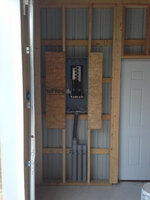
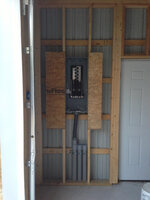
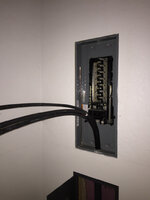
I plan to run surface mounted conduit in my garage so I had the same dilemma. I ended up mounting my panel inside the wall (flush mount) then I installed a box above it to run the conduit off of (kinda a transition from behind the wall to outside the wall) I'm not finished yet but here is what I have so far.

536d7d9f1e07f2c3946fa180eeb09bb0.jpg

89067b66f6b7be81e222c2a6b7916011.jpg

0fb9b1cbd1a71d8bc5ab1f9cf463b126.jpg
 

Attachments

  • 536d7d9f1e07f2c3946fa180eeb09bb0.jpg
    536d7d9f1e07f2c3946fa180eeb09bb0.jpg
    696.7 KB · Views: 2
  • 89067b66f6b7be81e222c2a6b7916011.jpg
    89067b66f6b7be81e222c2a6b7916011.jpg
    895.7 KB · Views: 2
  • 0fb9b1cbd1a71d8bc5ab1f9cf463b126.jpg
    0fb9b1cbd1a71d8bc5ab1f9cf463b126.jpg
    558 KB · Views: 2

Todd.Brock

Well-known member
Joined
Jul 15, 2008
Messages
4,250
Location
Cincinnati
RickDel- I believe that there is a technicality that limits #2 to 90 amps. I recall that there is something that de rates it, possibly b/c it's a subpanel. Hopefully NorCal will jump in.

I used 2-2-2-4 SER for my basement subpanel based on recommendation from a commercial electrician. And ran it in the drywall across garage down common wall into basement and then into a sub panel. in basement. The electrician I used never said anything about a 90amp limit. It had a 100a breaker. Way over kill for a basement, but with jacuzzi tub and heater, can lights, microwave circuit at wet bar, etc. do it once and never worry about it. I'm not sure I would ever get to 90 amps in a basement.
 

wyliesdiesels

Well-known member
Joined
Aug 14, 2012
Messages
19,998
Location
Modesto, CA
This is CRAZY!! Like I said, EVERYTHING I read says I need to use #1 Aluminum AWG for this project. The guy at the electrical supply store said I only needed to use #2 aluminum and that's what all the electricians were using. Than, I asked and you guys and Norcal confirmed:


I just spoke to my inspector, who said "you only need #2 Al for a 100amp subpanel".

What the hell??? I'm never going to drawl 100amps anyway, but I wonder if I should run #2 Al and just put a smaller breaker in my main (like an 80amp) to be safe?

Thanks

Its a common misconception that #2 al can do 100a for every application. If u look at T310.15(b)(16) it is rated for 90a in the 75* c column.

The confusion comes in because code allows #2 al to be breakered at 100a IF it feeds the entire load of a dwelling...
 
To avoid these ads, REGISTER NOW!
Top Bottom