To avoid these ads, REGISTER NOW!

Foam Insulation on a Knee Wall

TractorJeff

Well-known member
Joined
Dec 8, 2013
Messages
3,309
Location
Elkhorn, WI
When installing Foam Insulation on a Knee Wall does the Aluminum Face go against the Cold Concrete to reflect Cold or does it go toward the room to reflect Heat? It will be covered by a 2x12 Plank when finished.

What is the typical way to attach the Foam Sheet to Concrete?
I am waffling between shooting Concrete Nails with Washers or Liquid Nails? It is old Concrete so I am thinking it might be hard to shoot Nails in to it.
 
To avoid these ads, REGISTER NOW!

slowtwitch73

Well-known member
Joined
Apr 18, 2019
Messages
5,876
Location
Hellgate
If heating the space the foil side, the paper side, etc always faces the heated space.

I just went through a box of Liquid nails on a project and wish I had gone with another adhesive like Sika. The LN takes a long time to set,and over the course of tearing stuff down, I've found it doesn't hold that well. If putting up panels you may need to brace them to keep them from pulling as the LN dries.
 
OP
T

TractorJeff

Well-known member
Joined
Dec 8, 2013
Messages
3,309
Location
Elkhorn, WI
I'll look to see if SIKA has something compatible.
Yes its heated.
Just questioning the effectiveness of the Foil when its behind 1.5 inches of Wood.
That is why I am wondering why not to put it against the Concrete to reflect the cold from entering.
 

pvfjr

Well-known member
Joined
Aug 6, 2015
Messages
101
Location
Oregon
The foil on insulation has two purposes. It servers as a barrier to radiant heat transfer, but it also can function as a vapor barrier. Vapor barrier placement and strategies vary by geographic location, but I believe in most places it goes toward the heated space just as slowtwitch73 has advised above.

For radiant heat transfer, you slow it down by having a surface with lower emissivity. Foils usually have a very low emissivity, especially when highly polished. The fun part is, it really doesn't matter which way it faces when you do the math. You can think about "reflecting cold", but it's technically a matter of not emitting the heat off into cold space. The best way to make a radiant barriers effective is to actually give them a little air space on either side. If a low-emissivity surface is pressed tightly against another surface, conductive heat transfer takes over instead.
 

dmdc411

Well-known member
Joined
Aug 28, 2016
Messages
132
Location
Mn
My house has high density foam over the concrete wall, then, 2 x 4 studded knee wall with bat insulation. Don't remember where the plastic vapor barrier was located, but there is a gap along the block wall. I'm guessing to all moisture to drain down.. Mines is a little drafty, so when my son moves out in the fall, I'm removing the sheetrock to investigate!

Sent from my SM-G970U using Tapatalk
 

Toyomech

Well-known member
Joined
May 31, 2010
Messages
67
Location
Delaware
Any vapor barrier should go towards the predominantly warm side. I get your meaning but cold cannot be reflected, cold is just the absence of heat. We generally will use a ramset tool, nails with washers, but you can also use adhesive or can foam which is a very powerful adhesive.
 
To avoid these ads, REGISTER NOW!

slowtwitch73

Well-known member
Joined
Apr 18, 2019
Messages
5,876
Location
Hellgate
I agree that can foam is a strong adhesive... similar to Gorilla Glue I suspect, but how do you keep it from expanding and moving the rigid foam off the wall?
 

PWC Repair

Well-known member
Joined
Dec 27, 2012
Messages
3,177
Location
Arkansas
I agree that can foam is a strong adhesive... similar to Gorilla Glue I suspect, but how do you keep it from expanding and moving the rigid foam off the wall?

Don't use the triple expanding stuff! Use the gaps and cracks version. Put it on, let it expand for 15 seconds or so, THEN press the foam up against the surface. I have 3" foam 'glued' like this inside my whole shop.
 

K'ledgeBldr

Well-known member
Joined
Aug 22, 2011
Messages
1,925
Location
Johns Creek, GA
Had to do some head scratching there-

You’re referring to a “Stem wall” not a “Kneewall”.
If you’re going to use foam ridge board insulation against a concrete wall- I’d use no radiant barrier at all. The net gain is not worth the expense for what you’re doing. I would be more concerned about how much (thickness) foam board you plan to use. Then there’s the question of the stem wall itself- what is on the exterior; air or earth? If there is earth, is it waterproofed with a membrane? And the height of this wall is only 12”?

There’s no ROI here-
 

slowtwitch73

Well-known member
Joined
Apr 18, 2019
Messages
5,876
Location
Hellgate
I was faced with the same issue recently. I just framed over the wall and put in craft faced bat insulation. Higher R than any rigid.
 

toyotadriver

Well-known member
Joined
Dec 30, 2010
Messages
1,586
Use regular canned foam to stick it to the concrete. WAY better than foam glue in a tube.
 
OP
T

TractorJeff

Well-known member
Joined
Dec 8, 2013
Messages
3,309
Location
Elkhorn, WI
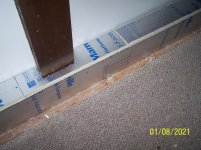
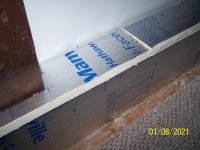
OK! See 2 photo's of Insulation project.
This PolyIso Board has Plastic on one side currently towards Cold and Foil on the Interior side.
Want to put it up tight to reduce Pests from using the enclosure as a Highway/Nesting area.
 

Attachments

  • Foam Board Close.jpg
    Foam Board Close.jpg
    147.5 KB · Views: 27
  • Foam Board Distant.jpg
    Foam Board Distant.jpg
    152.7 KB · Views: 16
To avoid these ads, REGISTER NOW!
Top Bottom