To avoid these ads, REGISTER NOW!

Foam under concrete

FEDER

New member
Joined
Apr 3, 2006
Messages
2
Location
Bothell WA
I live in Washington state, north of seattle. Temperature here is fairly mild.
70s in summer and 30s t0 50s in winter. Maybe a month a year high teens to 20s. Rarely below that.
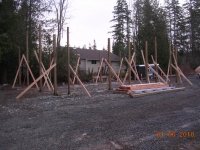
Would it be beneficial to put 2" blue foam board under the concrete. Could I gain 5 to 10 degrees maybe if I did? We are planning to insulate well and sheet rock walls and lid. Thanks for any input. FEDER
 

Attachments

  • SHOP BUILD 003.jpg
    SHOP BUILD 003.jpg
    149.7 KB · Views: 29
  • SHOP BUILD 009.jpg
    SHOP BUILD 009.jpg
    147.7 KB · Views: 26
To avoid these ads, REGISTER NOW!

BLUBAYOU

Well-known member
Joined
Mar 25, 2008
Messages
163
Not sure if I would bother investing in it. Most of your heat is being lost up and out, not through the floor. If you did insulate beneath the floor, it'd be good to insulate the sides of the floor, too, since they will also lose heat to the surrounding soil.
 

Sharps

Well-known member
Joined
Aug 23, 2009
Messages
153
Depending on type of footing/walls/slab/turn downs that are used in your area you may or may not see benefit. I would contact at least two of the most knowledgeable concrete finishers and all of the senior sales consultants for commercial work for your local concrete suppliers and ask what is typical on standard and custom jobs and use that as a comparison.

I never trust the opinion of one person regarding construction methods as there are too many ways to achieve the same goal.

Just my .02
 

bgott

Well-known member
Joined
Oct 31, 2005
Messages
3,512
Location
Houston, TX.
Wouldn't there be a possibility of the foam deteriorating and leaving a void under the slab? I would think that you would want the concrete slab to set directly on the compacted dirt for reinforcement, on top of a vapor barrier, of course.
 
To avoid these ads, REGISTER NOW!

Rich

Well-known member
Joined
Jan 31, 2005
Messages
177
Location
Lake Stevens, WA
I'm not sure this is relevant to your situation or not, but we put down pink foam in my garage. It was recommended by the company I got the radiant heat package from.

462448586_6CnuA-M.jpg


Have you considered radiant heat? It truly rocks and isn't that expensive. My garage is a constant 58 degrees. 30's to 50's sounds pretty mild until you're out working in it. The radiant heat gets rid of the humidity too.
 

Teikas Dad

Well-known member
Joined
Dec 13, 2009
Messages
132
Location
Connecticut
I used foam on mine...but in a different configuration. I went with a Frost Protected Shallow Foundation. I was trying to figure a less expensive way of pouring a foundation. I saw one idea where a trench was dug 16" wide by 4' deep. The trench was then filled with concrete and after it set a 2X6 form was set on top and a slab poured. I mentioned that to my town building inspector and told me I could do it that way, but he suggested a Frost Protected Shallow Foundation. Basically it's a monolith foundation, but it's only 2' deep. It has 1" of extruded polystyrene foam on the outside edges and horizontal at the bottom of the foundation. I had a 20X32 foundation excavated and poured for $5000.00 by a masonry contractor. He poured 20 yards of concrete into it, reinforced with wire mesh, compacted trap rock and plastic vapor barrier, all tied into an existing foundation on my barn. If I wanted 4' frost walls with a floating floor it would have cost me another $2000 or so.

I wasn't sure if it would be safe from the frost, but when I did all the calculations in the manual it works out that I didn't need the horizontal insulation...I added it anyway. Apparently they use these types of foundations in areas much colder than where I'm at and they work.

Here's the info on the foundation setup: http://www.toolbase.org/PDF/DesignGuides/revisedFPSFguide.pdf
 

galwaytt

Well-known member
Joined
Oct 16, 2009
Messages
94
Location
Galway, Ireland
my 0.02, as they say, but generally, seeing as we treat our garages as an extension of the house, and spend a lot of time in them, then I would build the floor to house standard, but with durability.

Example, here, even though it's a mild climate, you have to have a minimum of 50mm of insulation under your floor. Contrary to what you might think, yes, your floor does 'radiate' heat downwards to subfloor/ground, if you don't. Simple physics - if the air in the garage is warm, it will have a somewhat heating effect on the slab, and by conduction.........the ground under it. This is more felt by the floor being 'cold' than by your floor being a 'warm path', out...........same thing, but perception is different.

Now, I'm a big UFH fan, and have had it since 1997. In my new build, in 2007, I put it everywhere: in the house, basement, GF/FF,and the garage.

The requirement here is that if using UFH, then you must now put in a minimum of 125mm of insulation. I've done this, and in some places (the utility room), I have 200mm of it. And boy is it noticeable.

The company I work for HERE uses DOW Styrofoam, more particularly their LB-X product, which is a structural grade insulation. This is what I used in my own build. I've seen 'earth-sheltered' houses built with it under the structural slab, to a thickness of 300mm, with 400mm of concrete over, and the whole concrete house built on top of that - it's that strong.

You simply can't have enough insulation, UFH heating, or not, and it's a much, much better investment than heaters, and is a once-off cost.

Oh yeah, +1 on the humidity thing too: a nice side-effect. No worries about any of your veh's or tools getting rusty or corroded for evermore !
 
Last edited:
To avoid these ads, REGISTER NOW!
Top Bottom