To avoid these ads, REGISTER NOW!

Foldable Workbench Issue

Slowbra

Well-known member
Joined
Jun 5, 2012
Messages
276
Location
NC
I finally got the urge to build a foldable workbench for my garage this week. After searching many threads on here and talking with the folks at the lumber store I thought I had learned enough to start my very first wood working project.

I modeled my workbench after seeing an example they had at the lumber store. However, the table I built is a little taller and wider. It is very unstable and I am looking for advice on how to add stability while maintaining folding/portability.


I used:
3/4" hardwood plywood as the top.
Built a frame out of 2x4s and attached the top to it
Attached a 2x4 to the top, which I then mounted the legs onto with a door hinge
Built a support to attach a 2x4 between the legs for stability.
Pictures and a video are attached.

Any suggestions on how best to correct the issue and still keep it foldable/portable?
 
To avoid these ads, REGISTER NOW!
OP
S

Slowbra

Well-known member
Joined
Jun 5, 2012
Messages
276
Location
NC
Here are some pictures and a video of my project and issue.

Video: http://s233.photobucket.com/albums/ee144/slowbra98/Stuff/?action=view&current=IMG_1731.mp4

photo1.jpg


photo2.jpg
 

geologist

Well-known member
Joined
Dec 14, 2011
Messages
5,326
Drill a round hole in each of the flat crossmembers and then cut a length of board (perhaps a furring strip) long enough to bridge them, using dowels on either end to fit in the holes you placed in the crossmembers.

Your connecting piece should resemble something like this:

==||======================||==
 

Brian_B_

Well-known member
Joined
May 12, 2012
Messages
505
Location
North Central, AR
No clue on the folding part of it..but without some sort of diagonal bracing to keep it from moving..it will move. My work bench (not folding) wobbled the same until the diagonals were screwed in.
 

tube_guy

Well-known member
Joined
Jan 21, 2009
Messages
749
How does it fold up? Are your stretchers also hinged or are they removed for the legs to each fold inward?

If you cut a few 2x4s so they fit between the legs very tightly, and then push them between the legs using a mallet so the 3.5 inch dimension of the boards are vertical, that would certainly tighten it all up a bit. The fit would have to be tight but you could put those boards up underneath the table or down near your stretchers. To fold the table up, you'd use your mallet to remove the boards. Of course, this will stress the rest of your joinery work and the strength with this solution will depend on the strength of the rest of your joinery.

If that were my bench, I would remove those stretchers and get rid of the metal brackets or hinges that hold them in place. I'd get four 2x4s for stretchers, cut to exactly the same length. I would cut a half inch dado slot in the middle of one face on each board. That way when two of the stretchers are stacked face to face, the dado slots line up and create a square hole through their entire length. Then I'd screw each pair of stretchers together that way. Then I'd drill a hole through each leg, to line up with the dado holes that pass through the stretcher pair. Then I'd get a piece of threaded rod that passes through the stretcher pair and the two legs and I'd use nuts and washers to draw it all together nice and tight. That would be quite sturdy, but you'd have to remove the stretchers to fold the table up.

I’d also put another 2x4 stretcher lap jointed to the side legs so that the legs fold inwards as a pair, not individually. That would add some stiffness front to back too. I’d probably put these below the removable stretchers if that were possible. Putting the removable stretchers vertically in the middle of the legs would add the most side to side stiffness, I think.

In general, with woodworking, metal brackets are a bad thing. The metal normally fails by bending, and those bending stresses get large very quickly. Less metal and more wood to wood joinery is almost always much stronger. It tends to be more bulky, but geometry wins strength contests almost all the time. The setup with the hinges holding the tops of the legs won’t be that strong, so you really need to get your strength with the stretchers.
 
OP
S

Slowbra

Well-known member
Joined
Jun 5, 2012
Messages
276
Location
NC
Drill a round hole in each of the flat crossmembers and then cut a length of board (perhaps a furring strip) long enough to bridge them, using dowels on either end to fit in the holes you placed in the crossmembers.

Your connecting piece should resemble something like this:

==||======================||==

I attempted to draw (in MS Paint) what you suggested. Let me know if my understanding is correct.

photo3.jpg
 

Brian_B_

Well-known member
Joined
May 12, 2012
Messages
505
Location
North Central, AR
This is not the same, but I made some folding sawhorses. I agree the metal door hinge is not great, but the angled legs (using a piece of chain to keep them from going too far) work well. No wobble. The horses do not fold totally flat, but save a ton of space even so.

Your on the right track with triangulation.

horses.jpg
 
OP
S

Slowbra

Well-known member
Joined
Jun 5, 2012
Messages
276
Location
NC
How does it fold up? Are your stretchers also hinged or are they removed for the legs to each fold inward?

Currently, the legs fold inwards (individually). The stretchers slide into brackets, which allows them to be removed so the legs can fold inwards.

If you cut a few 2x4s so they fit between the legs very tightly, and then push them between the legs using a mallet so the 3.5 inch dimension of the boards are vertical, that would certainly tighten it all up a bit. The fit would have to be tight but you could put those boards up underneath the table or down near your stretchers. To fold the table up, you'd use your mallet to remove the boards. Of course, this will stress the rest of your joinery work and the strength with this solution will depend on the strength of the rest of your joinery.

This is what I was attempting to do with the two stretchers that I have. If I understand you correctly, you recommend having two additional stretchers that fit very tightly between the legs. These can be pressed in with a mallet near where my current hinges are.

I can tell you that the legs do not open evenly using these hinges and thus the stretchers are not all that tight between them. Your idea, if I understood it correctly, may help this some.

If that were my bench, I would remove those stretchers and get rid of the metal brackets or hinges that hold them in place. I'd get four 2x4s for stretchers, cut to exactly the same length. I would cut a half inch dado slot in the middle of one face on each board. That way when two of the stretchers are stacked face to face, the dado slots line up and create a square hole through their entire length. Then I'd screw each pair of stretchers together that way. Then I'd drill a hole through each leg, to line up with the dado holes that pass through the stretcher pair. Then I'd get a piece of threaded rod that passes through the stretcher pair and the two legs and I'd use nuts and washers to draw it all together nice and tight. That would be quite sturdy, but you'd have to remove the stretchers to fold the table up.

I really like this idea as long as you think it will add the stability I need. Would I still have 1 stretcher on each side (each stretcher consisting of 2 boards with a dado slot between them or would you recommend more?

Does it matter where each stretcher would be (height wise) on the legs? My stretchers are currently 12" above the ground, but the legs are ~38" since the workbench is currently about 40" tall.

I’d also put another 2x4 stretcher lap jointed to the side legs so that the legs fold inwards as a pair, not individually. That would add some stiffness front to back too. I’d probably put these below the removable stretchers if that were possible. Putting the removable stretchers vertically in the middle of the legs would add the most side to side stiffness, I think.

I thought about joining the legs like this initially.

I know I asked this above, but if my legs are 38" long, would you recommend the removable stretchers be at ~19"? Then the permanent stretcher joining the two legs from the side would be below this?

In general, with woodworking, metal brackets are a bad thing. The metal normally fails by bending, and those bending stresses get large very quickly. Less metal and more wood to wood joinery is almost always much stronger. It tends to be more bulky, but geometry wins strength contests almost all the time. The setup with the hinges holding the tops of the legs won’t be that strong, so you really need to get your strength with the stretchers.

Makes sense. I'm somewhat limited in the garage I have now and need something portable.

I'm building a very large garage in the near future, which is why I've been lurking on this website for some time now. I can't wait to share what I am doing to get advice from all of you about things to do with it. The one thing it will have is plenty of space for built-in workbenches :)
 
Last edited:

tube_guy

Well-known member
Joined
Jan 21, 2009
Messages
749
Yes, you'd still have one stretcher on each set of legs. Each stretcher would be a pair of 2x4s screwed together. You'd want the longer of the two end dimensions of the boards facing vertically. The larger the dimension, the stiffer the bench legs will be. If you want it really stiff, use a pair of 2x6s for the stretchers. With that setup drawn together with the threaded rod, all the play in your bench will be from the leg boards themselves bending, not the actual bench racking, and that's what you want. It would make a small difference where you put the stretchers vertically, but not that much of one really. If you put them in the middle, vertically, that would stiffen it up the most, I believe, because that would minimize the cantilevered lengths of your legs so they are equal. But if you want the stretchers lower for some other reason, like a place to put your feet while using the bench, I'd put that utility above the increase in stiffness. Just keep in mind that the bending of the leg boards themselves is what will cause the racking so you wouldn't want to mount the stretchers really close to the bottom or top if your leg boards themselves are not so stiff.
 

tube_guy

Well-known member
Joined
Jan 21, 2009
Messages
749
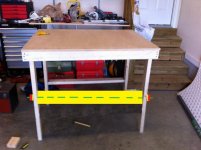
Here's a quick and dirty picture to describe what I'm talking about. The yellow stretcher is a pair of 2x4s or 2x6s screwed together. The green line is a piece of threaded rod. The dashed green line is a hidden line to show the threaded rod passing through the stretcher pair. The red and yellow blocks on the ends of the threaded rod are each a nut and a washer. Use a large washer so you can tighten it all up snug.
 

Attachments

  • Bench photo.jpg
    Bench photo.jpg
    83.9 KB · Views: 44
To avoid these ads, REGISTER NOW!
OP
S

Slowbra

Well-known member
Joined
Jun 5, 2012
Messages
276
Location
NC
Here's a quick and dirty picture to describe what I'm talking about. The yellow stretcher is a pair of 2x4s or 2x6s screwed together. The green line is a piece of threaded rod. The dashed green line is a hidden line to show the threaded rod passing through the stretcher pair. The red and yellow blocks on the ends of the threaded rod are each a nut and a washer. Use a large washer so you can tighten it all up snug.

A picture is worth a thousand words! Thanks!

The larger the dimension, the stiffer the bench legs will be. If you want it really stiff, use a pair of 2x6s for the stretchers. With that setup drawn together with the threaded rod, all the play in your bench will be from the leg boards themselves bending, not the actual bench racking, and that's what you want.

Do you believe this method will remove most all of they play caused by the hinges or would a cross brace also be needed?
 

tube_guy

Well-known member
Joined
Jan 21, 2009
Messages
749
I think you wouldn't need any other bracing to stop the side to side racking. Just two of those stretcher pairs, one on the front set of legs like I showed in the picture and another just like it on the back set of legs. Front to back, there could still be some racking because there's still no stretcher in that direction to stiffen up the legs. That's why I was thinking a permanent stretcher would be nice to make the legs fold in as a pair. If you could add a stretcher and use some nice tight fitting lap joints to hold it in place, that would stop the racking in that direction as well and I'd say you'd have a nice, simple, elegant, and sturdy folding bench.
 
OP
S

Slowbra

Well-known member
Joined
Jun 5, 2012
Messages
276
Location
NC
I think you wouldn't need any other bracing to stop the side to side racking. Just two of those stretcher pairs, one on the front set of legs like I showed in the picture and another just like it on the back set of legs. Front to back, there could still be some racking because there's still no stretcher in that direction to stiffen up the legs. That's why I was thinking a permanent stretcher would be nice to make the legs fold in as a pair. If you could add a stretcher and use some nice tight fitting lap joints to hold it in place, that would stop the racking in that direction as well and I'd say you'd have a nice, simple, elegant, and sturdy folding bench.

Sounds good. I plan to go with your suggestion for both the permanent and removable stretchers. I will post back on here with my results when I am done by this weekend.
 

tube_guy

Well-known member
Joined
Jan 21, 2009
Messages
749
I've used the method quite a few times before and it works really well. I recommend going with at least a half inch diameter threaded rod if you can. That way you can get the joints tight without friction between the nut and thread twisting the rod over such a long length. Larger diameter threaded rod is better. Also, if you can glue a wooden dowel into a hole in one of the legs so that the dowel fits into a hole in the end of the removable stretcher, that will prevent the removable stretcher from spinning around before it gets tightened up. Makes it a little easier to put the bench together.
 

tube_guy

Well-known member
Joined
Jan 21, 2009
Messages
749
Now that I'm thinking about it, you'd probably want to glue the dowel into the stretcher not the leg. That way it won't interfere with the folding legs at all.
 
OP
S

Slowbra

Well-known member
Joined
Jun 5, 2012
Messages
276
Location
NC
That makes sense. I'm going to first get all the pieces assembled and then work on the finishing touches.

I need to figure out the best way to go about getting the dado cut into the wood with the limited tools that I have.
 
OP
S

Slowbra

Well-known member
Joined
Jun 5, 2012
Messages
276
Location
NC
tube_guy,

Your ideas worked perfectly! The table is now very solid and still very lightweight. Thank you for the ideas and to all others that provided input.

I am now working on a few things related to the threaded rod:
1. A method to keep the threaded rod from spinning when tightening from the other side - The dado I cut was a little big and the rod freely spins. My idea is to use a locking nut on one side and put a small wooden block on the leg that would rest against the locking nut to prevent it from spinning when I tighten the other side.

2. Something to put on the ends of the rods that stick out to protect my legs - maybe a rubber plug/tube or something.
 

tube_guy

Well-known member
Joined
Jan 21, 2009
Messages
749
Thanks for letting us know. I'm glad it worked out for you.

If you want to be able to put it all together by yourself, you could secure a dowel or block to the leg on one side to use as stop, maybe 6 inches or so below the threaded rod. That way you could hang a box end wrench off the nut on that side. When you turn the other side, if the weight of the wrench itself isn't enough to stop the rod from spinning until friction takes over, the wrench would hit the stop and allow you to tighten the other side. You could use a locking nut or a doubled up nut backed into each other, in jam nut fashion on the end with the stop.

I would just round the ends of the threaded rod on a grinder to smooth out all the rough edges. That and if you make sure they're not cut too long, they’re usually not too obtrusive after that.
 
OP
S

Slowbra

Well-known member
Joined
Jun 5, 2012
Messages
276
Location
NC
Now I understand what you meant by using a dowel. Sounds like an easy idea to keep the rod from spinning.

I smoothed out the edges of the rod this past weekend. Each side of the rod sticks out ~1.5" from the nut at the moment. I don't think it would cut my leg, but it would still hurt :) I think I will reduce the overall length, especially the side with the locking nut.
 
To avoid these ads, REGISTER NOW!
Top Bottom