To avoid these ads, REGISTER NOW!

Foot candles?

iagsxr

Well-known member
Joined
Jan 10, 2010
Messages
1,499
Location
Vinton, Iowa
Quick question;

In my new 36' x 48' shop area, white 14' steel ceiling and walls, we're thinking 8 of the 6-bulb T8 light fixtures.

My electrician says the fixture supplier says that will be about 60 ft candles. That sound about right as far as lighting level for a shop?
 
To avoid these ads, REGISTER NOW!

pattenp

Well-known member
Joined
Jun 4, 2008
Messages
10,175
Location
Virginia - USA
Depends on the type of work you're doing. I think 60 is on the low end. Personally I like 100 to 125. But my eyes are getting old.
 

Charles (in GA)

Well-known member
Joined
Jan 11, 2006
Messages
12,489
Location
50 mi south of Atlanta
Aim for 100 fc. You will be happier with the results.

Using Lithonia I-Beam fixtures, 6 bulb T8, wide distribution (white reflectors, not the polished aluminum), with some uplight (very effective on a white steel ceiling) in a 48x36x14 area, with 75% reflectance on the ceiling, 60% on the walls (might be more, depends on how much stuff blocks the walls) and 20% on the floor (will be higher if you epoxy light gray or other similar reflectance) I get the result that you need 16 fixtures to get 110 fc at a 2.5 ft working height.

Increasing the floor reflectance to 40% reduces the number of fixtures needed to 12 and yields 91 fc at the 2.5 ft working height.

The fixtures need to be hanging below the ceiling, not right on it for the uplighting to have good effect.

Installing the narrow distribution, no uplight version of these fixtures still shows the need for 12 fixtures, but ups the light to 98 fc at 2.5 ft working height. These would be directly mounted (or nearly so) to the ceiling.

Visual software defaults to 100 fc as the desired level, that should tell us something.

Charles
 
Last edited:

2ManyProjects

Well-known member
Joined
Jul 18, 2013
Messages
757
Quick question;

In my new 36' x 48' shop area, white 14' steel ceiling and walls, we're thinking 8 of the 6-bulb T8 light fixtures.

My electrician says the fixture supplier says that will be about 60 ft candles. That sound about right as far as lighting level for a shop?

As others have pointed out, that would be very much on the low side, vis-a-vis generally accepted practice, even if it really met that 60fc figure -- which I rather doubt it would, at least at working height.

A typical F32T8 tube has a nominal output of 2700-2800 lumens when new (about 5-10% less than that after it has aged). Eight fixtures, with six tubes per fixture, gives us a total of about 132,000 lumens (at the sources, with fresh tubes). Spread over a 1,728-ft.^2 shop, that's only about 76 lumens/ft.^2, BEFORE we deduct for fixture inefficiency and/or the (usually substantial) losses incurred at working height vs. at the sources.

Further, I very much question the wisdom of concentrating all of your light into just eight source locations, especially in a shop that large. The relatively tall ceilings can help somewhat on this front; but even so, you would still near-certainly be MUCH better off with a greater number of fixtures, with fewer tubes in each one. As with most such projects, the biggest challenge will surely NOT be getting "enough" light (that much is relatively easy); it will be DISTRIBUTING that light evenly and effectively over the entire workspace (or at least those parts of it where good illumination is really needed).

If you can give us more details on the layout of the shop, and what sort of work you will be performing within it (and specifically WHERE within it), we can make better and more specific recommendations.


There are a number of charts out there showing recommendations, here's one: http://eeref.engr.oregonstate.edu/@api/deki/files/993/=Footcandle_Recommendations.pdf It says anywhere from 50 to 100 fc for a repair garage;

But it must be kept in mind that these recommendations are in the context of keeping workers (and outfits like OSHA) happy, in the face of business owners who have a vested interest in getting away with as little as possible; and are thus effectively recommended MINIMUMS. Virtually no one ever complains about having "too much" light to see what they're doing; but they can (and do, regularly) complain about having too little. Further, it really is next to impossible to actually have "too much", unless you go completely off the deep end (at least several hundred lumens/ft.^2 at working height, for example), as long as that "excessive" lighting is properly implemented -- i.e., well distributed, no "hot spots" vs. dim/shadowy areas, light sources located to avoid direct line-of-sight (and thus complaints about "glare" or harshness) during normal usage, good spectral distribution, and a litany of other things that CAN get into the act.

I'd go for somewhere in the middle (60 is probably OK but 75 would be better), with more task lighting over the workbench as required.

Splitting hairs over 75 lumens/ft.^2 vs, 60 lumens/ft.^2 is a fools errand. There just isn't that much difference in real life. Recall that a doubling or halving of actual light level is needed to make a difference of just one f-Stop in photography. A one f-Stop difference in light level is certainly noticeable; but it's just as certainly NOT "night and day". A difference of just 20-25% is essentially insignificant.

At the end of the day, the specific layout of the lighting vs. the layout of the shop will be the FAR more important factor. And if that is done really right, the odds are high that this will (coincidentally, in a sense) result in more-than-adequate overall average lighting levels.

 
OP
I

iagsxr

Well-known member
Joined
Jan 10, 2010
Messages
1,499
Location
Vinton, Iowa
Thanks for the replies so far

If you can give us more details on the layout of the shop, and what sort of work you will be performing within it (and specifically WHERE within it), we can make better and more specific recommendations.

I don't have any diagrams I can post so you'll have to look at pictures;

We're talking about the tall part(east end) of this building.


This is the view from right inside the walk-in door. I expect my toolbox to go between the two windows on the North wall and for the rest of that wall to be mostly bench. The east wall will be lathe, drill press, welders, etc. Haven't built it yet, but kinda see a 4' x 8' welding table by the south window.


This is the view from the SE corner. My compressor will go here with a blast cabinet right beside it. Any tools that don't fit along the East wall.


It has this little bathroom out of the SW corner.


Expect to have pallet racking all along the south wall.

They'll be a couple lift tables for bikes in there(they move). Up by my toolbox when there's a bike on them, probably down by the south wall when not.
 
Last edited:

W_A_Watson_II

Well-known member
Joined
Jan 3, 2010
Messages
369
Location
South East MO
I did 100fc at floor level, and wish I'd gone a little higher, especially as the light output with Florescent's decrease with age.
 

tshetter

Well-known member
Joined
May 19, 2011
Messages
603
Location
Central, FL
You will want two sets of lighting: one, general lighting for the whole shop, two, task lighting for specific work areas.

Trying to keep the whole shop lit up so you can work on small intricate projects needing high intensity lighting is impractical. So have good general lighting and also task specific lighting over workbenches and other specific areas where you will be working.

My shop is getting about 60 lumen/sqft, and also have some portable lighting for the work bench.
 

2ManyProjects

Well-known member
Joined
Jul 18, 2013
Messages
757
Thanks for the replies so far

If you can give us more details on the layout of the shop, and what sort of work you will be performing within it (and specifically WHERE within it), we can make better and more specific recommendations.

I don't have any diagrams I can post so you'll have to look at pictures;

That's OK. As the saying goes, "A picture is worth 1,000 words." And hand-drawn diagrams can often be difficult to properly interpret anyway.


We're talking about the tall part(east end) of this building.

{image deleted}

This is the view from right inside the walk-in door. I expect my toolbox to go between the two windows on the North wall and for the rest of that wall to be mostly bench. The east wall will be lathe, drill press, welders, etc. Haven't built it yet, but kinda see a 4' x 8' welding table by the south window.

{image deleted}

This is the view from the SE corner. My compressor will go here with a blast cabinet right beside it. Any tools that don't fit along the East wall.

{image deleted}

It has this little bathroom out of the SW corner.

{image deleted}

Expect to have pallet racking all along the south wall.

They'll be a couple lift tables for bikes in there(they move). Up by my toolbox when there's a bike on them, probably down by the south wall when not.

You've done an excellent job of detailing what will line the perimeter of the space. But at least most of that will require its own dedicated task lighting, which is pretty much a completely separate discussion from the general lighting of the shop area as a whole.

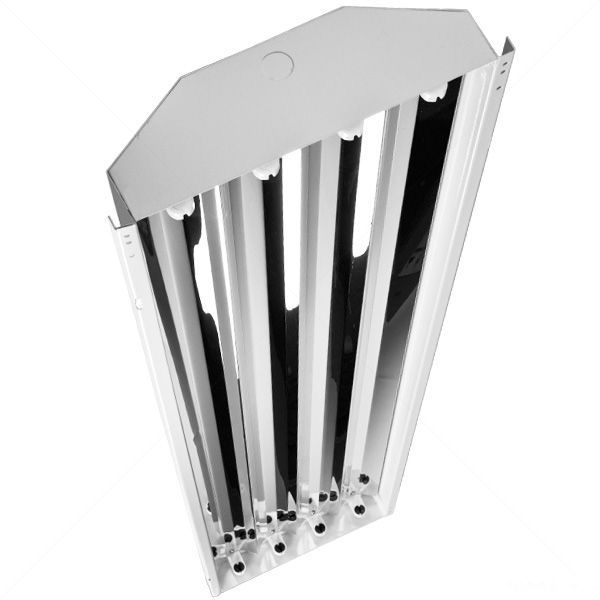
That said, I generally concur with the calculations made earlier by "Charles (in GA)", except for the use of six-tube fixtures. I think you would be FAR better off limiting the fixtures to no more than four F32T8 tubes each; and you might even want to use twin-tube fixtures in at least some places. Sticking to the Lithonia brand (but only because it's consistent with Charles' earlier calcs; there are MANY other potentially suitable choices), something like the IBZ-432WDU:

http://www.visual-3d.com/tools/photometricviewer/default.aspx?id=31494
http://www.globalindustrial.com/p/e...ed-fluorescent-high-bay-32w-wide-distribution
AIT_IBZ_432_WD.jpg


would be a reasonable bet. These would still need to be suspended some distance below the ceiling for best results; but because each fixture is providing a relatively smaller portion of the overall lighting, you can use more of them, spaced closer together, and achieve better overall coverage.

Plugging this into the same online calculator that Charles used (http://www.visual-3d.com/tools/interior/default.aspx?id=31494), and arbitrarily choosing a two-foot suspension height (i.e., about 12 feet above the floor) and 70/50/20 reflectance values, I get 24 of these fixtures to produce a nominal average of 107fc at a working height of 2-1/2 feet.

Notably, this works out to the same total of 96 tubes as in Charles' first example; but the evenness of coverage should be somewhat better, since the nominal "Spacing Criteria" for these fixtures (15.2' x 15.4') is nearly twice the actual 8'x 9' (on-center) layout grid. In fact, I might even fudge them just a bit closer together than that (say, 7.5' x 8.0' o.c.), in order to modestly increase the spacing between the last row/column on each side, and the adjacent walls; this should provide somewhat better "sideways" illumination of such things as those pallet racks; and most of the other stuff along the walls will be getting their own task lighting anyway. Using more fixtures, spaced closer together, also paves the way for using a multi-stage switching system, so that you can more effectively use only SOME of the lights a good portion of the time, such as when maximum brightness is not needed, but reasonably even coverage still is.


I did 100fc at floor level, and wish I'd gone a little higher, especially as the light output with Florescent's decrease with age.

No surprise. As I've said I-don't-know-how-many times now, it is REALLY hard to actually have "too much" light, as long as the light is implemented right, especially if a well-thought-out multi-stage switching scheme is used. Many folks try way too hard to stick to "only" 100 lumens/ft.^, as if it were some sort of gospel, and wind up with a less-than-ideal lighting solution in the long run.

 
OP
I

iagsxr

Well-known member
Joined
Jan 10, 2010
Messages
1,499
Location
Vinton, Iowa
Thanks this is really instructive.

Switch gears a little bit. My electrician is steering me toward T8s. I have a buddy with T5HOs in his shop that he loves. What about LED lighting?
 
OP
I

iagsxr

Well-known member
Joined
Jan 10, 2010
Messages
1,499
Location
Vinton, Iowa
http://garagejournal.com/forum/search.php?do=process

Above is a good link for you. There are literally hundreds of threads about T5HO v/s T8 v/s LED

It's ok if you don't know either.

Charles and this 2ManyProjects fellow seem rather smart about such things.

I was hoping one(or both) of them could give me the Cliffsnotes version without wading through hundreds of pages of ******** that may or may not apply to my project.

So my electrician is fairly adamant the 100fc is way overkill. He gave me a little light meter to check out different lighting levels with.

It looks like this;


This is my garage at my house, 18' x 24', four 150w bulbs;


Light meter is reading 10 right below a light on my toolbox 46" off the floor.

Anyone care to comment on it's accuracy?
 

2ManyProjects

Well-known member
Joined
Jul 18, 2013
Messages
757
Thanks this is really instructive.

Switch gears a little bit. My electrician is steering me toward T8s. I have a buddy with T5HOs in his shop that he loves.

The short answer is, using T5HO tubes will effectively put you right back in the same position as using 6- or 8-tube fixtures -- i.e., too much lighting power concentrated into too few places. Which is not to say that you couldn't use them; but it would be somewhat more difficult to maintain even coverage throughout the space. If you do go with T5HO tubes, I would recommend no more than two of them per fixture.

What about LED lighting?

As a general rule, not yet a mature enough technology to offer any real advantage over properly implemented fluorescents, unless perhaps you really NEED some of their particular attributes (such as the potential ability to smoothly dim them, or in SOME cases less EMI/RFI radiation), and are willing to pay a large premium for those features. Otherwise, they tend to be a rather poor value. Compare, for example:

http://www.lithonia.com/commercial/led+bay+lighting.html
http://www.homedepot.com/p/Lithonia-Lighting-2-ft-White-LED-High-Bay-Light-IBH-11L-MV/203812710
6c03025b-1f9f-4883-84bd-441d389f7baf_1000.jpg


at about $220, to (again, just for example) any of these:

http://www.homedepot.com/p/Lithonia...put-Fluorescent-High-Bay-IBC-454-MV/202838871
a4fbe34d-a534-4e52-815b-603e77935edd_1000.jpg


http://www.1000bulbs.com/product/93811/BSS-HB4T5.html
93811_a3a27e0aa9283898b927884b1859c8cc174f6c37_original_x_600_1372489330.jpg


http://www.1000bulbs.com/product/64991/PLT-TL5084T5.html
64991_b96e8a8635018a511b9d962d738bc7914426661c_original_x_600_1327492732.jpg


at under $100. And the kicker here is, not only would you need approximately twice as many of the LED fixtures to produce the same total light output (thus rendering them effectively 4-5 times as expensive, instead of "merely" twice as much), the LED fixtures will actually cost MORE to run, because they are significantly LESS efficient on a lumens/watt basis.


So my electrician is fairly adamant the 100fc is way overkill.

He was right about the T8s; but you need to ignore him on this issue.

He gave me a little light meter to check out different lighting levels with.

It looks like this;

This opens a whole can of worms which I'd prefer to not get bogged down in (again). Suffice it to say that there are MANY other variables involved which can (and often will) make those "light meter" readings highly misleading. If you want to induce a headache, dive in:

http://www.garagejournal.com/forum/showthread.php?t=231996

The long and short of it is, while such light meter readings can be both meaningful and useful when used for RELATIVE measurements using the same meter and the same light sources, the ABSOLUTE values just don't translate very well.


W_A_Watson_II

Well-known member
Joined
Jan 3, 2010
Messages
369
Location
South East MO
For reference in my 54' x 48' x 14' Shop I have 6 rows of 8' fixtures. Each row holds 16 4' T-8 tubes.
The two rows over the bench area has each has 4 extra tubes each. So I have a total of 104 4' T-8 tubes.

MyShopLights.gif


This picture was taken shortly after moving in, and cleaning it out in preparation for a party, but you can see the fixtures at the top of the picture.

DSC01682_Shop-InteriorWide.JPG
 

jvitez

Well-known member
Joined
Nov 30, 2009
Messages
2,429
Location
Big Sky Country, Canada
How long will you keep the house? How old are you?

Our eyes require about double the light output from age 20 to 40, and about double again from 40 to 60 years of age. Ever notice how old folks flick on lights all the time? You'll get there too, God willing.....:) So no, 100 lumens/sq ft is not too much light. It depends on all the parameters mentioned so far. "Too much" IS much better than not enough.
 

Vegaman_Dan

Well-known member
Joined
Jun 1, 2012
Messages
2,453
Location
Pacific, WA
With all that white metal ceiling in place, I'd be tempted to hang lights shining down, but also mount some shining up to bounce light off that ceiling for more ambient light.

There's an ergonomic reason for it too. When you have darkness above from poor lighting, you feel cramped and contained. The night closes about you regardless how bright it is. When the ceiling is lit up as well, it's like being outside with brighter skies and much less mental pressure applied.

I know it sounds silly, but it's how our minds work.
 

Charles (in GA)

Well-known member
Joined
Jan 11, 2006
Messages
12,489
Location
50 mi south of Atlanta
With all that white metal ceiling in place, I'd be tempted to hang lights shining down, but also mount some shining up to bounce light off that ceiling for more ambient light.

There's an ergonomic reason for it too. When you have darkness above from poor lighting, you feel cramped and contained. The night closes about you regardless how bright it is. When the ceiling is lit up as well, it's like being outside with brighter skies and much less mental pressure applied.

I know it sounds silly, but it's how our minds work.

Its commonly referred to as "cave effect" and I usually mention it but did not, due to the bright white metal ceiling. I did suggest the fixtures with uplighting, and I am a fan of fixtures with uplighting, but not so sure that in this case, it will make a big difference. This is why open strips work so well, as they utilize the ceiling as the reflector.

Charles
 
OP
I

iagsxr

Well-known member
Joined
Jan 10, 2010
Messages
1,499
Location
Vinton, Iowa
Thanks for all the help.

So as it turns out I have a buddy with a buddy that's a lighting consultant.

Met with him Thursday. He spec'd out twelve 8' six-bulb T8 fixtures.

The fixtures will be wired so I can have two bulbs on one switch and four bulbs on another. That gives me three levels of lighting, 2, 4, or all six bulbs on at once.

All six bulbs on should be well over 100fc.

The fixtures are from Energy Solutions International which he says is a division of Hubbell. I assume they're good fixtures. He seemed to think they are.
 
To avoid these ads, REGISTER NOW!

2ManyProjects

Well-known member
Joined
Jul 18, 2013
Messages
757
Thanks for all the help.

So as it turns out I have a buddy with a buddy that's a lighting consultant.

Met with him Thursday. He spec'd out twelve 8' six-bulb T8 fixtures.

Are you sure of that description? Six-tube tandem fixtures are a rare beast indeed. In fact, I don't recall ever seeing one. OTOH, if you're talking about something which actually uses 8-foot (F96T8) tubes, you DEFINITELY want to re-think that.

The fixtures will be wired so I can have two bulbs on one switch and four bulbs on another. That gives me three levels of lighting, 2, 4, or all six bulbs on at once.

That much is good. Dual-ballast fixtures tend to be a bit costlier than normal ones; but there IS an obvious benefit.

All six bulbs on should be well over 100fc.

I seriously doubt that, unless you're talking only about SOURCE lumens. The figures Charles and I posted were based on effective lumens at working height, which is where it really matters. And recall that it took 96 tubes to get you barely over 100 lumens/ft.^2. Your "lighting consultant" is claiming "well over 100" with only 72 tubes? I don't think so.

The fixtures are from Energy Solutions International which he says is a division of Hubbell. I assume they're good fixtures. He seemed to think they are.

EXACTLY what fixtures did he suggest? I just went through the entire list at http://www.esilighting.com/products, and found NOTHING which even vaguely resembles your description above, regardless of which way I interpret it.

FWIW (which may not be much), I've never heard of "Energy Solutions International" until your post above. I also found no evidence to suggest a connection to Hubbell Incorporated. The two companies are based in entirely different places (St. Paul, MN and West Chester, PA, respectively), and neither mentions the other on their web sites; nor is "Energy Solutions International" (or anything like it) listed under "Brands" at http://www.hubbell.com/. Not that this "brand association" (or lack thereof) really makes any practical difference; but you seemed to be viewing it as a selling point.

As for the overall quality of the fixtures, who knows? The really critical part of that would be the ballasts; in particular, you want something which is Residential-rated and carries an FCC Class B certification.

 
OP
I

iagsxr

Well-known member
Joined
Jan 10, 2010
Messages
1,499
Location
Vinton, Iowa
EXACTLY what fixtures did he suggest? I just went through the entire list at http://www.esilighting.com/products, and found NOTHING which even vaguely resembles your description above, regardless of which way I interpret it.


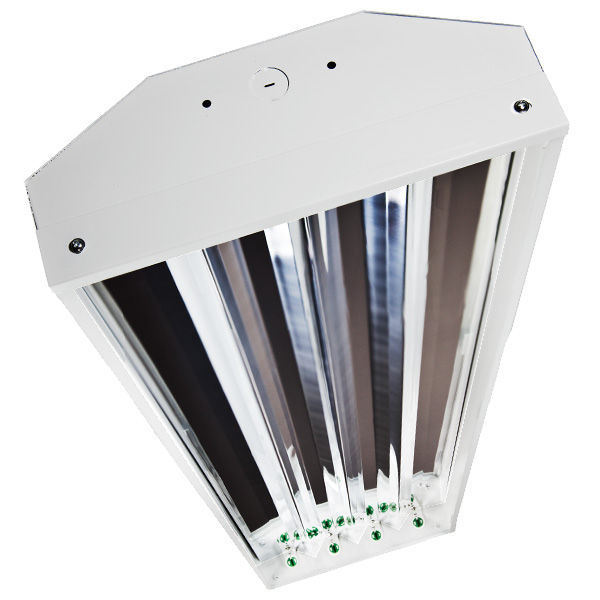
This family of fixtures;

http://www.esilighting.com/sites/es...heets/PS Series Industrial Strip (8L 1x8).pdf

I know this pdf doesn't show a 6-lamp fixture. I have a printout of basically the same page that does.

But yea now that I look the quote sheet is 72 lamps. I was thinking 144.

His layout printout is showing lighting levels in the mid-90s. He felt that was a little low.
 

2ManyProjects

Well-known member
Joined
Jul 18, 2013
Messages
757

Those fixtures are not at all appropriate for your project, for several reasons.

First and foremost, they require 277V three-phase power, which I'd wager heavily you don't have.

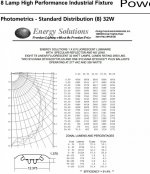
Second, as so-called "High Bay" fixtures, you would need to mount them smack up against the ceiling in order to have any hope of getting decent light distribution; and even then it would be "iffy" at best (14 feet is just not all that high in this context). In that scenario, the integral reflectors are actually hurting you, not helping. Look at the photometric chart on Page 2 of that spec sheet. As you'll note, the radiation pattern is very "tall & skinny", which mens that comparatively little light is allowed to spread out to the sides of each fixture. That in turn means that the fixtures MUST be spaced more closely together than would otherwise be necessary, which (again in turn) means more fixtures to cover a given space.

Back to the drawing board...


Kevin C

Well-known member
Joined
Aug 4, 2011
Messages
1,653
Location
Portland OR
Those fixtures are not at all appropriate for your project, for several reasons.

First and foremost, they require 277V three-phase power, which I'd wager heavily you don't have.

Second, as so-called "High Bay" fixtures, you would need to mount them smack up against the ceiling in order to have any hope of getting decent light distribution; and even then it would be "iffy" at best (14 feet is just not all that high in this context). In that scenario, the integral reflectors are actually hurting you, not helping. Look at the photometric chart on Page 2 of that spec sheet. As you'll note, the radiation pattern is very "tall & skinny", which mens that comparatively little light is allowed to spread out to the sides of each fixture. That in turn means that the fixtures MUST be spaced more closely together than would otherwise be necessary, which (again in turn) means more fixtures to cover a given space.

Back to the drawing board...

Take another look at the spec sheet.... Your confusing the part number tested VS what can be ordered. -UNV allows operation from 120 to 277 V. So the lights will operate on 120.

BTW, that's not a tall and skinny light pattern. The output is quite good at 45° from the center line. Based on my read of the photo metric chart and the number of fixtures you proposed, you would get a very even light pattern.

If the chart seems confusing, just look at the shape of the reflector. :thumbup:

The estimated FC seems realistic. One thing that gets lost is many people think they have a much higher light level than they do. A real 60 FC is reasonable. A bit higher might not be a bad call.

One thing to note, the ballasts are FCC 47CFR Part 18 Non-Consumer, so you might have an issue with your FM radio. Actually you will have an issue with any radio since you have an all metal building.
 
Last edited:

Kevin C

Well-known member
Joined
Aug 4, 2011
Messages
1,653
Location
Portland OR
This opens a whole can of worms which I'd prefer to not get bogged down in (again). Suffice it to say that there are MANY other variables involved which can (and often will) make those "light meter" readings highly misleading. If you want to induce a headache, dive in:

http://www.garagejournal.com/forum/showthread.php?t=231996

The long and short of it is, while such light meter readings can be both meaningful and useful when used for RELATIVE measurements using the same meter and the same light sources, the ABSOLUTE values just don't translate very well.


Just to clarify ... I did compare my meter to one of the meters in the lab, its within 10%. That and my calculated results are within 20% of my measured.

Basically, the results translate perfectly.
 
OP
I

iagsxr

Well-known member
Joined
Jan 10, 2010
Messages
1,499
Location
Vinton, Iowa
One thing to note, the ballasts are FCC 47CFR Part 18 Non-Consumer, so you might have an issue with your FM radio. Actually you will have an issue with any radio since you have an all metal building.

What do the ballasts need to be for this to not be a problem?
 
OP
I

iagsxr

Well-known member
Joined
Jan 10, 2010
Messages
1,499
Location
Vinton, Iowa
For reference in my 54' x 48' x 14' Shop I have 6 rows of 8' fixtures. Each row holds 16 4' T-8 tubes.
The two rows over the bench area has each has 4 extra tubes each. So I have a total of 104 4' T-8 tubes.

MyShopLights.gif


This picture was taken shortly after moving in, and cleaning it out in preparation for a party, but you can see the fixtures at the top of the picture.

DSC01682_Shop-InteriorWide.JPG

See I look at this and my shop is 67% the square footage of his.

He has 104 bulbs. To equal bulbs per sq ft. my shop needs just shy of 70. My guy's proposing 72.

His shop has plywood on the walls, which I like by the way, where mine is steel clear to the floor. Gaining reflectance.

I get that the fixtures aren't apples to apples but I can't see how my guy can be that far off.
 

W_A_Watson_II

Well-known member
Joined
Jan 3, 2010
Messages
369
Location
South East MO
IAGSXR, 72 is by no means an overkill, I'd actually suggest closet to 82 if I was to do it.

Some where between 1.6 and 2 watts per sq, foot would be my new target was I to do it again with 14' ceiling. I'm at only about 1.4 in the shop (quoted above, based on interior size of 52'x46'), and with the lights output dropping with age (7 years old now), starting higher would make is nicer now.
 
Last edited:

2ManyProjects

Well-known member
Joined
Jul 18, 2013
Messages
757
Take another look at the spec sheet.... Your confusing the part number tested VS what can be ordered. -UNV allows operation from 120 to 277 V. So the lights will operate on 120.

Actually, I looked up the specific ballast model quoted (Sylvania QT3X32/277/PLUS). The reference I found explicitly listed is as being 277V ONLY (cf. http://www.bulbtronics.com/Search-The-Warehouse/ProductDetail.aspx?pid=OSQT3X32277IS); which implies that this are NOT the ballast supplied by ESI when the "480V" option is chosen, and must therefore be the ballast supplied when the "-UNV" option is chosen. However, since you raised the point, I looked for some additional references; and indeed, found some which did list that model as a 120-277V unit. OTOH, I also found that Osram/Sylvania themselves lists both 120V and 277V variants separately, with no mention of either a "universal" version or a 480V variant. On top of that, per http://assets.sylvania.com/assets/d...plac.9e236694-59f8-4ecd-a91a-9a7819807617.pdf, they also show that model as "Discontinued"; and it apparently has been so since at least 2008 -- so who knows what ESI is really supplying?!?

BTW, that's not a tall and skinny light pattern. The output is quite good at 45° from the center line. Based on my read of the photo metric chart and the number of fixtures you proposed, you would get a very even light pattern.

This starts to get a little subjective; and the situation is not helped by the fact that ESI apparently screwed up when pasting that chart into the spec sheet, and cut off at least the first digit of the Y-axis labels. But looking at the overall SHAPE of the curves, I stand by my assessment. Out to about 30-35 degrees off-axis, the output holds up pretty well; past that, it drops like a rock.

Bottom Line: It is still very much a "High Bay" fixture, which would NEED to be mounted as high as possible (probably smack up against the ceiling in the OP's case, since his ceilings aren't really all that high to start with). At the very least, that hampers placement flexibility.

What do the ballasts need to be for this to not be a problem?

As noted earlier, they should be explicitly rated for Residential applications; and if so-rated, they will near-certainly carry an FCC "Class B" certification for EMI/RFI radiation.

 
OP
I

iagsxr

Well-known member
Joined
Jan 10, 2010
Messages
1,499
Location
Vinton, Iowa
IAGSXR, 72 is by no means an overkill, I'd actually suggest closet to 82 if I was to do it.

Some where between 1.6 and 2 watts per sq, foot would be my new target was I to do it again with 14' ceiling. I'm at only about 1.4 in the shop (quoted above, based on interior size of 52'x46'), and with the lights output dropping with age (7 years old now), starting higher would make is nicer now.

Thanks Will.

My garage is about 1.4 watts per sq ft with 8ft ceiling. I wouldn't want any more light in there, but I'm six foot closer to the light source.
 
OP
I

iagsxr

Well-known member
Joined
Jan 10, 2010
Messages
1,499
Location
Vinton, Iowa
Bottom Line: It is still very much a "High Bay" fixture, which would NEED to be mounted as high as possible (probably smack up against the ceiling in the OP's case, since his ceilings aren't really all that high to start with). At the very least, that hampers placement flexibility.

As noted earlier, they should be explicitly rated for Residential applications; and if so-rated, they will near-certainly carry an FCC "Class B" certification for EMI/RFI radiation.


The fixtures will be mounted to the ceiling. That's my requirement and non-negotiable. I should have stated that earlier.

Like I said that pda was just for the family of fixtures. They have multiple ballast options. I will double check the radio interference thing though. Thanks
 

Kevin C

Well-known member
Joined
Aug 4, 2011
Messages
1,653
Location
Portland OR
This starts to get a little subjective; and the situation is not helped by the fact that ESI apparently screwed up when pasting that chart into the spec sheet, and cut off at least the first digit of the Y-axis labels. But looking at the overall SHAPE of the curves, I stand by my assessment. Out to about 30-35 degrees off-axis, the output holds up pretty well; past that, it drops like a rock.

Bottom Line: It is still very much a "High Bay" fixture, which would NEED to be mounted as high as possible (probably smack up against the ceiling in the OP's case, since his ceilings aren't really all that high to start with). At the very least, that hampers placement flexibility.


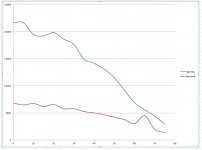
Somewhat subjective... But There are some clues.

1: The High Bay fixtures often have the term High Bay in the cut sheet. The fixtures the OP linked to have the phrase "Standard Distribution" on the cut sheet (see attached).


2: The drop off rate on the High Bay is slightly faster and the overall intensity is much, much higher. It's two factors intensity and pattern. Good optics that reduce wasteful side lighting does not make a light fixture a "High Bay".

For an example of bad optics look at low cost wrap lights, 200° light patterns that can only produce 70 to 120 lumens power sq ft at a 3' distance and are only 64% efficient.

The manf does confuse things a little with this statement "A Breakthrough Alternative to HID
High-Bay Systems"

To be sure, I graphed the outputs of the OP's light VS a HighBay from the same company.

Its subtle... But if you look closely there is a slight difference. :lol_hitti

Candella VS Angle:

attachment.php


OP fixtures:

If you take the time to calculate out the light pattern drop off VS the fixture spacing, the drop off at the outer angles of one fixture, is taken up by the overlap light from the next.

Basically, we can skip the semantics of High Bay vs Standard and use the photmetric data to estimate the light pattern.

Bottom line?

Based on my calculations, his electrician and light supplier are recommending a fixture with an output pattern that is well matched for the height of his ceiling and fixture spacing.

As far as the ballast goes, standard industry practice is if it says UNV, expect 120 to 277 operation. Multi voltage ballast are almost always FCC 47CFR Part 18, Non Consumer. AKA... Commercial.

The upside is they have power factor correction.

As far as the OP fixtures go, they are commercial fixtures with commercial ballasts. On a special order, they might fit them with a consumer style, FCC Class B ballast. However, you might not be able to easily specify a higher ballast factor with a consumer grade ballast (You wont get quite as much light). Reading the data sheet, I'm pretty sure they are using a ballast factor of 1.2. A Standard consumer ballast will often have a factor of .85 or so.

I like the design of that series of lights. Other than the ballast issue, it looks like a good series of products. There are other light in that family that might be worth considering (slightly higher output).

Worth a call to ask about options.

I myself would go with the commercial grade ballasts. With an all metal building, radio reception is going to be challenging no matter what fixture you use. For my shop, I just stream music using a computer hooked up to the internet.
 

Attachments

  • Graph- High VS Standard.JPG
    Graph- High VS Standard.JPG
    56 KB · Views: 253
  • Standard Dist fixture.jpg
    Standard Dist fixture.jpg
    114.9 KB · Views: 10
  • Highbay.JPG
    Highbay.JPG
    111.6 KB · Views: 9
Last edited:
OP
I

iagsxr

Well-known member
Joined
Jan 10, 2010
Messages
1,499
Location
Vinton, Iowa
Fixtures came today.

My electrician says it will be Thurs/Fri next week before they can get back to me.

Can't think it will take more than a couple days to run the conduit and get the lights up.

So we'll all know pretty soon how this deal turns out.
 

dtcooper

Active member
Joined
Jan 30, 2014
Messages
30
gsxr,
I hope you get your fixtures installed, and end up ecstatic with the light output you obtain!!!!
With that said, I WORK for Hubbell Lighting... I've never heard of esi..
As 2many said, not that it matters.... But it ain't so.

2many,
3 lamps (per cross section) is very common in tandem (as well as single) strip bodies..
Once again, just because you've not heard of or seen something, doesn't mean it doesn't exist..
 
OP
I

iagsxr

Well-known member
Joined
Jan 10, 2010
Messages
1,499
Location
Vinton, Iowa
Electrician started on lights today. Can't get pictures of what they got done to post from my phone. Don't think they'll get done tomorrow but by end of the day Wednesday we'll know what we've got.
 

Charles (in GA)

Well-known member
Joined
Jan 11, 2006
Messages
12,489
Location
50 mi south of Atlanta
gsxr,
I hope you get your fixtures installed, and end up ecstatic with the light output you obtain!!!!
With that said, I WORK for Hubbell Lighting... I've never heard of esi..

Hubbell lists the following brands in their lighting division.

Hubbell Lighting
Provides a full range of indoor and outdoor lighting products for commercial, industrial, institutional, sports lighting, landscape and residential markets, including green initiatives for vacancy sensors and daylight harvesting controls.


OurBrands:
Alera Lighting / Architectural Area Lighting / Beacon Products / Columbia Lighting / Compass Products / Devine Lighting / Dual-Lite / HomeStyle Lighting / Hubbell Building Automation / Hubbell Industrial Lighting / Hubbell Outdoor Lighting / Kim Lighting / Kurt Versen / Precision-Paragon / Prescolite / Progress Lighting / Security Lighting Systems / Spaulding Lighting / Sportsliter Solutions / Sterner Lighting Systems / Whiteway
 
OP
I

iagsxr

Well-known member
Joined
Jan 10, 2010
Messages
1,499
Location
Vinton, Iowa
First impression is that I'm happy with the lighting. Didn't take the light meter out there tonight. Probably will at some point before I give it back just for my own curiosity.
 

Durasmack

Well-known member
Joined
Dec 25, 2009
Messages
60
Location
Chicagoland
I just read thru all of this and get to the end.... No payoff!
Any updates to this?
Got pics?
What does / did the light meter say.
This was like reading a murder mystery and the last chapter was missing!
 
To avoid these ads, REGISTER NOW!
Top Bottom