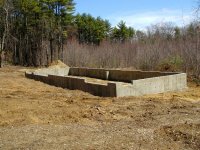
I'm in the design phase and had a question about footers. I'm planning on a concrete block foundation on top of poured footers, for a 24X30 garage. My question is does the footer continue all the way around the garage, including underneath the garage doors, or can they be stopped when they reach the door?


You are using an out of date browser. It may not display this or other websites correctly.
You should upgrade or use an alternative browser.
You should upgrade or use an alternative browser.
Footers
- Thread starter Kapt
- Start date
The footer has to go all the way around the garage. Usually what happens at the doorways is the block is brought up enough to allow the concrete floor to rest on it. Because there is block under the doorways, you need a footer for the block to rest on. Running footers all the way around distributes the weight and ties together both ends of the doorways.
Thanks for the reply. One thing I don't understand is concerning the concrete floor resting on part of the block. I plan on a floating slab after I do the concrete block work. The part where the garage door goes will not have any support from below, only the header above. I understand what you said about distributing the load all the way around the footer, but not about bringing the block up to floor level. Is the block just under the 4 inch floating slab or in front of it? THanks.
plepper
Member
Normally the block are left 4" below the top of slab at door openings this allows the slab to pour through the block wall and be smooth as opposed to the block going to the top of slab and the cells and walls of the block being exposed.
Kapt said:Thanks for the reply. One thing I don't understand is concerning the concrete floor resting on part of the block. I plan on a floating slab after I do the concrete block work. The part where the garage door goes will not have any support from below, only the header above. I understand what you said about distributing the load all the way around the footer, but not about bringing the block up to floor level. Is the block just under the 4 inch floating slab or in front of it? THanks.
Yes, the block is sitting under the "floating" slab. You can't see it, but under every garage door apron, is an short block wall on top of the footers. On top of that short block wall (often below grade) sits the slab.
Kapt said:By the way, what model BMW do you have? Mine is a '88 535is that is my daily driver.
I've got 2 at the moment... a '90 535i and an '87 325ic.
along this vein of topic...can you - would it be ok- to dig the footings and stem wall this year, build the stucture before winter, and then do the floor next year ??? and would the footing walls have to go all the way below frost freeze level, or would 18" down x 8" thick with rerod be adequate ? and should the rerod continue into the floor , or let that be completely separated ? (1/2" tar strip around perimeter)
lots of concrete questions
Jim
lots of concrete questions
Jim
Pretty cold in Iowa I take it? Footings have to be below the freeze level.
I had the mason build my footings/block on my detached garage at the same time they did the foundation (11/01). I didn't start framing the garage until last August (8/04). I poured the floor late November of last year (11/04). It doesn't matter when you do the floor. Some people like to do the floor first and then frame, but I preferred to do the floor last to avoid construction damage to it. When you drop a hammer from 16' in the air, it's bound to chip the concrete. If I may make a suggestion, pour the floor when the temperature calls for it... not too cold, not too hot outside. Spring or fall would be the best.
My floor is not attached to the foundation around the perimeter. It merely "sits" on top of the foundation in three places: (1) the rear man-door, (2) garage bay 1, (3) garage bay 2. The perimeter is surrounded by expansion material. Code (NJ) says footer must be 8" x 16" minimum, 30" depth minimum.
I had the mason build my footings/block on my detached garage at the same time they did the foundation (11/01). I didn't start framing the garage until last August (8/04). I poured the floor late November of last year (11/04). It doesn't matter when you do the floor. Some people like to do the floor first and then frame, but I preferred to do the floor last to avoid construction damage to it. When you drop a hammer from 16' in the air, it's bound to chip the concrete. If I may make a suggestion, pour the floor when the temperature calls for it... not too cold, not too hot outside. Spring or fall would be the best.
My floor is not attached to the foundation around the perimeter. It merely "sits" on top of the foundation in three places: (1) the rear man-door, (2) garage bay 1, (3) garage bay 2. The perimeter is surrounded by expansion material. Code (NJ) says footer must be 8" x 16" minimum, 30" depth minimum.
The slab should rest on a ledge in the wall or footing. If the footer is poured and block laid on top of it, then maybe 4 courses of 12" block are laid and then 8" are laid. Similar to the way my walls were poured.
The ledge can be seen in this photo.

The rebar is resting on it in the picture but is raised up the slab is poured.
I see you're in Maryland too. (which part?) The frost footings should be 36" deep here.
The foundation should continue under all doorways. The block under them should also continue under them.
The ledge can be seen in this photo.
The rebar is resting on it in the picture but is raised up the slab is poured.
I see you're in Maryland too. (which part?) The frost footings should be 36" deep here.
The foundation should continue under all doorways. The block under them should also continue under them.
Chuck
Active member
Yes, as has been said, the footer should definitely be continuous around the perimeter of the building. You'd bring it up to just below slab level at openings, and extend the slab out over the top. You should also add short lengths or additional rebar (or one appropriately bent bar) across the inside corners you make in the slab when you extend it out that way -- try and get the bar perpendicular to the line that bisects the corner, because that is where cracks will form. Make sure you have about 18" of bar on either side of the corner, You might have to bend one end of the bar to get this "development length" and still keep it in the conrete.Kapt said:I'm in the design phase and had a question about footers. I'm planning on a concrete block foundation on top of poured footers, for a 24X30 garage. My question is does the footer continue all the way around the garage, including underneath the garage doors, or can they be stopped when they reach the door?

The footing below the entrances helps prevent moisture intrusion underneath the slab that would cause major frost heave in the winter, and tear up your concrete at the doorway in short order.
Yep, no problems at all with waiting to do the floor. You will definitely have to go all the way down to the frost depth with your footings, though. Don't tie the slab to the walls at all with reinforcement -- concrete slabs shrink as they cure, and restraining the edge of the slab by tying it to the wall will usually cause big time cracking. A nice, 1/2" bond break around the perimeter would be the good way to go, and once the slab has had a month or two to cure, go around the perimeter and seal the top of the joint (most all shrinkage will be done by then).camarojim said:along this vein of topic...can you - would it be ok- to dig the footings and stem wall this year, build the stucture before winter, and then do the floor next year ??? and would the footing walls have to go all the way below frost freeze level, or would 18" down x 8" thick with rerod be adequate ? and should the rerod continue into the floor , or let that be completely separated ? (1/2" tar strip around perimeter)
lots of concrete questions
Jim
This is sometimes done, but is not necessary. In fact, doing so makes it harder to isolate the slab from the foundation. You want the slab to be able to "float". I've done design work on buildings with footprints up to around 55,000 sq.ft., and though we often incorporate ledges into the foundation below ground level, they're always on the outside, because our architects love brick and need somewhere to set it.swgray said:The slab should rest on a ledge in the wall or footing. If the footer is poured and block laid on top of it, then maybe 4 courses of 12" block are laid and then 8" are laid. Similar to the way my walls were poured...

A few random tips:
-- Make sure your wall footing is reinforced properly. You usually need at least a minimum of bar parallel to the wall, in addition to the transverse reinforcement.
-- All blocks and cavities should be grouted full below ground/top of finish floor level, whichever is higher.
-- I don't know offhand how much reinforcing you'll have in the wall, but you should have matching reinforcement in the footer. You should have hooked (L shaped) bars that stub up out of the footer, to be lapped side-by-side with the bars that will go into the wall. 48 times the rebar diameter is a rule of thumb for laps that will cover almost all contitions.
-- Bond beams are rows of CMU (a.k.a. cinder block
) that contain horizontal reinforcement. We call out bond beams at floor level, the top of the wall, and top and bottom of all openings, plus at a maximum spacing of 8' vertically if the wall is tall. If you have a building large enough for control joints in the CMU, the bond beams should be the only thing continuous through the joints. Yes, we reinforce things a LOT, but the folks I work for have been designing reinforced CMU walls longer than just about anyone else ... and our stuff lasts. No block walls crumbling in 20 years here unless someone drives a truck into them. 
That's a lot more detail than most people doing something the size of a garage project go into, but when your building inspector sees the structure built this way, you'll have a MUCH easier time getting him to sign off on your projects.