To avoid these ads, REGISTER NOW!

Found a Compressor

FMC1959

Well-known member
Joined
Feb 9, 2014
Messages
2,305
Location
Montreal, Canada / Upstate NY
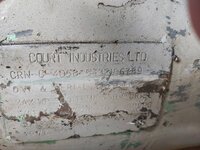
I have been looking for about a year and a half; never found the right combination of decent price as well as a compressor that has at least 15CFM. Two days ago I saw an add for this, went to see it and bought, even though I do not know what the CFM on it is. I got it for $200, which I figure is easily worth the price of the tank; incredibly thick and solid. From what I see, this tank would require another 50 + years before any chance of it rusting through. The tank has a Court Industries tag on it with a lot of numbers which I really do not know what they are for.

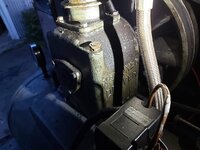
The pump is a Gardner Denver, a brand I have heard of...but that's it; I have heard of the name but know nothing about them like they are good or bad. Sam goes with the tank, I have heard of Court Industries, but that's it.

The motor looks like it has been changed. I am pretty sure it should do the trick, otherwise I can change it out.

My question is if anyone knows of this brand or any opinions on anything they see as not looking right?
 

Attachments

  • 20210728_204655.jpg
    20210728_204655.jpg
    178.5 KB · Views: 101
  • 20210728_204844.jpg
    20210728_204844.jpg
    211.4 KB · Views: 96
  • 20210728_204713.jpg
    20210728_204713.jpg
    268.8 KB · Views: 87
  • 20210728_204733.jpg
    20210728_204733.jpg
    122.9 KB · Views: 87
  • 20210728_122148.jpg
    20210728_122148.jpg
    315.6 KB · Views: 76
  • 20210728_204933.jpg
    20210728_204933.jpg
    274.1 KB · Views: 91
To avoid these ads, REGISTER NOW!

The Tool Tyrant

ALLIANCE MEMBER
Joined
Dec 19, 2011
Messages
2,181
Location
Bonita, Ca. (San Diego)
Well, you're not going to be happy with this, but with a 3" bore x 3.5" stroke @ 800 RPM, the DISPLACED (dcfm) is only 3.8 Actual (acfm) is usually approx. 25% less, so you're probably more like 2.86 ACFM.
 

FMB4

Well-known member
Joined
Jan 19, 2017
Messages
2,926
Ya, that pump is not original to the rest of the AC. It's a single cyl pump that may, or may not, meet your needs. The original pump was likely a twin cyl and possibly two stage. Anyway, if it doesn't work out for you, then I'd check the motor HP and RPM specs and chase down a 2 cyl pump that will work with those motor specs. You're looking at ~ $100 or so in good used condition (or much less if you poke around). Scrap yards can be a good source for such stuff. Btw, that tank looks like an ASME (spelling???) rated tank (with is a very good thing).
 
OP
F

FMC1959

Well-known member
Joined
Feb 9, 2014
Messages
2,305
Location
Montreal, Canada / Upstate NY
Well, you're not going to be happy with this, but with a 3" bore x 3.5" stroke @ 800 RPM, the DISPLACED (dcfm) is only 3.8 Actual (acfm) is usually approx. 25% less, so you're probably more like 2.86 ACFM.
I have never understood this. I think what you are referring to is the CFM at the pump. Most specs and what people generally care about it the CFM at the tank outlet.

If you take two 120 lb tanks, simply tank with no motor or pump on them. Setup a 1/2" outlet on one, and a 3/4" outlet. You will have different CFM on 2 identical tanks. You can do a similar test with a 20 gal, and a 120 gal tank, all tanks with the same outlet size. If you fill the 20 gal to 225 psi and the 120gal to 100 psi, the 20 gal will have a much higher cfm, although it won't sustain it for long, as where tha 120 gal will have less CFM flowing, but can sustain it for much longer as the air volume goes down slowly.

When you are talking 80-120 gal tanks, the volume goes down much slower and with tools that use low CFM, like an impact wrench, you can probably take off 4 wheels and re-install the 4 wheels, without the the motor licking in. So again, I see this as the CFM at the tank as being relevant. Once the motor does kick in, the CFM at the pump will determine if the tank can sustain a given CFM, or not, and for how long.

Another example is when people add a 2nd (or even 3rd) tank. People generally do this to keep the CFM at the tank outlet high and to avoid the pump/motor to kick' usually a situation where the pump/motor cannot keep with the required flow of the tool being used.

At least until the pump/motor kick in, all of the flow is determined at the tank outlet. Then, that is where the pump becomes important, needing fill the tank with air as it is also being consumed.

So, I see your point, but with the large tank, I probably won't notice the air deficit, except under high usage condition...like a die grinder or sander being run under close to constant use.

I will see as time goes on, but for my needs, I don't believe I will have many instances where I have a high CFM tool being used under sustained periods. If I am wrong and it happens more often than I thought, then I will look into changing the pump, like FMB4 mention, probably a 2 stage.
 
Last edited:
OP
F

FMC1959

Well-known member
Joined
Feb 9, 2014
Messages
2,305
Location
Montreal, Canada / Upstate NY
As FMB4 stated, and I am not sure what the designations are or mean, I noticed when loading onto my truck that the tank is very solid. When I knock on it with my hand, the sound is much different than most tanks. It almost does not sound hollow, so whatever the designation is, it probably means something like a very thick gauge steel is used.

The motor is definitely not original, a made in China, probably about 5 years old or so as everything in it seems pretty clean. As long as it works, great (it is also very quiet. Something not usually mentioned about an air compressor motor because the pump noise easily drowns it out. This pump is incredibly quiet, hopefully it is able to keep up enough that the need to change is not required because I love the sound it makes!
 

Xcursion88

Well-known member
Joined
Apr 18, 2013
Messages
785
As FMB4 stated, and I am not sure what the designations are or mean, I noticed when loading onto my truck that the tank is very solid. When I knock on it with my hand, the sound is much different than most tanks. It almost does not sound hollow, so whatever the designation is, it probably means something like a very thick gauge steel is used.

The motor is definitely not original, a made in China, probably about 5 years old or so as everything in it seems pretty clean. As long as it works, great (it is also very quiet. Something not usually mentioned about an air compressor motor because the pump noise easily drowns it out. This pump is incredibly quiet, hopefully it is able to keep up enough that the need to change is not required because I love the sound it makes!
Could be filled with a lot of water...hence the sound difference.

I have never understood this. I think what you are referring to is the CFM at the pump. Most specs and what people generally care about it the CFM at the tank outlet.

If you take two 120 lb tanks, simply tank with no motor or pump on them. Setup a 1/2" outlet on one, and a 3/4" outlet. You will have different CFM on 2 identical tanks. You can do a similar test with a 20 gal, and a 120 gal tank, all tanks with the same outlet size. If you fill the 20 gal to 225 psi and the 120gal to 100 psi, the 20 gal will have a much higher cfm, although it won't sustain it for long, as where tha 120 gal will have less CFM flowing, but can sustain it for much longer as the air volume goes down slowly.

When you are talking 80-120 gal tanks, the volume goes down much slower and with tools that use low CFM, like an impact wrench, you can probably take off 4 wheels and re-install the 4 wheels, without the the motor licking in. So again, I see this as the CFM at the tank as being relevant. Once the motor does kick in, the CFM at the pump will determine if the tank can sustain a given CFM, or not, and for how long.

Another example is when people add a 2nd (or even 3rd) tank. People generally do this to keep the CFM at the tank outlet high and to avoid the pump/motor to kick' usually a situation where the pump/motor cannot keep with the required flow of the tool being used.

At least until the pump/motor kick in, all of the flow is determined at the tank outlet. Then, that is where the pump becomes important, needing fill the tank with air as it is also being consumed.

So, I see your point, but with the large tank, I probably won't notice the air deficit, except under high usage condition...like a die grinder or sander being run under close to constant use.

I will see as time goes on, but for my needs, I don't believe I will have many instances where I have a high CFM tool being used under sustained periods. If I am wrong and it happens more often than I thought, then I will look into changing the pump, like FMB4 mention, probably a 2 stage.
Anything that with a big air appetite will not work so good for you.
While what you say is true to a point with the tank...it doesn't take much running an angle die grinder or a sander to drop the tank to a kick on pump level.
Then try running that tool while the pump is running. It won't stop running and your consumption will be more than it's making. A lot more.
 

Xcursion88

Well-known member
Joined
Apr 18, 2013
Messages
785
To add...your examples are only true on a full tank.
The moment air goes down the cfm starts decreasing.
Pump kicks on...replenishes the air...
 

GeoBruin

Well-known member
Joined
May 5, 2018
Messages
3,732
Well, you're not going to be happy with this, but with a 3" bore x 3.5" stroke @ 800 RPM, the DISPLACED (dcfm) is only 3.8 Actual (acfm) is usually approx. 25% less, so you're probably more like 2.86 ACFM.
I don't follow your math. How do you get 3.8 cfm from a 3" bore and 3.5" stroke at 800 rpm?
 

American Locomotive

Well-known member
Joined
Jan 8, 2017
Messages
10,928
Location
Rhode Island
I have never understood this. I think what you are referring to is the CFM at the pump. Most specs and what people generally care about it the CFM at the tank outlet.
It's actually the opposite. What most people care about is the CFM the pump is capable of. Even the tiniest tank can supply enough CFM to power the biggest air tool. But high consumption air tools quickly deplete tanks. Running things like plasma cutters, sanders, blast cabinets, die grinders, etc... all require a steady flow of air. A die grinder will deplete even a 120 gallon tank very rapidly if the pump can't keep up.

I don't follow your math. How do you get 3.8 cfm from a 3" bore and 3.5" stroke at 800 rpm?
3" bore and 3.5" stroke is 0.01416088 cubic feet. At 800 RPM, the piston will compressor air 800 times a minute. 800 x 0.01416088 = 11.45 CFM, which is actually pretty high.

So it's likely this compressor is capable of around ~10CFM @ 100 PSI or so. It's actually reasonably capable, assuming the pump is actually turning at 800 RPM. It'll likely need a 3HP motor to achieve that, though.
 
OP
F

FMC1959

Well-known member
Joined
Feb 9, 2014
Messages
2,305
Location
Montreal, Canada / Upstate NY
American Locomotive, you are right, especially in commercial applications where compressors do a lot of running....people care more about the CFM at pump...my bad.

So between your calculations and Tool Tyrant's calculations, I don't 100% understand it but definitely like your conclusions more.

The thing is, I have seen this before on GJ. , Someone uses a formula, such as Tool Tyrant used, then someone such as yourself, disputing the results using a different calculation. Before you know it, someone will come along and say "actually they are both wrong, this is the way...".

I kind of understand your formula and it makes sense, but as the pump gets older (this pump looks pretty old), I imagine the piston seaIs start to give and the amount of air being moved diminishes over time. I was wondering if there is some kind of gauge that you stick on the end of the hose and it gives a reading of air flow in CFM. I have seen similar type of gauges where you put the gauge between the hose and tool and this tell you how much CFM the tool is actually using, but yet to find one that measure just the flow from the compressor hose. Does one exist and not cost big $$$?
 
OP
F

FMC1959

Well-known member
Joined
Feb 9, 2014
Messages
2,305
Location
Montreal, Canada / Upstate NY

pcmeiners

Well-known member
Joined
Aug 13, 2009
Messages
7,825
Location
In the only town in Pennsylvania, Bloomsburg.
As to the motor, it is farm duty, which designates heavy duty and the (service factor) SF=1.15 is the old default for a compressor motor, usual now is SF=1.0, SF1.15 is better. A higher Service factor means the motor can produce a bit more than the label horse power.
Basically you did pretty good.
American Locomotive is a compressor guru around here, heed his advice.

"I was wondering if there is some kind of gauge that you stick on the end of the hose and it gives a reading of air flow in CFM."

You can can get a flow meter which measures the CFM BUT you need to follow standard parameters ( or a meter which compensates for variables of temperature, altitude, humidity) to get proper CFM. That said, most of the compressor manufacturers deviate from the standards as to CFM measurement.
 
Last edited:

American Locomotive

Well-known member
Joined
Jan 8, 2017
Messages
10,928
Location
Rhode Island
The formula Tool Tyrant used isn't right. It says "(Bore x Stroke x RPM/)2200". You can quickly realize that can't be correct, because increasing diameter causes the volume to increase by the square. It actually needs to be "(Bore² x Stroke x RPM)/2200”. You do that, and you'll get the 11.45 CFM.

You'll have to check the pulley sizes to figure out the RPM your pump runs at. Divide the diameter of the big pulley by the small one. Then divide the motor RPM (1750) by the number you get from the first calculation to get pump RPM.

At 2HP, you should be able to get 6-7 CFM out of that pump without overloading the motor.
 

tre873

Well-known member
Joined
Mar 1, 2017
Messages
607
Location
NE TX
You can also use the following website to get your pump speed. It seems to be pretty sccurate.
 
OP
F

FMC1959

Well-known member
Joined
Feb 9, 2014
Messages
2,305
Location
Montreal, Canada / Upstate NY
As to the motor, it is farm duty, which designates heavy duty and the (service factor) SF=1.15 is the old default for a compressor motor, usual now is SF=1.0, SF1.15 is better. A higher Service factor means the motor can produce a bit more than the label horse power.
Basically you did pretty good.
American Locomotive is a compressor guru around here, heed his advice.

"I was wondering if there is some kind of gauge that you stick on the end of the hose and it gives a reading of air flow in CFM."

You can can get a flow meter which measures the CFM BUT you need to follow standard parameters ( or a meter which compensates for variables of temperature, altitude, humidity) to get proper CFM. That said, most of the compressor manufacturers deviate from the standards as to CFM measurement.
Thanks
The formula Tool Tyrant used isn't right. It says "(Bore x Stroke x RPM/)2200". You can quickly realize that can't be correct, because increasing diameter causes the volume to increase by the square. It actually needs to be "(Bore² x Stroke x RPM)/2200”. You do that, and you'll get the 11.45 CFM.

You'll have to check the pulley sizes to figure out the RPM your pump runs at. Divide the diameter of the big pulley by the small one. Then divide the motor RPM (1750) by the number you get from the first calculation to get pump RPM.

At 2HP, you should be able to get 6-7 CFM out of that pump without overloading the motor.
The big pulley on the pump, did not get a chance to measure it, but did notice yesterday that it turns quite easily. My buddy helping said that motor should have zero issues turn that pump. When running, it has a really low pitch sound, easy to talk over. I have only heard sounds like this on really old equipment.
You can also use the following website to get your pump speed. It seems to be pretty sccurate.
Thanks
 

American Locomotive

Well-known member
Joined
Jan 8, 2017
Messages
10,928
Location
Rhode Island
The force on the motor depends on the belted pump speed. If it's belted to run at 300 RPM, it will put the motor at very little load, but also only make maybe 3-4 cfm.
 
OP
F

FMC1959

Well-known member
Joined
Feb 9, 2014
Messages
2,305
Location
Montreal, Canada / Upstate NY
I checked the wheel/pulley. The large one on the pump, it measures 16" but take into account there is 1/2" groove for the belt; so does that make it a 15 1/2" wheel or a straight 15" wheel (taking a 1/2" each side) The smaller pulley on the motor is about 4 3/4" but again taking into account the groove depth, about 3/8 to 1/2", this would leave a 4" wheel, maybe as small as 3 3/4".
 

tre873

Well-known member
Joined
Mar 1, 2017
Messages
607
Location
NE TX
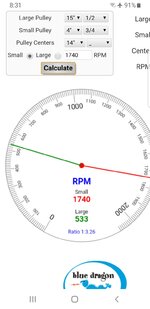
Using the calculator in the link...
 

Attachments

  • Screenshot_20210801-203103_Samsung Internet.jpg
    Screenshot_20210801-203103_Samsung Internet.jpg
    91.4 KB · Views: 41
To avoid these ads, REGISTER NOW!

tre873

Well-known member
Joined
Mar 1, 2017
Messages
607
Location
NE TX
I don't see a link. There is only an attachment, which is a screenshot of what looks like a calculator to get the CFM. But again, it isn't working as it is only a screenshot
The link is in post #16.
 

The Cobbler

Super Moderator
Staff member
Joined
Oct 24, 2013
Messages
25,802
Location
Niagara Region, Ontario, Canada
You can also use the following website to get your pump speed. It seems to be pretty sccurate.

Using the calculator in the link...

I don't see a link. There is only an attachment, which is a screenshot of what looks like a calculator to get the CFM. But again, it isn't working as it is only a screenshot
the link was in a previous post. the screenshot is a shot from that link, all quoted above
 

tre873

Well-known member
Joined
Mar 1, 2017
Messages
607
Location
NE TX
I am getting 517 rpm. This is for the large pulley being 16", and the small at 4 3/4", motor having 1740 rpm.
I just glanced at your post with the pulley sizes and 15.5 stuck with me for some reason and that's what I plugged into the calculator. Oops..
 
OP
F

FMC1959

Well-known member
Joined
Feb 9, 2014
Messages
2,305
Location
Montreal, Canada / Upstate NY
The pump says 800 rpm right on it, which I assume would be either the max or recommended rpm. If I play around and change the small pulley on the motor from 4 3/4" to 8", it says I would get 870 rpm. Anyway, playing with pulley size, as I get the pump going faster, is there a general rule that strain will be more evident on the motor, or more on the pump?

And going to an 8" pulley, giving 870 rpm on the pump, which is rated at 800 rpm; would this be considered a small amount over the recommended and not be a factor for the pump, or are compressor pumps delicate about their top rpm?

As far as the motor, I am guessing to check it when the compressor reaches pressure and stops. If it is close to untouchable hot...not good. If it is warm but can keep my hand on it, and no funky smells; then the motor isn't have problems with the 8" pulley?
 

tre873

Well-known member
Joined
Mar 1, 2017
Messages
607
Location
NE TX
I wouldn't go over the recommend rpm. The slower you spin the pump, the longer it will last.
 

American Locomotive

Well-known member
Joined
Jan 8, 2017
Messages
10,928
Location
Rhode Island
The pump will be fine (and would likely be fine at 870 RPM, too), but the motor will not be able to handle that pump at 800 RPM at full pressure (120 PSI). You will need at least a 3HP motor to run that pump at 750-800 RPM.
 

The Tool Tyrant

ALLIANCE MEMBER
Joined
Dec 19, 2011
Messages
2,181
Location
Bonita, Ca. (San Diego)
The formula Tool Tyrant used isn't right. It says "(Bore x Stroke x RPM/)2200". You can quickly realize that can't be correct, because increasing diameter causes the volume to increase by the square. It actually needs to be "(Bore² x Stroke x RPM)/2200”. You do that, and you'll get the 11.45 CFM.

Well hell! I should have caught that myself....boy do I feel embarrassed! Thanks for the correction American Locomotive!
 
OP
F

FMC1959

Well-known member
Joined
Feb 9, 2014
Messages
2,305
Location
Montreal, Canada / Upstate NY
The pump will be fine (and would likely be fine at 870 RPM, too), but the motor will not be able to handle that pump at 800 RPM at full pressure (120 PSI). You will need at least a 3HP motor to run that pump at 750-800 RPM.
Where are you getting "full pressure 120 PSI"? Is it a calculation or did you see it listed somewhere? I ask because I was with a buddy who understands compressor a bit more than me, but would not consider himself an expert. When we got the electrical setup and got the compressor working, he played with a screw under the black plastic square thingy that has the start switch on it. The max pressure went from about 125-130 to 150, which I thought was fine, so we left it there.
 
OP
F

FMC1959

Well-known member
Joined
Feb 9, 2014
Messages
2,305
Location
Montreal, Canada / Upstate NY
The pump will be fine (and would likely be fine at 870 RPM, too), but the motor will not be able to handle that pump at 800 RPM at full pressure (120 PSI). You will need at least a 3HP motor to run that pump at 750-800 RPM.
Then also the motor, some motors a bulletproof and can take whatever you throw at them. Then some cheap motors have trouble hitting rated numbers without getting into difficulty.

So question is, If I play around with the pulleys, and as you feel that even 870 rpm should not be a problem for the pump, what are things to look for, a motor that is struggling and won't last at whatever the given output is?
 
To avoid these ads, REGISTER NOW!
Top Bottom