To avoid these ads, REGISTER NOW!

Foundation Plumbing Methods

scootermcrad

Well-known member
Joined
Nov 26, 2011
Messages
405
Location
Concord, NC
Hey everyone! Been a minute since I've posted. Garage design 3,576, in-process. Getting closer to something I might actually build, though.

I'm working on a foundation layout and looking for some details for plumbing. Cold water in and drain/septic/sewage out. The foundation type will be footer with block stem walls. Detached building.

Does the plumbing have to pass through the stem wall, presumably at the first course of block (?), and penetrate the slab before jogging up into the wall cavity? OR! Is there an acceptable method to enter the wall cavity through the block stem wall, through the sole plate, and into the wall cavity so it doesn't have to be in the floor space? The stem walls and slab will most likely be insulated with rigid foam, as well.

I'm in North Carolina and can't seem to find a good detail that shows acceptable configurations, per current building code. I could be looking in the wrong place, though. Any proper foundation plumbing methodology that could be shared here, would be appreciated!

Thank you!
 
Last edited:
To avoid these ads, REGISTER NOW!
OP
S

scootermcrad

Well-known member
Joined
Nov 26, 2011
Messages
405
Location
Concord, NC
Additional details about the planned plumbing for the building
Upstairs: small bathroom and will add a kitchenette later, water heater will be upstairs.
Main shop level (on-grade): only a small wash sink. Hot water fed from upstairs water heater. Drain for sink. No floor drain.
Outside: hose spigot close to water line entry point and far side of building
 
OP
S

scootermcrad

Well-known member
Joined
Nov 26, 2011
Messages
405
Location
Concord, NC
I've been pouring over people's builds and searching, but still haven't come up with what I'm looking for. It seems like everyone who has upstairs plumbing in their shop (apartment, office, etc.) are coming up through a planned interior wall, like a stairway wall. Not seeing any direct wyes up through the foundation into an exterior wall. But I don't recall seeing where anyone has come up through their slab and jogged into the wall cavity, either.

What am I missing? Anyone with upstairs plumbing in their shop care to comment or share about how you handled this?

Additional information, on my potential layout:
- block on poured footer foundation
- shop level sink will be at the opposite end of the building from the upstairs plumbing
- upstairs plumbing will be at the end closest to the inlet/exit, closest to cold water in and septic septic (which is why I would prefer to go up through that exterior wall)
 

doctordirt

Well-known member
Joined
May 15, 2014
Messages
492
Typically, a sewer would pass under the footing if the depth allowed. A septic line would pass through wall as they are much shallower. Here in Michigan our water needs to be 4 ft. deep. So on a full basement thru the wall, crawl space under the footing.
 

BobnCO

Well-known member
Joined
Apr 2, 2023
Messages
200
Both would work particularly for your climate location. Many times the preference is to pass through or under your stem wall (as DrDirt points out this depth fully depends where the sewer line is going, distance and fall), then up an interior wood frame wall for ease of block laying and plumbing. But you can go up the block wall if there are no interior walls that work. It is a little more work for the mason… and would try n lay out plumbing so it lands in the block voids. Best to start talking to plumber (maybe that’s you) and mason early. My 2cents..
 
OP
S

scootermcrad

Well-known member
Joined
Nov 26, 2011
Messages
405
Location
Concord, NC
Both would work particularly for your climate location. Many times the preference is to pass through or under your stem wall (as DrDirt points out this depth fully depends where the sewer line is going, distance and fall), then up an interior wood frame wall for ease of block laying and plumbing. But you can go up the block wall if there are no interior walls that work. It is a little more work for the mason… and would try n lay out plumbing so it lands in the block voids. Best to start talking to plumber (maybe that’s you) and mason early. My 2cents..
Thankfully, water and septic are pretty close to where the building will be. Septic tie-in is about 20 feet away from the closest wall, cold water feed about 30 feet. Very convenient. The horizontal distance to that exterior wall where the plumbing enters the foundation will probably about 8 feet. So pretty short runs. The foundation will probably only be 3 course of block at that location, as well. So if the mason could navigate those few courses, then that would be great.

This is part of the reason I'm asking these questions now. I'm doing all the CAD work and layout myself, and want to nail down all the details so I can have educated conversations with subs and contractors before agreeing to anything. I have not been able to find a detailed rough-in drawing that shows the drain going up through those courses of block. If I can create all the details myself and have an engineer review and approve them, that could save me quite a bit of money, that I can put back in the building, but also it feels like knowing every detail inside and out, only makes everything better. I will most likely be doing all the framing myself, and will hire the foundation work.
 

Rusted Nut

Well-known member
Joined
Dec 11, 2022
Messages
1,805
Location
PNW
Typically a sewer line would go under the footer, if grade allows. If not you can through the footer, with extra depth and reinforcement. You can also go through the wall if grade dictates that. You can buy a link seal to run the plumbing line through, for waterproofing. Plumbing can go most anywhere. Make sure you have sufficient depth for your local area on all you plumbing outside the building for freezing issues.
 

larry4406

Well-known member
Joined
Jan 27, 2006
Messages
19,089
Location
Northern Virginia
Actually, you work backwards from the outfall. This is where a site plan with elevations and distances is helpful/vital.

Let me explain this further. Your sewage goes somewhere. You need to determine how far away from your structure and how deep this existing outfall is. Knowing this, you can determine how far you can run the sewer lateral to your structure.

Your last post says the septic tie in is about 20' away from the closest wall. So, lets assume that your septic pipe is 4", so that means its 4.5" outside diameter. But we don't know how deep the bottom of the existing pipe is relative to grade and your top of slab, nor do we know the thickness of your slab.

Your plumbing ground works, if running below the slab, need to be fully below the slab (ie you can't encapsulate part of your horizontal ground works in the slab as it weakens the slab). So, from your design, you know your slab thickness, its elevation, the outside diameter of your pipe, and therefore the elevation of the bottom of a pipe that would be below your slab if it just kissed the bottom of the slab. Knowing this, will the sewer lateral at 1/4"/ft make the 20' run and tie into the existing septic pipe? Bare in mind, that 20' at 1/4" per foot is only 5" of rise.

In some instances, there is "plenty of grade" available to the outfall, so the ground works and stacks can be run anywhere that is most convenient as the vertical margin is more than enough. When this happens, the ground works are run below the footing.

In many instances, the vertical margin to the outfall is minimal. When this happens, the structure gets one stack at the closet point. From there, the DWV piping is run within the structure above slab and referred to as a hung sewer. The sewer later (buried basement) enters the buried wall above slab grade.

In some instances, you can't get there from here as gravity sewer won't work due to elevations, distances, etc. This is when a grinder pump comes in to play.

I have not seen a sewer lateral within a block or foundation wall in the vertical arrangement that later turns horizontal. I can see where you might like this so as to get the stack within the exterior framed wall while avoiding a framed box around it.
 
OP
S

scootermcrad

Well-known member
Joined
Nov 26, 2011
Messages
405
Location
Concord, NC
Realizing NC isn't real cold but still, I have a rule- no water piping in an outside wall. Dealt w/ frozen pipes too many times.
Yeah, as someone that grew up in Iowa, that is definitely a legit concern and it definitely gets cold enough where we're at to worry about that. Unfortunately, the only interior wall will be all the way at the other end of the building, about as far away from the septic and water service as could possibly be. So I guess we'd have to take extra care to make sure that the cavity was properly insulated.
 
To avoid these ads, REGISTER NOW!
OP
S

scootermcrad

Well-known member
Joined
Nov 26, 2011
Messages
405
Location
Concord, NC
Typically a sewer line would go under the footer, if grade allows. If not you can through the footer, with extra depth and reinforcement. You can also go through the wall if grade dictates that. You can buy a link seal to run the plumbing line through, for waterproofing. Plumbing can go most anywhere. Make sure you have sufficient depth for your local area on all you plumbing outside the building for freezing issues.
Yeah, that seems reasonable, considering the depth of the footer and the location of the septic, relative that should work out. The dept of the dig for the footer in that area should be about 20-inches (or more) above the depth of the septic tank inlet. My only concern, if I wanted to go straight into blocks, would be going up through the poured footer to access the block cavity and sole plate directly.
 
OP
S

scootermcrad

Well-known member
Joined
Nov 26, 2011
Messages
405
Location
Concord, NC
Actually, you work backwards from the outfall. This is where a site plan with elevations and distances is helpful/vital.

Let me explain this further. Your sewage goes somewhere. You need to determine how far away from your structure and how deep this existing outfall is. Knowing this, you can determine how far you can run the sewer lateral to your structure.

Your last post says the septic tie in is about 20' away from the closest wall. So, lets assume that your septic pipe is 4", so that means its 4.5" outside diameter. But we don't know how deep the bottom of the existing pipe is relative to grade and your top of slab, nor do we know the thickness of your slab.

Your plumbing ground works, if running below the slab, need to be fully below the slab (ie you can't encapsulate part of your horizontal ground works in the slab as it weakens the slab). So, from your design, you know your slab thickness, its elevation, the outside diameter of your pipe, and therefore the elevation of the bottom of a pipe that would be below your slab if it just kissed the bottom of the slab. Knowing this, will the sewer lateral at 1/4"/ft make the 20' run and tie into the existing septic pipe? Bare in mind, that 20' at 1/4" per foot is only 5" of rise.

In some instances, there is "plenty of grade" available to the outfall, so the ground works and stacks can be run anywhere that is most convenient as the vertical margin is more than enough. When this happens, the ground works are run below the footing.

In many instances, the vertical margin to the outfall is minimal. When this happens, the structure gets one stack at the closet point. From there, the DWV piping is run within the structure above slab and referred to as a hung sewer. The sewer later (buried basement) enters the buried wall above slab grade.

In some instances, you can't get there from here as gravity sewer won't work due to elevations, distances, etc. This is when a grinder pump comes in to play.

I have not seen a sewer lateral within a block or foundation wall in the vertical arrangement that later turns horizontal. I can see where you might like this so as to get the stack within the exterior framed wall while avoiding a framed box around it.
Thanks for the great explanation!! I appreciate you taking the time to do that.

I do think I probably have enough grade above the elevation of the septic tank to run under the footing! This would also explain why I haven't seen a rough-in detail that goes straight up into the block and wall cavity.

I may need to rethink all this so that the shop sink is the primary location for the sewer/septic to penetrate up through the slab and then can dive into the wall cavity behind it. I don't think this would be an unreasonable arrangement. Also avoiding a framed or boxed in portion in the shop floor space.

We are most likely going to have the septic updated at the same time, so I could have a lot of this work done "while I'm in there", or at least have the wye in the septic tank main to tap-in at easily with a simple dig and connect.
 
Last edited:

OccupantRJ

Well-known member
Joined
May 15, 2009
Messages
10,982
Location
Eastern North Carolina
Yeah, as someone that grew up in Iowa, that is definitely a legit concern and it definitely gets cold enough where we're at to worry about that. Unfortunately, the only interior wall will be all the way at the other end of the building, about as far away from the septic and water service as could possibly be. So I guess we'd have to take extra care to make sure that the cavity was properly insulated.
I am in the Goldsboro area and my stick built insulated shop generally gets no lower than 45 degrees f inside when there is no heat on in the shop. It would have to be a week in the teens to bring it much lower, if this helps you any.
 
OP
S

scootermcrad

Well-known member
Joined
Nov 26, 2011
Messages
405
Location
Concord, NC
I am in the Goldsboro area and my stick built insulated shop generally gets no lower than 45 degrees f inside when there is no heat on in the shop. It would have to be a week in the teens to bring it much lower, if this helps you any.
Yep! It would be rare to see temps that do damage. I generally try to plan for it anyway, though. Last year we had a handful of days where things got to that level and knew a bunch of people that had serious issues. Handful of years ago we saw 8-degrees, also. We weren't prepared for that, at all. But, to your point... it's rare to see crazy pipe-freezing weather in our area.

RJ, without getting too off-topic, did you build your own building, or was it hired out? I know every county is a little bit different, and you being in the Eastern portion of NC have some interesting hurdles, but I've been curious about hurdles with self-builds, in North Carolina.
 
OP
S

scootermcrad

Well-known member
Joined
Nov 26, 2011
Messages
405
Location
Concord, NC
Thanks everyone for your responses! It's definitely helping make some decisions. Wish I had some visuals to show you of the proposed site plan, but still working through that. One of these days, I might actually kick this build off.
 

OccupantRJ

Well-known member
Joined
May 15, 2009
Messages
10,982
Location
Eastern North Carolina
Yep! It would be rare to see temps that do damage. I generally try to plan for it anyway, though. Last year we had a handful of days where things got to that level and knew a bunch of people that had serious issues. Handful of years ago we saw 8-degrees, also. We weren't prepared for that, at all. But, to your point... it's rare to see crazy pipe-freezing weather in our area.

RJ, without getting too off-topic, did you build your own building, or was it hired out? I know every county is a little bit different, and you being in the Eastern portion of NC have some interesting hurdles, but I've been curious about hurdles with self-builds, in North Carolina.
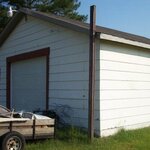
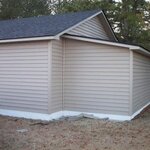
Mine started out as a 26x26 backyard garage built by previous owner amateurs. It was stick framed and directly covered only by masonite lap siding. It did have a new garage door though. At the time we moved here you could stand on a step ladder at a roof corner and sway the building slightly by hand.
I stripped it one wall at a time, squared it up with a come along, installed 1/2” OSB sheathing, then wrap and vinyl siding. I then stripped and redid the roof, and along the way added an 8x20 shed roof room onto the rear, along with a shed roof 10x26 room on the left side.
The inside was insulated and covered with 1/2” BC plywood, and the ceiling with 7/16 OSB. I did all the work except for a coworker pouring the added concrete and hired the shingles out because it was 98 degrees at the time. This was done in 2010 and I only spent $7,000 for the “remodel”.
Permit? I didn’t get no steenkin‘ permit! 😤 I live at the edge of town and nobody ever noticed my “repairs” because I painted all the sheathing the original building color on my working weekends with cheapest paint as fast as it went up. Raw OSB didn’t have the “stealth“ look I prefered.
 

Attachments

  • 435274F4-3448-4F32-A401-479D43F70259.jpeg
    435274F4-3448-4F32-A401-479D43F70259.jpeg
    31.3 KB · Views: 7
  • F7D5BCF4-B71C-4181-8DB5-ECE2CD8A2F9C.jpeg
    F7D5BCF4-B71C-4181-8DB5-ECE2CD8A2F9C.jpeg
    35.7 KB · Views: 7
  • 8C39A634-9732-4FFB-872C-97E8AD1FB9FD.jpeg
    8C39A634-9732-4FFB-872C-97E8AD1FB9FD.jpeg
    36 KB · Views: 7
OP
S

scootermcrad

Well-known member
Joined
Nov 26, 2011
Messages
405
Location
Concord, NC
Mine started out as a 26x26 backyard garage built by previous owner amateurs. It was stick framed and directly covered only by masonite lap siding. It did have a new garage door though. At the time we moved here you could stand on a step ladder at a roof corner and sway the building slightly by hand.
I stripped it one wall at a time, squared it up with a come along, installed 1/2” OSB sheathing, then wrap and vinyl siding. I then stripped and redid the roof, and along the way added an 8x20 shed roof room onto the rear, along with a shed roof 10x26 room on the left side.
The inside was insulated and covered with 1/2” BC plywood, and the ceiling with 7/16 OSB. I did all the work except for a coworker pouring the added concrete and hired the shingles out because it was 98 degrees at the time. This was done in 2010 and I only spent $7,000 for the “remodel”.
Permit? I didn’t get no steenkin‘ permit! 😤 I live at the edge of town and nobody ever noticed my “repairs” because I painted all the sheathing the original building color on my working weekends with cheapest paint as fast as it went up. Raw OSB didn’t have the “stealth“ look I prefered.
Ah yes. Can't say I would have handled it any different. Good recovery!

We've had an on-going permit nightmare, from a contractor that made a mess of our renovation job, and we're FINALLY about to close the permit after 9 years. After living this process for almost a decade, I've decided I will be taking some different approaches, in the future. It has been quite an eye-opener. I will say, to the credit of the county we live in, our inspectors have always been really great and haven't given us a hard time, BUT the process itself was clunky, excessive, inconsistent in it's requirements, and their documentation in their database was lacking, which made it even more difficult. Ultimately, all leading to reasons people tend to avoid the process that really could be different or better.

The shop I can't get around pulling a permit for, but am hoping to keep the drama to a bare minimum. And I refuse to start the build until I know I can have relevant permits closed within a year. (fingers crossed) Planning and doing as much leg work as possible ahead of time is cheap/free labor and will only make all this go smoother and better understand the details of the build and the process to make it real.
 

dscheidt

Well-known member
Joined
Apr 26, 2017
Messages
2,888
Your plumbing ground works, if running below the slab, need to be fully below the slab (ie you can't encapsulate part of your horizontal ground works in the slab as it weakens the slab).

There are times when lateral lines are run through slabs. Typically they form around them and put them in a grade beam or similar deeper slab area, so there's not a thin spot. When the top of the pipe is below the top of the slab by whatever amount the engineer is happy with, they bury the pipe. I think they sleeve the pipe to allow some independent movement. a pump is probably easier, though.
 

larry4406

Well-known member
Joined
Jan 27, 2006
Messages
19,089
Location
Northern Virginia
There are times when lateral lines are run through slabs. Typically they form around them and put them in a grade beam or similar deeper slab area, so there's not a thin spot. When the top of the pipe is below the top of the slab by whatever amount the engineer is happy with, they bury the pipe. I think they sleeve the pipe to allow some independent movement. a pump is probably easier, though.
Yes there are exceptions. A normal 4" slab, one would not weaken it by encapsulating a pipe in it.
 
To avoid these ads, REGISTER NOW!
Top Bottom