To avoid these ads, REGISTER NOW!

Foundation question?

mosyoak1983

New member
Joined
Sep 28, 2015
Messages
4
Location
virginia
I have been wracking my brain and searching all over the internet for the proper way to build the foundation for my 30x40 garage. I would like to have a stem wall on the perimeter but I'm concerned about a floating concrete slab. Is this concern founded or should I just pour the slab over the stem wall and tie it in with rebar to the footings?
 
To avoid these ads, REGISTER NOW!

larry4406

Well-known member
Joined
Jan 27, 2006
Messages
19,101
Location
Northern Virginia
Welcome to the forum. Update your profile with a location (state, country, etc) as what works in Florida might not apply to Alaska.

Here in VA and MD my company does the following:
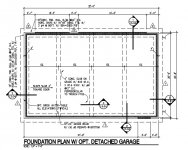
Pour an 8" concrete wall, put a 4" slab ledge on the inside. IF the ground is adequate for a slab on grade, then prep slab as normal and the slab perimeter will bear on your slab ledge. This rarely happens in my subdivisions.

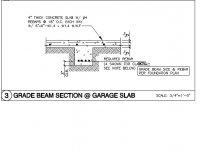
If the earth is fill (most case for me), then put pockets in the stem walls for grade beams, form grade beams with steel, and pour the grade beams integral with the slab.

Pictures attached. Hope these help.

I like the stem wall as it helps address adverse grade as my lots are rarely level. With a stem wall you can backfill against it. In our area if the 4" stem section would exceed 24' of exposure, we will upsize the concrete wall (i.e, 8-inch wall would go to 10" and still keep 4 inch interior slab ledge).
 

Attachments

  • Foundation Plan View.jpg
    Foundation Plan View.jpg
    93.2 KB · Views: 165
  • Detail at Foundation Wall.jpg
    Detail at Foundation Wall.jpg
    51.7 KB · Views: 187
  • Detail at Garage Door.jpg
    Detail at Garage Door.jpg
    51.6 KB · Views: 174
  • Grade Beam Section.jpg
    Grade Beam Section.jpg
    49.2 KB · Views: 158
Last edited:

Kevin54

MEMBER EMERITUS
Joined
Jan 12, 2005
Messages
29,341
Location
Urbana, Ohio
Like Larry stated.....put a location in your profile so we know where you are at, and it would be way simpler to answer the questions. Chances are you have someone real close that can answer the question with facts.

Welcome to Garage Journal!!!!
 

DTE

Well-known member
Joined
Jul 13, 2013
Messages
996
Location
North Carolina
I poured my slab so it floats, I used a 1/2 inch thick foam expansion joint around the perimeter and poured the slab against that , and that separates the slab from the wall. The stuff I used is 1/2 inch thick and 4 inches tall, when done you can go back and peel the top 1/2 inch off and fill that void with sealer. I did not tie my slab to the wall. And we cut control joints also.
 
OP
M

mosyoak1983

New member
Joined
Sep 28, 2015
Messages
4
Location
virginia
Thanks guys for the quick responses. I live in Virginia so the pictures were definitely helpful. I had a couple questions after looking at those plans. 1. What is the 2 inch pocket at the garage door for? 2. Is there an expansion joint around the slab? 3. If I want 2x6 stud walls how does that work with the 4 inch ledge, just build a 10 inch stem wall? 4. What makes the ground adequate for a slab on grade?

Also Larry if you see this, do you have any pictures of the pockets your talking about in the stem wall? thanks again...
 
Last edited:
To avoid these ads, REGISTER NOW!

larry4406

Well-known member
Joined
Jan 27, 2006
Messages
19,101
Location
Northern Virginia
mosyoak1983 - Answers to your numbered questions:

1. The 2-inch pocket at the garage door creates what is called a weather lip. The garage door seals in this depressed area. Driving rain under the door seal cannot climb the ledge. I personally do not like this feature and prefer to have the concrete sloped in this area but dead level in the plane of the door. The lip is a PIA when you are rolling floor jacks in and out. The sloped version is much nicer to roll in and out. I recommend you omit the weatherlip and slope your slab if you think you will roll jacks in and out.

2. The slab is poured tight to the stem walls, no expansion joint.

3. For 2x6 framed walls you can change the stem wall to 10" (6" for framing, 4" for ledge) or keep the 4" stem from the 8" wall, let the sill plate overhang the stem on the interior, and then build a pony wall to the slab. This lets you drywall all the way to the slab but be careful of getting the drywall wet when hosing out the garage. 10" walls are more expensive than 8" walls and the 10" walls also need a wider footing (more $).

4. I see you are in VA as well, so here we typically look for soils which can support 2500 PSF (pounds per square foot). A geotech tests the soils for capacity and ensures that there is no organic materials or root matter. Often folks will want to fill the foundation interior with gravel or compacted sand after removing the top soil, but the $ for these and monitoring of compaction can quickly exceed the price point of going to a structural slab with grade beams. Structural vs slab on grade can be advised by your geotech engineer.

I will be pouring a foundation in the next week or so, and I will try to snap some pictures of the garage stem wall and grade beam details for you.
 
OP
M

mosyoak1983

New member
Joined
Sep 28, 2015
Messages
4
Location
virginia
Thanks Larry. That was a big help, I learn a little bit more everyday from guys like you on the forum. It is much appreciated.
 

larry4406

Well-known member
Joined
Jan 27, 2006
Messages
19,101
Location
Northern Virginia
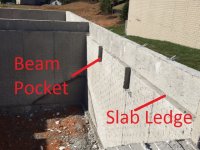
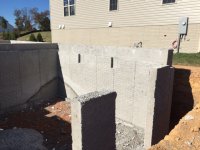
As promised, attached are pictures of the garage foundation walls of a house of mine under construction.

The walls are 10" thick and happen to be 9' tall due to the existing grade and soils. Note the 4" interior slab ledge and the pockets where the grade beams will tie in. The slab ledge runs around 3 sides and there are matching grade beam pockets on the wall opposite that shown. There is a 6" stem wall remaining for the 2x6 stud framing. The garage slab entrance will turn down onto the foundation wing walls and the central pier shown in the 2nd picture and the turn down will be below the frost line.

I will post pictures of the structural slab prep when it gets to that phase.
 

Attachments

  • Garage Walls.jpg
    Garage Walls.jpg
    130.4 KB · Views: 95
  • Garage Walls pier and wing walls.jpg
    Garage Walls pier and wing walls.jpg
    124.8 KB · Views: 87

matt_i

Well-known member
Joined
Mar 14, 2008
Messages
10,725
Location
SE Michigan
In my current build of 25' x 40', I built classic footer with 3 tracks of reinforcing steel, 8" wall that is straight up with no ledge. There are #4 rebars @ 16" on centers on both directions tying the wall to the footer and reinforcing the wall itself. Adding all of the rebar adds time and effort to bend, measure, and tie, but I feel like its well worth it to prevent any problems down the road.

6" slab about a week from pour with #4 rebar on 16" centers, sitting on 2" chairs. It will mostly float but feel like I need to pin it to the building next to it that I'm adding on to, for alignment. I have no grade beams, but there is a 4-5" crushed & washed limestone base that's compacted underneath. This is #6A stone, in Georgia its #57, basically 3/4" limestone which is washed and without the dusty fines that you'd have in something like "crusher run". The heavier slab is purposefully designed for heavy metalworking machinery and rigging forklift traffic (iow not constant traffic like a warehouse area). I bought, literally, a ton of rebar to go into this project.

If you have a larger time window, mother nature will do a great job of compacting the soil, but on a builder's timetable where one understandably wants to keep going in order to produce cash flow, things like jumping jacks and plate compactors do a good job of compressing the time window. Of course this is typically also an additional cost rental device that has to be delivered and picked up from the jobsite.
 
Last edited:

larry4406

Well-known member
Joined
Jan 27, 2006
Messages
19,101
Location
Northern Virginia
As promised, attached are pictures of the structural slab prep. This is the same house as the prior pictures.

The final slab elevation was determined based on the engineered site plan and calculation of the deck height with door sill to ensure no unnecessary stair risers. Our garage slabs have a 3" slope towards the front and then the 1" depression for the weather lip. I personally do not like the weather lip as it impedes rolling jacks in and out and chose a ramped section at the garage door instead when I built my prior shop.

The loose back fill was dug manually to create a trench for the grade beams. Vapor barrier was then applied. Rebar per plan was then added to the grade beams (note how the rebar turns down into the grade beam pockets in the foundation walls). Lastly the rebar matrix and welded-wire-fabric for the slab is positioned.

After inspection, concrete is placed and the concrete grade beams are then integral with the slab. The beams bear on the foundation pockets while the slab bears on the foundation slab ledge. The loose fill can settle as it wishes as it no longer provides a function (its only function was the mold).
 

Attachments

  • Structural Slab Prepped.jpg
    Structural Slab Prepped.jpg
    63.1 KB · Views: 68
  • Structural Slab Grade Beam Detail.jpg
    Structural Slab Grade Beam Detail.jpg
    130.6 KB · Views: 65
  • Structural Slab Grade Beams.jpg
    Structural Slab Grade Beams.jpg
    60.5 KB · Views: 68
To avoid these ads, REGISTER NOW!
Top Bottom