

You are using an out of date browser. It may not display this or other websites correctly.
You should upgrade or use an alternative browser.
You should upgrade or use an alternative browser.
Framing a garage
- Thread starter Bedrok
- Start date
94legaleagle
Well-known member
- Joined
- May 7, 2009
- Messages
- 294
go to a local bookstore or to a local home supply center and get a 12 - 15 dollar book on framing - that's all you need!
GSSFC
Well-known member
A garage is really no different than any other structure. You have some framing experience I assume?
Tim
Tim
ddawg16
Well-known member
A garage is really no different than any other structure. You have some framing experience I assume?
Tim
Tim....your being gentle....
Bedrok.....if this is the first time you have done any framing....I would suggesting getting some help from someone who has.....books are good references.....but....there are a lot of little things the book does not cover....
But...here are a couple of important points....
16"...The most important #. Make sure you have those studs on 16" centers....you will understand why when you start to put up shear walls.
Measure, measure, and then measure again.
The plumb bob is the most accurate and simple instrument ever made. Pick one corner...get it plumb....go from there. Check plumb as you go...
Level...once you have that first corner plumb and at the height you want....go to the far corner and make sure that it's level and plumb.
Inset your sole plate about 1/2" from the edge of the stem wall....that way your shear wall will be flush with the edge.....ask me how I know this is important......
There is a lot more....don't be afraid to ask questions....and make sure you post pics.
ghnl
Well-known member
Salem747
Well-known member
A couple of tools that you must have: 4' level, 4' t square, carpenter's square, sledgehammer for bumping things into place, survey string with level, 100' tape.
Nice to have tool: I can't say how much I love this thing. Normally I am not much of a nail guy, I prefer screws and my 1/4" cordless impact. But this thing is awesome! http://www.paslode.com/cordless-nailers/imct/ I bought 5000 bright nails and used 1/2 on my garage and I have almost finished a 2500 box of coated nails. I use it all the time.
Nice to have tool: I can't say how much I love this thing. Normally I am not much of a nail guy, I prefer screws and my 1/4" cordless impact. But this thing is awesome! http://www.paslode.com/cordless-nailers/imct/ I bought 5000 bright nails and used 1/2 on my garage and I have almost finished a 2500 box of coated nails. I use it all the time.
Just take your time, do some reading, ask questions and think things through.
A framing nailer has help out alot, you can use it for framing and nailing the sheeting on the walls/roof.
A framing nailer has help out alot, you can use it for framing and nailing the sheeting on the walls/roof.
If you plan on 2 x 6s @ 24" on center check with local building official to see if they allow
this on a detached garage. If no inspection required, go for it. I personally would not be
afraid of doing it this way. I would lay the sheathing down and break the joints like drywall though. Do you have someone helping you that has framed something before?
this on a detached garage. If no inspection required, go for it. I personally would not be
afraid of doing it this way. I would lay the sheathing down and break the joints like drywall though. Do you have someone helping you that has framed something before?
little d
Well-known member
if you cost it out you wont find a coupla hundred dollers different. the reason i like 16 over 24 is the rafters set directly over the studs, transfering the weight directly to the ground.
Salem747
Well-known member
Trusses should be on 24" centres tho, mine were. I would go with 16" anyway for the walls because, as mentioned, it won't cost much more but in most places 16" is code whether 2x4 or 2x6 and all the other building supplies like insulation batts and sheeting work better with 16" c/c.
mustangmccance
Well-known member
- Joined
- Sep 8, 2009
- Messages
- 832
I like videos. I bought this hometime video about 2 years before I built my first garage. my wife was sick to death of it. I think she threw it away after I built the garage I probably watched it 100 times. I also had some friends help me. but the video gives a lot of tips that were very useful. I recommend it.
http://www.shop.hometimevideo.com/product.sc?productId=15&categoryId=3
http://www.shop.hometimevideo.com/product.sc?productId=15&categoryId=3
cletus66
Well-known member
Since you are adding on to an existing building, look inside there and do it just like they did.
mustangmccance
Well-known member
- Joined
- Sep 8, 2009
- Messages
- 832
one other thing. DDawg mentioned the plum bob as a very simple critical tool. I personally love my chalk line. I use it all the time. I frequently use it as a plumb bob like when hanging drywall or plywood. mark the studs at the top and drive in one screw and hang my chalk line off of it and use it as a plum bob. I use it to mark plywood, osb, drywall to cut, and lots of other ways. a very cheap tool I keep it in my tool belt all the time.
limeranger
Active member
If you can find someone with experience to help. Even if only for a few hours, it will make a world of difference in your confidence and speed. When I started building my shop, my father and I did not have much experience, my wife thought I was nuts when she came home from work to find Dad and I reading a how to carpentry book in the middle of the slab, with the pile of wood that was delivered, and no idea where to start. I'm sure she thought it would never be done(i'm starting to think she was right and it never really will be). I was sure relieved when she told me one of her co-workers was coming over to help get us started even thoght we hadn't asked him to (she works for a scafold company that employs professional carpenters. We got more done in the 3 hours he was there then I think we would have got done all weekend without him, and he showed us some tricks to make things easier later. It also made things easier when I had a question to have someone to call and ask (wife took questions to work what seemed like everyday for months). After having stuff explained instead of reading and rereading a book things went faster and better.
gatchel
Well-known member
I will soon be framing my garage and will be definitely getting the help of an experianced framer. Learning always costs you money.
I second the suggestion to spend a few hundred to hire in a framer. Years ago when we were having an addition to the house My wife and I were having breakfast when the builders showed up. They were going to build and erect a 26' long wall with one door and two windows in it. I commented to the wife they would have that up by mid afternoon. They had it up in about 45 minutes. Made a believer out of me.
lg
no neat sig line
lg
no neat sig line
Salem747
Well-known member
Ditto on the chalk line. One tip tho, the cheap chalk that comes with them is junk, the circular saw blows it all away, get some good semi permanent chalk.
GSSFC
Well-known member
I was thinking about going with 2 x 6's on 24" centers. I have a 24" concrete stem wall and I'm going with a a 10' stud for a 12' ceiling height. Are 24" centers strong enough? Thanks!
I would use 24" on center.
There are so many tricks you need to know or learn, or you waste time and material.
Example: You have to "pull" the 1st stud 3/4" of an inch and measure layout from there or your sheathing won't fall in the middle of a stud, and you will have to rip 3/4" off the plywood.
It is like everything, if you do it everyday, these "tricks" come naturally. No one reads a book as they frame, so you can save yourself a lot of time and head scratching by having someone help you.
Tim
6768rogues
Banned
Our code allows studs under the roof framing members with a single top plate and studs not aligning with roof framing members with a double top plate. I like the double top plate because it gives a nice spot to overlap the corners.
mustangmccance
Well-known member
- Joined
- Sep 8, 2009
- Messages
- 832
I second the suggestion to spend a few hundred to hire in a framer. Years ago when we were having an addition to the house My wife and I were having breakfast when the builders showed up. They were going to build and erect a 26' long wall with one door and two windows in it. I commented to the wife they would have that up by mid afternoon. They had it up in about 45 minutes. Made a believer out of me.
lg
no neat sig line
it is like I frequently say about my garage and the stuff in it. it exists for me to do things. yes I could have hired someone to frame my first garage and I probably would have saved a ton of time and materials, but I learned a lot when I did it. I undoubtably used more 2x4's than a trained framer would have but I also guarantee my garage was built well and strong. the cupboards I have built cost more than buying them. true. but I built them. they also probably don't look as good as professional built ones but they are strong and I built them.
the whole point of building the garage is to be able to do things. I built the garage to work on cars true I also enjoy building the garage just for the simple joy of building it. I don't care if someone else could build the bathroom I am building now cheaper or faster. my Dad and I are doing it together and I am enjoying every minute of it. will it be finished as well as a professional contractor could do it probably not but so what. I built it myself, I will not compromise when safety is a factor I hired the electric water heater wiring done and I hired the plumbing done. but the framing and sheetrock, and all the light and plug in wiring I am doing myself simply because I want to. and I will learn in the process.
basically in my opinion don't compromise on safety but a garage is the perfect place to learn new skills. My garage in nebraska was the first structure I had ever built and it turned out great. best of luck to you.
Last edited:
70redbee
Well-known member
Do not space your studs 24 inches o.c.. Do 16 inches o.c. with a double top plate and pressoure treated bottom plate with foam sill sealer. Your walls with a 10 ft height will not have the strength you will need for the long term. You could also get bowing between the studs which will affect subsiding,finish siding and drywall. Use long 12 to 16 ft top and bottom plates and the stud length at your chosen height. The amount of extra studs between 16"o.c. and 24"o.c. is very small for all the advantages in return. I build houses for a living and never go 24"o.c. even for non bearing walls you get a better product that way. When you are doing it for yourself...don't cut any corners to save a buck. Don't pinch pennies and throw away dollars. JUST MY 2 CENTS
little d
Well-known member
bedrok, something else to take into consideration. unless you are buying "studs" your 2"by6" 10' will actual be any where from 3/8" to 5/8" longer. they leave this on lumber so you can square up the ends. like i said, the exception here is "studs" and they are cut to length for ya. ok, presuming you are going to do it right and have a double top plate, you need to take off 1 and 1/2" for each plate. 2 top plates and the sill plate = 4 and 1/2". in other words, you want your framed wall 10', or 120", square off one end and measure out 115 and 1/2", this, when put together will give ya a 120" wall. as has been said, after your first stud, burn 3/4" for all of the rest of the studs. if ya don't understand this, measure out 4', ya want it to be centered, so you would mark it 3/4" back for your stud. when laying out a building, ya want to start on the same side every time. in other words, say your building sets north to south, your framing the west and east walls, start laying out from the south or north but, do it the same way for both walls. also, the walls that your rafters/trusses set on are your outside walls, frame them out and set them first, this way your rafters/trusses will set over your studs.
i hope all of this makes since, it ought to get ya started, if ya need help let me know, little d.
i hope all of this makes since, it ought to get ya started, if ya need help let me know, little d.
twostory
Well-known member
Do not space your studs 24 inches o.c.. Do 16 inches o.c. with a double top plate and pressoure treated bottom plate with foam sill sealer. Your walls with a 10 ft height will not have the strength you will need for the long term. You could also get bowing between the studs which will affect subsiding,finish siding and drywall. Use long 12 to 16 ft top and bottom plates and the stud length at your chosen height. The amount of extra studs between 16"o.c. and 24"o.c. is very small for all the advantages in return. I build houses for a living and never go 24"o.c. even for non bearing walls you get a better product that way. When you are doing it for yourself...don't cut any corners to save a buck. Don't pinch pennies and throw away dollars. JUST MY 2 CENTS
I second everything 70redbee said.
Also, building 16"oc will make many things work out better for 4x8 sheet of plywood/osb/drywall.
The double top plate will handle the load of the roof. Just about every house is built that way & they do not fall down due to double top plate failure.
GarageEnvy
Well-known member
I just a quick preface to the post. I studied architecture in college, worked as a framer for a short period of time and have framed a lot of my own stuff. That being said, right now there is a framing crew outside framing my garage.
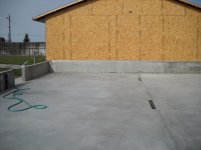
Looking at your picture it looks like you will be tying into the existing roof and it also looks like you will be pulling back some existing roofing and cutting off that overhang. I assume you will be using trusses and I'm assuming you are working from a set of blueprints. If you have shear wall requirements, especially on narrow walls, pay attention to those details. You may even have a double inspection (like I did) for those shear walls so they can inspect the bolts and hardware prior to sheathing the inside. If you happen to be using a Simpson strongwall make sure your heights are right. Framing a wall 16" oc is the way to go in my opinion. Nails come in several varieties. Know the difference. You wouldn't be the first guy to have to renail something. I'd pull back some sheathing on your existing so all your "breaks" on sheathing don't end on that one wall. If at all possible, get your truss guy to do a field measurement and inspection. In my area it was almost impossible, but now with the slowdown they'll do it. Lastly, there will be problems. Know that going in. A garage is a perfect first-time framing project. It's about as simple as it gets. You'll miss a few things and waste some lumber. You might even fail an inspection or two. To me, the crux of your project is the tie-in. Don't be surprised if things have shifted or settled over time. At least it's not a hip roof you're tying into.
Looking at your picture it looks like you will be tying into the existing roof and it also looks like you will be pulling back some existing roofing and cutting off that overhang. I assume you will be using trusses and I'm assuming you are working from a set of blueprints. If you have shear wall requirements, especially on narrow walls, pay attention to those details. You may even have a double inspection (like I did) for those shear walls so they can inspect the bolts and hardware prior to sheathing the inside. If you happen to be using a Simpson strongwall make sure your heights are right. Framing a wall 16" oc is the way to go in my opinion. Nails come in several varieties. Know the difference. You wouldn't be the first guy to have to renail something. I'd pull back some sheathing on your existing so all your "breaks" on sheathing don't end on that one wall. If at all possible, get your truss guy to do a field measurement and inspection. In my area it was almost impossible, but now with the slowdown they'll do it. Lastly, there will be problems. Know that going in. A garage is a perfect first-time framing project. It's about as simple as it gets. You'll miss a few things and waste some lumber. You might even fail an inspection or two. To me, the crux of your project is the tie-in. Don't be surprised if things have shifted or settled over time. At least it's not a hip roof you're tying into.
Ord
Well-known member
A few weeks ago I found this website with some step by step instructions on framing and raising walls: http://www.biytoday.com/outsidewallassembly.htm
For what it's worth, the more I read about it the happier I was that I am getting a contractor to do the framing.
For what it's worth, the more I read about it the happier I was that I am getting a contractor to do the framing.
ddawg16
Well-known member
I just got a Paslode framing gun. What length and kind of nails does everyone recomend?
Rull of Thumb (Thumb, sure had a lot of rules)
16D for Studs
10D for Shear walls to Studs
8D for roof sheathing....
I would suggest talking with your local building inspector to be sure.....
The way I understand it is that your looking to get about 1.75-2" of nail penetration into the stud to insure proper holding strength.
moparmuscle88
Well-known member
Do not space your studs 24 inches o.c.. Do 16 inches o.c. with a double top plate and pressoure treated bottom plate with foam sill sealer. Your walls with a 10 ft height will not have the strength you will need for the long term. You could also get bowing between the studs which will affect subsiding,finish siding and drywall. Use long 12 to 16 ft top and bottom plates and the stud length at your chosen height. The amount of extra studs between 16"o.c. and 24"o.c. is very small for all the advantages in return. I build houses for a living and never go 24"o.c. even for non bearing walls you get a better product that way. When you are doing it for yourself...don't cut any corners to save a buck. Don't pinch pennies and throw away dollars. JUST MY 2 CENTS
i build houses too and we do everything 16oc becuase the sheetrock stays stiffer, more to screw to, stronger walls, more places to hang things to later on etc, and its only a few hundred more for a whole house
12 penny sinkers should be fine for framing up the walls, 8 penny for the sheathing.
you only need a 2x6 wall if you plan to run larger than 2" pipes thru the plates for an upstairs
alsobe sure to set you walls to a string to make sure their good