To avoid these ads, REGISTER NOW!

Framing Long Walls

bad_idea

Well-known member
Joined
Jun 11, 2011
Messages
4,329
Location
Pasquotank, NC
Building a 30x40x10 garage with 2x6 walls. To make the wall sections more manageable, I would like to frame 16' sections and raise them individually, then join them. I know splices are to be done over a stud. Is it an issue to put a stud on each side of the splice, raise the sections, then nail the studs at each section end together? Seems to me it wastes a handful of studs, but if it saves me equipment rental costs, hired hands, hernia surgery, then it is worth the cost. Any structural issues?
 
To avoid these ads, REGISTER NOW!

fountain

Active member
Joined
May 28, 2009
Messages
33
No issues. Be sure to stagger your top Plates over the splice a minimum
of 32”. Always put a top plate splice over a studs.
 

NUTTSGT

Super Moderator
Staff member
Joined
Sep 14, 2009
Messages
50,853
Location
Northern Central Ohio
It's what I would do and who cares about spending an extra $15-20 when framing your walls ?

Like fountain says about splitting the seam over a stud and I'd also put in a double top plate.
 
OP
B

bad_idea

Well-known member
Joined
Jun 11, 2011
Messages
4,329
Location
Pasquotank, NC
Double top plate is required and will be installed. As far as splitting seam, plan to have bottom and bottom-top plate seam over same stud. Then stagger seam between the top plates 4'.
 

maxpat82

Well-known member
Joined
Dec 9, 2012
Messages
275
16' of 2x6 frame can be lifted by hand easy...but not if it as the exterior sheeting :|
 

8mpg

Well-known member
Joined
Jul 9, 2012
Messages
350
What those guys said... Its what I did. Staggered the top plate seams by minimum 4' though.
 

6768rogues

Banned
Joined
Nov 28, 2007
Messages
4,524
Location
Western NY
If your roof framing/trusses do not rest directly on top of the wall studs a double top plate is required. If they fall directly over the wall studs, a single top plate is acceptable. You can build it in sections without the double studs at the junctions. Simply cut your bottom and top plates so the seams fall between studs, and then reinforce the junctions with a scrap piece below the top plate from stud to stud. If you are doubling the top plate, skip the reinforcement. I am assuming that with your span you will be using trusses, which have downward force on the walls, not outward force, after they are braced.
 

ddawg16

Well-known member
Joined
Jul 11, 2008
Messages
21,005
Location
S. California
First off......wise choice going with 2x6's....2x4's have trouble staying straight when you go above 8'.

Second....in the grand scheme of things....the cost of a few studs is nothing compared to the whole project....

Now, lets do a little math.....

Typical stud spacing is 16' OC (OC=On Center)

30x40.....Neither wall is going to divide perfectly if into 16....translation....there will be parts where it's not exactly 16" for you stud spacing.

I'm assuming you will have windows and doors. Figure out where you want those. They make a great place for the non 16" studs to fit.

Figure out where you wan them. Cuz.....believe it or not, the header for a door or window does not have to be at the window or door.....it can be at the top plate....which makes a great place for the 1st plate to splice.

If it was me....I'd do 10' sections....give or take 16".

Also take into consideration what you are using for the outside. If vinyl, don't forget the sections are 16' long. A door is a great way to help prevent overlapping seams if you put the door less than 16' from a corner or another door.
 

mrobins297aaa

Well-known member
Joined
Sep 20, 2010
Messages
3,283
Location
south east michigan
I built this barn in 2004 at our previous house. it was 68x30 with 10' walls.
we put the walls up in 16' sections with the sheating on. I had to lift the walls about 6-8" to get them on the block foundation. We just scabbed some 2x4 pieces on a angle and lifted them with the bucket on my Kubota......worked ok.
In the pictures it doesn't show the double top plate which I added later.
 

Attachments

  • P1010005.jpg
    P1010005.jpg
    149 KB · Views: 170
  • P1010004.jpg
    P1010004.jpg
    132.5 KB · Views: 145
  • P1010003.jpg
    P1010003.jpg
    146.9 KB · Views: 140
OP
B

bad_idea

Well-known member
Joined
Jun 11, 2011
Messages
4,329
Location
Pasquotank, NC
I also will have to lift the walls onto the block foundation, I'll have to lift them 20-22". I am in process of building a gin pole for the bed of my F250. The truck had a 5th wheel in it at some point (previous owner), so it's fairly simple to fab up a mount for it. A tractor would make this much easier. No such luck. I don't see the end of your 16' sections. Did you double up studs or toe nail in the stud between sections afterward?

I'm still fuzzy on if it is acceptable to have the splice of the top plate directly above the bottom plate splice.
 
Last edited:

matt_i

Well-known member
Joined
Mar 14, 2008
Messages
10,717
Location
SE Michigan
Where it gets fuzzy is when you have to lift the wall up and set it over top of, and in alignment with the precast anchor bolts.

What I have done is measure and mark out the bolt holes, I've seen it done where the bottom plate was set on top of the studs, a whack with a hammer on each one and it makes a dimple. Then drill thru the dimple.

Then test the fit of the bottom plate only. Where tight spots are found, a round microplane is the fastest tool I've found for slotting the hole. As long as the washer covers it, I am OK with a small slot to make it fit.

Then nail up the wall, tilting it up isn't bad at all, but there's no substitute for lifting power when it comes to getting it set down. I really like the idea posted about using the tractor bucket :thumbup: Its important not to get too rough and mess up the sill gasket material.
 
OP
B

bad_idea

Well-known member
Joined
Jun 11, 2011
Messages
4,329
Location
Pasquotank, NC
I will be using a 2x8 sill plate to cap the blocks. Then a 2x6 bottom plate for the walls to make sheet rocking easier down the road. The sill gasket will be under the 2x8s and I can wrestle those on by themselves.
 

73fxe

Well-known member
Joined
Jun 11, 2016
Messages
308
Location
SW. Michigan
Vinyl siding comes in 12' 6" lengths. And in Michigan all barring walls need a double top plate. Trusses should sit above a stud.
 

mrobins297aaa

Well-known member
Joined
Sep 20, 2010
Messages
3,283
Location
south east michigan
I also will have to lift the walls onto the block foundation, I'll have to lift them 20-22". I am in process of building a gin pole for the bed of my F250. The truck had a 5th wheel in it at some point (previous owner), so it's fairly simple to fab up a mount for it. A tractor would make this much easier. No such luck. I don't see the end of your 16' sections. Did you double up studs or toe nail in the stud between sections afterward?

I'm still fuzzy on if it is acceptable to have the splice of the top plate directly above the bottom plate splice.

yes they were doubled up.
 
To avoid these ads, REGISTER NOW!

8mpg

Well-known member
Joined
Jul 9, 2012
Messages
350
Just watch this video:

It'll show you everything you need to know. Just dont forget to get the correct length studs. 8' walls dont use an 8' stud. It uses 92 5/8" stud to account for the bottom and double top plate.
 

Falcon67

Well-known member
Joined
Jun 11, 2009
Messages
18,371
Location
Merkel, TX
Did same here, raised the whole building in sections. 24x40, did 12' sections on the ends, two 16' + 8' on the long side.

Framing3.jpg
 

Milton Shaw

Well-known member
Joined
Feb 11, 2011
Messages
4,835
Use strings to make sure the wall is straight top and bottom when you put the trusses up. Sliding the trusses up can cause the wall to move and you might secure the trusses to a crooked wall. At least square wall sections and secure at least one piece of wall board to help keep the wall square when you go up with them.
 

The Tool Tyrant

ALLIANCE MEMBER
Joined
Dec 19, 2011
Messages
2,181
Location
Bonita, Ca. (San Diego)
Building a 30x40x10 garage with 2x6 walls. To make the wall sections more manageable, I would like to frame 16' sections and raise them individually, then join them. I know splices are to be done over a stud. Is it an issue to put a stud on each side of the splice, raise the sections, then nail the studs at each section end together? Seems to me it wastes a handful of studs, but if it saves me equipment rental costs, hired hands, hernia surgery, then it is worth the cost. Any structural issues?

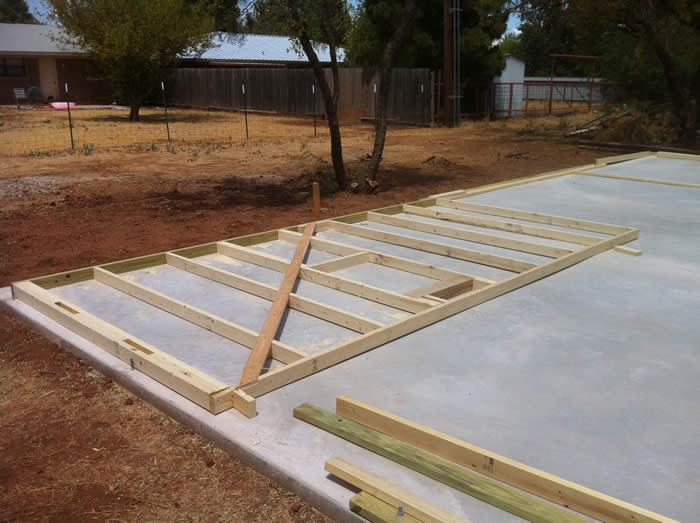
Save the extra stud...place the last stud 3/4" proud of the 'layout plate', next section has no end stud, so the 'Layout Plate' butts the first section 'Layout Plate' and nails into the first section end stud...the same way you would frame the wall if you were framing the entire wall on the ground. Be sure to lap the 'Framing plate' 4' minimum past the break in the 'Layout Plate'.
 

gtae07

Well-known member
Joined
Mar 6, 2015
Messages
2,962
Location
Fayetteville, GA
I used one stud at the split point. Left it out until the walls were standing (have to get them up onto the anchor bolts), then installed the one stud. Finished by adding the second layer of top plate. But then, I used 2x6 at 24" centers, 8ft walls. I didn't have helpers so everything had to be doable myself.

If your roof framing/trusses do not rest directly on top of the wall studs a double top plate is required. If they fall directly over the wall studs, a single top plate is acceptable.
Check your codes; this might not apply everywhere. We have to build for hurricane winds here and single top plate isn't an option.
 

jetnow1

Well-known member
Joined
Jun 27, 2016
Messages
511
Location
CT.
I did my walls by myself, the plate was on top of a course of block higher than the floor. I put a 2 by 8 on its side with a couple of short pieces nailed to the ends to hold it on its side, then framed my wall sections basically level with one end on the plate, one on the 2 by 8. Made lifting the wall into place easy, just put a block screwed to the outside so it would not kick. Did the 30 foot walls in 3 sections, the 24 foot rear wall in two. I am in my mid 60's, and it is not worth it to get hurt lifting mote than a 12 foot section at a time.
 

6768rogues

Banned
Joined
Nov 28, 2007
Messages
4,524
Location
Western NY
Vinyl siding comes in 12' 6" lengths. And in Michigan all barring walls need a double top plate. Trusses should sit above a stud.

Please clarify for me.
Can you give me the specific code section that requires a double top plate? The Internationsl Building Code requires a double plate if the trusses/rafters above do not fall directly over the wall studs but allows a single top plate if they do. Does Michigan use the IBC?
If the wall framing is on 16 inch centers and the trusses are on 24 inch centers, all the trusses and studs do not line up. How do they remedy that in Michigan if, as you said, trusses should sit above a stud?
 

gtae07

Well-known member
Joined
Mar 6, 2015
Messages
2,962
Location
Fayetteville, GA
Please clarify for me.
Can you give me the specific code section that requires a double top plate? The Internationsl Building Code requires a double plate if the trusses/rafters above do not fall directly over the wall studs but allows a single top plate if they do. Does Michigan use the IBC?
If the wall framing is on 16 inch centers and the trusses are on 24 inch centers, all the trusses and studs do not line up. How do they remedy that in Michigan if, as you said, trusses should sit above a stud?

Michigan adopts the IBC with amendments, apparently.

https://up.codes/viewer/michigan/mi-building-code-2015/chapter/23/wood#23

Bearing and exterior wall studs shall be capped with double top plates installed to provide overlapping at corners and at intersections with other partitions. End joints in double top plates shall be offset not less than 48 inches (1219 mm), and shall be nailed in accordance with Table 2304.10.1. Plates shall be a nominal 2 inches (51 mm) in depth and have a width not less than the width of the studs.

Exception:A single top plate is permitted, provided that the plate is adequately tied at corners and intersecting walls by not less than the equivalent of 3- inch by 6-inch (76 mm by 152 mm) by 0.036-inch-thick (0.914 mm) galvanized steel plate that is nailed to each wall or segment of wall by six 8d [21⁄2" x 0.113" (64-mm by 2.87 mm)] box nails or equivalent on each side of the joint. For the ****-joint splice between adjacent single top plates, not less than the equivalent of a 3-inch by 12-inch (76 mm by 304 mm) by 0.036-inch-thick (0.914 mm) galvanized steel plate that is nailed to each wall or segment of wall by 12 8d [21⁄2-inch x 0.113-inch (64 mm by 2.87 mm)] box nails on each side of the joint shall be required, provided that the rafters, joists or trusses are centered over the studs with a tolerance of not more than 1 inch (25 mm). The top plate shall not be required over headers that are in the same plane and in line with the upper surface of the adjacent top plates and are tied to adjacent wall sections as required for the **** joint splice between adjacent single top plates.

Where bearing studs are spaced at 24-inch (610 mm) intervals, top plates are less than two 2-inch by 6-inch (51 mm by 152 mm) or two 3-inch by 4-inch (76 mm by 102 mm) members and the floor joists, floor trusses or roof trusses that they support are spaced at more than 16-inch (406 mm) intervals, such joists or trusses shall bear within 5 inches (127 mm) of the studs beneath or a third plate shall be installed.

Again, this is why you need to check your local codes as well as IBC/IRC. Sometimes states and local jurisdictions can be more stringent than the base code, and sometimes they may also be more lenient (e.g. some states may only require earlier versions of the NEC).

In my case, all of my rafters sit directly above the studs, but I still needed double top plates because of the wind requirements.
 

NitroGarage

Well-known member
Joined
Mar 2, 2016
Messages
203
Location
Cleveland, OH
40x60x16 we stick built. 14' walls on block. We did those in 8 foot wide segments. Tried raising by hand but ended up using a telehandler.
 

n20junkie

Well-known member
Joined
Aug 22, 2010
Messages
538
Location
Grand Island, NY
We went a step further and added another double stud every 4 feet on top of the wall splice double studs. That way every sheet of plywood ends on a full stud.

In the grand scheme, it added like $150 to a 30x50 build. With your spending 70k, whats $150.
 

Chilliwack Murray

Well-known member
Joined
Dec 10, 2012
Messages
1,500
Location
Chilliwack BC
I built all the walls and the roof structure on the ground and used a local delivery guy with a crane truck to stand them up. Actual time required for the crane was only a couple hours and it made the work much safer doing it all on the ground.

Around here there are lots of owner operators that will work for around $100 per hour, especially if they don't have to carry something heavy on the truck.

https://www.garagejournal.com/forum/showthread.php?t=187939&page=2
 

maxpat82

Well-known member
Joined
Dec 9, 2012
Messages
275
We went a step further and added another double stud every 4 feet on top of the wall splice double studs. That way every sheet of plywood ends on a full stud.

In the grand scheme, it added like $150 to a 30x50 build. With your spending 70k, whats $150.

that styr up s** a bit when doing insulation and electrical. :|
 

Falcon67

Well-known member
Joined
Jun 11, 2009
Messages
18,371
Location
Merkel, TX
that styr up s** a bit when doing insulation and electrical. :|

Siding a bigger issue IMHO than insulation or electrical. Insulation easy to trim, Irwin wood bits make quick work going through a double stud or double plate.
 

n20junkie

Well-known member
Joined
Aug 22, 2010
Messages
538
Location
Grand Island, NY
Siding a bigger issue IMHO than insulation or electrical. Insulation easy to trim, Irwin wood bits make quick work going through a double stud or double plate.

How so? There is even MORE wood for siding nails. When I sided it, it went just the same as any other siding project.
 
To avoid these ads, REGISTER NOW!
Top Bottom