akalian
Well-known member
If you're a woodworker, cabinet maker, or carpenter you know you couldn't live without compressed air to power your nail guns, be they brad nailers to frame nailers. One thing that you also know is that you are tethered to the air compressor by a long hose, sometimes a very long hose, and you need a power cord or a generator. Sometimes you have to set all of this up just to drive a few nails. What a pain. I know, I've been there. My last project at a friends house, was the straw that broke the camel's back.
I had to drive 20 nails, and I had to lug my small compressor into the kitchen, fire it up drive the nails, and my friends wife thanked me, for doing the project and for marking up her floor with the rubber mounting feet on my compressor. Fortunately they hadn't installed the new flooring so it was no big deal, but it would have been a big deal if it was the new floors, friend or not. So I got to thinking for a solution. I tried many things, many prototypes, some close calls and finally came up with a system that solves a problem every woodworker or carpenter has faced at one time or another.
I call it Freedom Air because for the first time you can finally take your nail gun anywhere, whether there is electricity or not. You don't need to drag around a compressor, and you don't need 50 or 100 feet of air hose. If you wanted you could fire nails into a 2x4 while driving down the road at 65 mph.
The heart of the system is the valve assembly and the high pressure CO2 supplied by a Paintball cylinder. Paintball cylinders are a natural, since they are readily available, affordable, and can be filled at any Paintball store, many Sporting Goods stores (like Sports Authority) and even exchanged at Wal Mart. The CO2 coming out of a paintball cylinder is way too much pressure for a nailer. Usually it is about 850 psi and that will fry any nail gun. I know because I fried many o-rings and hoses in the development of this product.
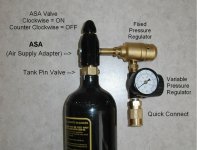
The pressure had to be reduced and I felt it necessary that it be fixed so that there was no chance of the high pressure getting loose. Paintball tanks come with what is called and ASA (Air Supply Adapter) and the one that I decided to use not only opens and closes the valve to the cylinder. It bleeds off the air in the system automatically when closed.
The large brass cylinder on the assembly is a fixed pressure regulator that limits the output pressure from the paintball cylinder to 125 psi max. Fine tuning of the pressure is done with an air compressor regulator that will allow adjustment from 0-125 psi. You will need to check your hoses and nailers to be sure that you don't exceed the manufactures recommended air pressure, or you WILL blow o-rings and maybe even the hose. The fine adjustment regulator has a quick connect fitting that will accomodate any air nailer, or for that matter any air tool. But a word of caution. Although you can run any air tool with this system, be aware you WILL deplete the system quickly. Sanders, drills and the like are out, forget about using them. You can use it as a blow gun, but use it sparingly. I can be used to inflate bike tires, even your car tires. No telling how many soccer balls you could fill up
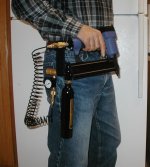
The additional weight of the valve on a cylinder makes it a bit top heavy so I cut some schedule 40 PVC and glued it to and ABS base to keep it from tipping. The entire assembly isn't much larger than a brad nailer and a 25 foot length of hose. It's very easy to move around, take it wherever you want to nail.
Paintball cylinders come in two flavors. One is CO2 and the other is HPA (high pressure air) There are pro's and con's for each. The Freedom Air valve works with either.
Pros of CO2
• It's readily available.
• It's affordable, a 20 oz cylinder like the one shown in this auction costs $30.00 retail
• It can be filled for about $3.00- $4.00 at Paintball stores, and if you exchange it at WalMart, typically $7.50
• More nails per cylinder volume
Cons of CO2
• If you fire it rapidly it will tend to cool the components
• It might cool a cheap nylon hose enough so that if it is kinked it might crack but I've had no such problems
• It might contaminate the nailer or gum up the O-rings, but I've had no such problems
• Temperature and altitude have an affect on CO2, though negligible for nailing purposes
==============================================
Pros of HPA
• No chance of contamination
• Unaffected by temperature or altitude
Cons of HPA
• Must be filled at a scuba shop or Paintball store but only costs $3.00-$4.00.
• Less nails per cylinder volume
• Higher initial cost. Typically a 48 cubic inch tank costs $80-$100 and a carbon fiber tank much more
So what's the bottom line here. Well it's a bit confusing. CO2 is measured in weight, ounces/pounds. HPA is measured in cubic inches. The math works out like this. In a typical 48 cubic inch HPA cylinder under 3000 psi which equals 200 atmospheres. 48 x 200 = 9600 cubic inches divided by 1728 (cubic inches in a cubic foot) = 5.5 cubic feet. A 20 oz tank of CO2 equals 1.25 pounds and one pound of CO2 = 8.74 cubic feet x 1.25 = 10.92 cubic feet. The reason there is more CO2 is that it is stored as a liquid and the HPA is just compressed air. A typical brad nailer will use approximately .04 cu ft per shot so doing the math shows that CO2 should get about 300 brad nails per tank and a HPA cylinder should get 137.
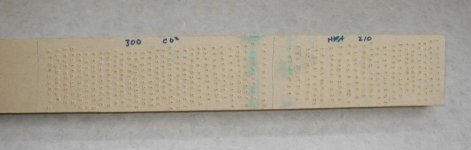
Math is one thing, but real life is another. So I got a full tank of CO2 and one of HPA and got to nailing. Take a look at the results, pretty close to the calculated results.
And if there are any frame nailers out there that think this isn't for them, or not up to the task, consider this. A frame nailer uses .08 cu ft per shot so you could theoretically drive over 100 3" nails from a single tank of CO2. And at a max of 125 psi you can power any large nailer.
Big **** Version
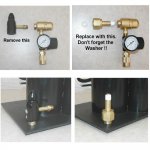
When you get a fixed Pressure Regulator it comes with a CGA320 fitting that you remove and replace with a pipe ****** to connect the ASA. If you want some real production out of this system, you can get a larger tank. They come 5#, 10#, 20# and larger. Readily available at welding, refrigeration and other places.
The stand I built keeps the larger tank upright, and the valve makes a pretty good handle, but probably should have fashioned one connected to the stand instead of the valve.
.
I had to drive 20 nails, and I had to lug my small compressor into the kitchen, fire it up drive the nails, and my friends wife thanked me, for doing the project and for marking up her floor with the rubber mounting feet on my compressor. Fortunately they hadn't installed the new flooring so it was no big deal, but it would have been a big deal if it was the new floors, friend or not. So I got to thinking for a solution. I tried many things, many prototypes, some close calls and finally came up with a system that solves a problem every woodworker or carpenter has faced at one time or another.
I call it Freedom Air because for the first time you can finally take your nail gun anywhere, whether there is electricity or not. You don't need to drag around a compressor, and you don't need 50 or 100 feet of air hose. If you wanted you could fire nails into a 2x4 while driving down the road at 65 mph.
The heart of the system is the valve assembly and the high pressure CO2 supplied by a Paintball cylinder. Paintball cylinders are a natural, since they are readily available, affordable, and can be filled at any Paintball store, many Sporting Goods stores (like Sports Authority) and even exchanged at Wal Mart. The CO2 coming out of a paintball cylinder is way too much pressure for a nailer. Usually it is about 850 psi and that will fry any nail gun. I know because I fried many o-rings and hoses in the development of this product.
The pressure had to be reduced and I felt it necessary that it be fixed so that there was no chance of the high pressure getting loose. Paintball tanks come with what is called and ASA (Air Supply Adapter) and the one that I decided to use not only opens and closes the valve to the cylinder. It bleeds off the air in the system automatically when closed.
The large brass cylinder on the assembly is a fixed pressure regulator that limits the output pressure from the paintball cylinder to 125 psi max. Fine tuning of the pressure is done with an air compressor regulator that will allow adjustment from 0-125 psi. You will need to check your hoses and nailers to be sure that you don't exceed the manufactures recommended air pressure, or you WILL blow o-rings and maybe even the hose. The fine adjustment regulator has a quick connect fitting that will accomodate any air nailer, or for that matter any air tool. But a word of caution. Although you can run any air tool with this system, be aware you WILL deplete the system quickly. Sanders, drills and the like are out, forget about using them. You can use it as a blow gun, but use it sparingly. I can be used to inflate bike tires, even your car tires. No telling how many soccer balls you could fill up
The additional weight of the valve on a cylinder makes it a bit top heavy so I cut some schedule 40 PVC and glued it to and ABS base to keep it from tipping. The entire assembly isn't much larger than a brad nailer and a 25 foot length of hose. It's very easy to move around, take it wherever you want to nail.
Paintball cylinders come in two flavors. One is CO2 and the other is HPA (high pressure air) There are pro's and con's for each. The Freedom Air valve works with either.
Pros of CO2
• It's readily available.
• It's affordable, a 20 oz cylinder like the one shown in this auction costs $30.00 retail
• It can be filled for about $3.00- $4.00 at Paintball stores, and if you exchange it at WalMart, typically $7.50
• More nails per cylinder volume
Cons of CO2
• If you fire it rapidly it will tend to cool the components
• It might cool a cheap nylon hose enough so that if it is kinked it might crack but I've had no such problems
• It might contaminate the nailer or gum up the O-rings, but I've had no such problems
• Temperature and altitude have an affect on CO2, though negligible for nailing purposes
==============================================
Pros of HPA
• No chance of contamination
• Unaffected by temperature or altitude
Cons of HPA
• Must be filled at a scuba shop or Paintball store but only costs $3.00-$4.00.
• Less nails per cylinder volume
• Higher initial cost. Typically a 48 cubic inch tank costs $80-$100 and a carbon fiber tank much more
So what's the bottom line here. Well it's a bit confusing. CO2 is measured in weight, ounces/pounds. HPA is measured in cubic inches. The math works out like this. In a typical 48 cubic inch HPA cylinder under 3000 psi which equals 200 atmospheres. 48 x 200 = 9600 cubic inches divided by 1728 (cubic inches in a cubic foot) = 5.5 cubic feet. A 20 oz tank of CO2 equals 1.25 pounds and one pound of CO2 = 8.74 cubic feet x 1.25 = 10.92 cubic feet. The reason there is more CO2 is that it is stored as a liquid and the HPA is just compressed air. A typical brad nailer will use approximately .04 cu ft per shot so doing the math shows that CO2 should get about 300 brad nails per tank and a HPA cylinder should get 137.
Math is one thing, but real life is another. So I got a full tank of CO2 and one of HPA and got to nailing. Take a look at the results, pretty close to the calculated results.
And if there are any frame nailers out there that think this isn't for them, or not up to the task, consider this. A frame nailer uses .08 cu ft per shot so you could theoretically drive over 100 3" nails from a single tank of CO2. And at a max of 125 psi you can power any large nailer.
Big **** Version
When you get a fixed Pressure Regulator it comes with a CGA320 fitting that you remove and replace with a pipe ****** to connect the ASA. If you want some real production out of this system, you can get a larger tank. They come 5#, 10#, 20# and larger. Readily available at welding, refrigeration and other places.
The stand I built keeps the larger tank upright, and the valve makes a pretty good handle, but probably should have fashioned one connected to the stand instead of the valve.
.