To avoid these ads, REGISTER NOW!

French Drain Pipe

wfopete

Well-known member
Joined
Sep 6, 2009
Messages
501
Location
Somewhere North of Dover, AR
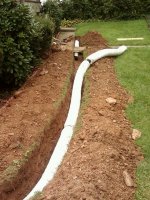
I'm going to be installing several french drains around my property. These drains will be used for water drainage from my garage roof and to drain water from ground saturated after a heavy rain. At times I will have literally water coming up from the ground and running down my driveway. For instance, one area that I'm looking at is where a shallow ditch used to be, until I leveled the ground around it. Guess what, water still came up where the ditch was and followed down hill where that ditch used to be. Once I get rain it will flow for weeks. I guess the guy who put in the ditch knew what was going on. Sounds like I basically need to keep the water table from rising above the ground. Yes?

Can anyone recommed a superior drain pipe for these applications?

FWIW, I realize that in a french drain application the gravel/slope takes most of the water away before it fills the pipe. But I also need a pipe that won't crush due to vehicular traffic over it. I plan to have the pipes buried so the top of the pipe is about a 12 inches from the surface.

Thanks.
 
Last edited:
To avoid these ads, REGISTER NOW!
Joined
Oct 21, 2009
Messages
307
Location
Illinois
for the drain to work properly wont you have to be deeper? possibly ending into a drywell? the research I have done, it is recomended to go at least 3 ft to control the groundwater collection and to get it where you want it to go?
 

K'ledgeBldr

Well-known member
Joined
Aug 22, 2011
Messages
1,925
Location
Johns Creek, GA
Can anyone recommed a superior drain pipe for these applications?

This is usually used for septic systems. But has also been used for foundation perimeter drain systems, and french drains. The price is somewhat comparable when you adjust for labor and gravel cost. It's literally a one man install.
As far as the "driving over" part- that would probably not be a good idea unless it was running through concrete pipe.

http://www.infiltratorsystems.com/productline/ezflow.asp
 

Zeke

Well-known member
Joined
Aug 13, 2009
Messages
17,176
Location
Long Beach CA, the sewer by the sea.
Compact gravel around perforated pipe and you can drive over it. Use some filter fabric to keep mud out of your drain.

french%20drain.jpg
 
OP
W

wfopete

Well-known member
Joined
Sep 6, 2009
Messages
501
Location
Somewhere North of Dover, AR
for the drain to work properly wont you have to be deeper? possibly ending into a drywell? the research I have done, it is recomended to go at least 3 ft to control the groundwater collection and to get it where you want it to go?

I have a creek to drain into which is handy, I can go to three foot but this condition was controled before with a open ditch that was less than a 12" deep. This is in Arkansas (very poor soil, rocky/clay).
 

JSBriggs

Well-known member
Joined
May 10, 2009
Messages
1,041
Location
Auburn CA
I have a spring in my front yard. Once i put the drain in it flows all year long. I used 4" perforated polyethylene pipe. Its the stuff that is white on the outside, black on the inside with holes drilled in it. Put it in your trench withe holes facing up.

Stay away from the the black corrigated stuff.

-Jeff
 
OP
W

wfopete

Well-known member
Joined
Sep 6, 2009
Messages
501
Location
Somewhere North of Dover, AR
Thanks Jeff, I was looking at the black corrigated stuff with slits in it at Lowes. It didn't look like it was very "crush" proof or that it would let in much water.
 

JSBriggs

Well-known member
Joined
May 10, 2009
Messages
1,041
Location
Auburn CA
The corrugated stuff is flimsy, and doesnt flow well allowing silt to build up, then roots and things plant them selves in it further restricting flow.

The downside to the smooth pipe is that it need fittings. I ran double 45's at the corners instead of a 90 so i could snake it out if i ever needed to.

-Jeff
 

Jeffksf

Well-known member
Joined
Jul 24, 2007
Messages
381
Location
Cleveland Ohio
If you use solid plastic pipe with holes on one side the holes go on the BOTTOM, do not put the holes facing up. The idea is the trench fills up and from the bottom up and then falls into the pipe to get carried away. If you put the holes facing up the trench will have to fill up the diameter of the pipe before it falls into the pipe saturating the trench more then it needs to be. I do this for a living (waterproofing) and that is how perf pipe is done per city codes.
Also the black HDPE corrugated will do fine for french drains. You can buy it with a filter "sock" already installed over the pipe, this will help keep the pipe cleaner longer.
Rent a trencher start at the outlet and trench away. If you rent a 4" trencher and use 4" black corrugated you will have trouble squezzing it into the the trench but it can be done. I also recommend backfilling with gravel all the way to the top of the trench, this way you get no settlement, ground water will "find" the pipe quicker and easier, and it will keep the the dirt out of your pipe longer.

I did 180' of this in my dads back yard in about 4hrs. including trencher pick up and drop off.
 

bmcdowell40

Well-known member
Joined
Nov 12, 2009
Messages
80
Location
Lanse, PA
Use the corrugated perforated polyethylene that you by in a roll. Use clean gravel around the pipe and wrap the whole stone envelope with filter fabric as shown on the picture that milt posted.
 

jay8s

Well-known member
Joined
Mar 5, 2007
Messages
653
Location
St. Louis
I did three of these about 10 years ago on my parents property. I used the corrugated pipe by the roll, probably 300 feet in total. They have not shifted at all, nor have they collapsed at all. I did three rows of about 40 feet side by side with the fabric sock around the pipes, larger rock around them, and then fabric on top of that. some of it is under grass now, and some is under a gravel walk way. We went from having 6-8 inches of standing water after a moderate rain to nothing. We did add a dry well for all the pips to drain into, and to allow for access to all the pipe. I wish I had a bobcat to do the digging, took me about 3 weeks to dig it all by hand. I will be starting another one in the near future.
 

WarDamnEagle

Well-known member
Joined
Mar 13, 2009
Messages
208
Location
Auburn
Compact gravel around perforated pipe and you can drive over it. Use some filter fabric to keep mud out of your drain.

french%20drain.jpg

I've used this system many times with no problems. I do, however, always buy "socked" pipe or buy a sock for the pipe (can't remember which). 4" corrugated pipe has never been a problem but you would want to protect it from crushing if you plan on driving over it and don't have more than a few inches of dirt/gravel on top.
 

58Yeoman

Well-known member
Joined
Oct 1, 2010
Messages
8,999
Location
Central IL
Not trying to hijack your thread, but I'm planning on digging a couple treches in my back yard next month to get rid of standing water after a heavy rain. I'm going to use the 4" rolls, and will be renting a 6" ditcher...how deep should I dig the trench, and do I use pea gravel to backfill? It'll be more or less in a main part of the yard, so I'll want to have dirt above the gravel to grow grass.
 

JSBriggs

Well-known member
Joined
May 10, 2009
Messages
1,041
Location
Auburn CA
If you use solid plastic pipe with holes on one side the holes go on the BOTTOM, do not put the holes facing up. The idea is the trench fills up and from the bottom up and then falls into the pipe to get carried away. If you put the holes facing up the trench will have to fill up the diameter of the pipe before it falls into the pipe saturating the trench more then it needs to be. I do this for a living (waterproofing) and that is how perf pipe is done per city codes.
Also the black HDPE corrugated will do fine for french drains. You can buy it with a filter "sock" already installed over the pipe, this will help keep the pipe cleaner longer.
Rent a trencher start at the outlet and trench away. If you rent a 4" trencher and use 4" black corrugated you will have trouble squezzing it into the the trench but it can be done. I also recommend backfilling with gravel all the way to the top of the trench, this way you get no settlement, ground water will "find" the pipe quicker and easier, and it will keep the the dirt out of your pipe longer.

I did 180' of this in my dads back yard in about 4hrs. including trencher pick up and drop off.

Holes facing down is for septic drain lines. Hole up is for french drains.

The idea being that on a 4" pipe there will be 3" of pipe depth to take the water away. If you run it holes down you only get about 1/2" of depth on the pipe to flow water, any more water and it will constantly be trying to go out the drain holes potentially saturating other areas down line. Because the ground is already saturated, having the bottom 3' of the trench saturated with water is a non issue.

-Jeff
 

pstnbly

Well-known member
Joined
Jul 20, 2010
Messages
766
Location
So. Vermont
Try to find perforated SDR 15 pvc usually light green color, if not SDR 1600 which is polyethelene white pipe as another poster said, holes down. Dig trench, line with filter fabric, place pipe, 1.5" crushed stone, fold fabric over stone, bring to grade with free draining material such as good quality gravel without much clay fines in it.
 
OP
W

wfopete

Well-known member
Joined
Sep 6, 2009
Messages
501
Location
Somewhere North of Dover, AR
Boy, all this hole up/down talk makes my want to perform a "see through" french drain experiment. Kinda like a ant farm. I think Milt has it almost right in his drawing. Meaning, the idea is to completely surround the pipe with gravel; including the bottom, say with several inches of gravel. The gravel will act has a primary drain and the pipe kicks in only when the gravel cannot carry away the water before the pipe starts to fill. So theoretically, if the holes were on the bottom of the pipe the water would only have to reach the base of the pipe before entering. Conversely, if the holes were in the top, water would have to saturate the gravel to the point where the top of the pipe is reached before the pipe would do much good.

Which method would be preferred and why?
 
Last edited:
To avoid these ads, REGISTER NOW!

SUPERFORD

Well-known member
Joined
Jun 7, 2008
Messages
138
I plan to use this:

Multi-Flow by Varicore

It has quite a few design & installation advantages.

Multi-Flow-pr-1024x767.jpg


i think it's worth checking out.

I plan to collect water throughout my yard with this and then empty it into a drywell and pump it to a nearby stormdrain
 

s.a.steel

Active member
Joined
Dec 4, 2009
Messages
43
Location
Bulverde, TX
Been a plumber for over 20 years, and have run thousands of feet of French drain. Holes definatley go down, preferably two rows at about 5:00 and 7:00. The pipe AND the gravel will flow the water.
 

WarDamnEagle

Well-known member
Joined
Mar 13, 2009
Messages
208
Location
Auburn
Been a plumber for over 20 years, and have run thousands of feet of French drain. Holes definatley go down, preferably two rows at about 5:00 and 7:00. The pipe AND the gravel will flow the water.

x2. The holes are 120 degrees apart (in the smooth pipe with round holes) and you split the difference with the holes down....at least according to my civil engineering wife.
 

Frank The Plumber

Well-known member
Joined
Feb 19, 2011
Messages
2,644
Location
Chicago.
In a saturated trench that is done correctly the entire trench will be a storage unit and or a conduit of flow. As long as you put in the proper mesh to keep the debris out of the tubing and the proper barrier to keep the drainage substrate from becoming impregnated with debris it really will not matter which way the holes face. If you do point them up you may get some water being stored which may become amoxic, and that may produce an odor. Might want to trap the drain to keep stink out.
 

Jeffksf

Well-known member
Joined
Jul 24, 2007
Messages
381
Location
Cleveland Ohio
Also if you go stone all the way to the top the grass will almost completely cover the gravel, you;ll never notice the trench unless your standing directly over it.
 

theoldwizard1

Well-known member
Joined
Feb 22, 2011
Messages
43,076
Location
SE MI
I have a spring in my front yard. Once i put the drain in it flows all year long. I used 4" perforated polyethylene pipe. Its the stuff that is white on the outside, black on the inside with holes drilled in it. Put it in your trench withe holes facing up.

Stay away from the the black corrigated stuff.

-Jeff
I second every thing he said ! I put a "sock" on the pipe to prevent any gravel from falling in to the pipe.

My problem is I really didn't have any place for the water "to go" ! I had a 6' round 4' deep pit dug in the far corner of the yard, which was naturally lower. I installed a dry well and back filled around it with gravel and then topsoil. When it rains hard, the dry well does overflow, but my garage is dry. A couple of hours with a small paddle pump and the yard is dry.

I don't care what anyone says, the hole go on the top ! You want to carry the water somewhere else, not try and discharge it along the way.
 

cjbcpa

Member
Joined
May 3, 2007
Messages
22
I just put in a french drain this weekend and used these:

http://www.lowes.com/pd_308700-676-...&currentURL=/pl__0__s?Ntt=drainage&facetInfo=

Already has the "aggregate" and mesh surrounding the pipe. Each segment weighs only about five pounds. This really simplifies the entire process. No worries about getting gravel delivered and shoveled into the trench.

I won't get into the debate about top or bottom holes (no inuendo intended). However, the manufacturer of this product states it doesn't matter with respect to their product. See page 5 of the tecnhical guide.

http://www.ndspro.com/images/stories/pdfs/drainage/ez-drain-technical-specification-guide.pdf

Here's a picture of my install.


CB
 

Attachments

  • French Drain 3.jpg.jpg
    French Drain 3.jpg.jpg
    120.5 KB · Views: 80
Last edited:

Lippyp

Well-known member
Joined
Jun 26, 2006
Messages
6,720
Location
Shropshire, UK
I need to do this along the back wall of my house in France, the floor is below ground level inside by a couple of feet and the wall is damp (its about a meter thick wall, random stone with a rubble core and lime mortar) its not running with water but I reckon a french drain next to the wall will make a huge difference. Its on a slope so theres an easy route to dump the water downslope from the house out onto the dirt path that runs along the back of the house. The path itself is a cause of a lot of the problems as when it rains heavily (we get a lot of heavy thunderstorms at various times of the year) it tends to flood down the path. I've got it largely routed a good few feet away from the wall but a French drain should make all the difference I reckon. If I do it right up against the wall it should also allow the wall to breath better and dry out.
 

buening

Well-known member
Joined
Dec 17, 2007
Messages
1,338
Location
Decatur, IL
In a saturated trench that is done correctly the entire trench will be a storage unit and or a conduit of flow. As long as you put in the proper mesh to keep the debris out of the tubing and the proper barrier to keep the drainage substrate from becoming impregnated with debris it really will not matter which way the holes face. If you do point them up you may get some water being stored which may become amoxic, and that may produce an odor. Might want to trap the drain to keep stink out.

+1 Holes facing down for french drains, period. You want all of the water from the aggregate trench to be removed, and having the holes face the bottom accomplishes this. The aggregate trench acts as a holding tank during peak saturation until the perforated drain can remove the water completely (occurs at desaturation of the soil)

I don't care what anyone says, the hole go on the top ! You want to carry the water somewhere else, not try and discharge it along the way.

The pipe will not discharge the water as it travels through the pipe with the holes facing down. The purpose of the drain is to discharge water from the area and this will almost always occur when the ground is fully saturated. With the ground saturated, it cannot hold any more water and the pipe will act as if there are no holes in regards to drainage/pipe flow. In fact the aggregate around the pipe will likely have enough pore pressure that it will add more water to the pipe until equilibrium is reached. Think of it as more pressure on the outside of a pipe than inside and then picture water escaping in the perforated pipe. An extreme example would be a submarine in the ocean with a pinhole. :thumbup:

For those that like fancy pictures, here is a nice 3D schematic:

french_drain_003.jpg


I must stress that those who use french drains for their gutters must have an exit for the pipe outside of the soil (daylight into a ditch, for example). When you have water flowing in your gutters it often occurs when the ground is very wet. You'll almost always have the gutters back up without the pipe daylighting because the ground soil can't absorb any of the water from the french drain. That setup actually acts the opposite of a french drain's intent.
 

justanengineer

Well-known member
Joined
Apr 5, 2011
Messages
7,722
Location
Motor City
I wont reiterate the mostly good advice already given, but will pass along a lesson learned. When you buy drain tile make sure you check its flexibility. Many of the box stores leave it outside in the sun which hardens it and wont allow it to flex. Then when you get it home and unroll it, it cracks and is effectively ruined. Definitely not a fun thing to discover when the store is 30+ minutes away and the ditch is waiting.
 

Frank The Plumber

Well-known member
Joined
Feb 19, 2011
Messages
2,644
Location
Chicago.
+1 Holes facing down for french drains, period. You want all of the water from the aggregate trench to be removed, and having the holes face the bottom accomplishes this. The aggregate trench acts as a holding tank during peak saturation until the perforated drain can remove the water completely (occurs at desaturation of the soil)


The pipe will not discharge the water as it travels through the pipe with the holes facing down. The purpose of the drain is to discharge water from the area and this will almost always occur when the ground is fully saturated. With the ground saturated, it cannot hold any more water and the pipe will act as if there are no holes in regards to drainage/pipe flow. In fact the aggregate around the pipe will likely have enough pore pressure that it will add more water to the pipe until equilibrium is reached. Think of it as more pressure on the outside of a pipe than inside and then picture water escaping in the perforated pipe. An extreme example would be a submarine in the ocean with a pinhole. :thumbup:

For those that like fancy pictures, here is a nice 3D schematic:

french_drain_003.jpg


I must stress that those who use french drains for their gutters must have an exit for the pipe outside of the soil (daylight into a ditch, for example). When you have water flowing in your gutters it often occurs when the ground is very wet. You'll almost always have the gutters back up without the pipe daylighting because the ground soil can't absorb any of the water from the french drain. That setup actually acts the opposite of a french drain's intent.

This is a nice picture but I would like to add a detail to it. You would want some type of soils membrane between the stone and the soils to keep the soils from breaking down and washing into the stone which is your storage area. You could use any type of soils cloth for this. If you have sands or loose soils you would want to completely surround the stone with a soils cloth so the soil does not enter from the sides.
 

buening

Well-known member
Joined
Dec 17, 2007
Messages
1,338
Location
Decatur, IL
I agree completely Frank! That is a detail often overlooked by the average Contractor and they then wonder why the area around the trench is sagging.
 

WarDamnEagle

Well-known member
Joined
Mar 13, 2009
Messages
208
Location
Auburn
I won't get into the debate about top or bottom holes (no inuendo intended). However, the manufacturer of this product states it doesn't matter with respect to their product. See page 5 of the tecnhical guide.

That's because the holes are staggered all the way around the pipe.

x2 on everything that buening posted.
 
Last edited:

srmofo

Well-known member
Joined
Oct 15, 2009
Messages
6,161
Location
SW ohio
Quick physics lesson....or at least the reason I always thought the holes faced down.

As the water level around the pipe starts to rise it will enter the pipe and try to equalize the outside and inside water levels. This would not be true if the pipe was sealed on the end , but then it wouldnt be a drain would it? Air pressure would keep the water out of it.

An example working in the opposite would be to fill your sink with water, insert a glass (this would be your pipe) and make sure its filled with water, turn it upside down and lift it mostly out of the water, but not all the way. The water will stay in. Now insert a bendy straw into the glass above the sinks water line and poke the other end out into the air. The water will drain from the glass. In a french drain, the water will be pushing in instead of out.
 
Last edited:

buening

Well-known member
Joined
Dec 17, 2007
Messages
1,338
Location
Decatur, IL
Capped on both ends of the drain, holes facing the bottom, and ASSUMING perfectly sealed joints (not likely if using corrugated black in multiple sections), then yeah it will have an air pocket above the highest perforation on the pipe. A french drain, installed for its intended use, will not have both ends capped and will therefore not have the air pocket above. The air above the highest perforation will be pushed out the end of the pipe as the pore water pressure pushes it out and the pipe fills.
 
To avoid these ads, REGISTER NOW!
Top Bottom