To avoid these ads, REGISTER NOW!

From Cherry Tree to Tool handles - tree is down, now what?

Skyd

Active member
Joined
Nov 26, 2021
Messages
27
Hey all, hopefully this question is ok to post here. Last weekend we cut down a small wild (black) cherry tree on my dad's land where he's building a shed. It occurred to me that I could do something with that wood other than burn it in a campfire. The tree is maybe 6-8" in diameter at the base, so not real big, and not great for dimensional lumber I wouldn't think. But I'd like to use it for smaller projects such as wooden handles for old monkey wrenches, or a screwdriver, or as decoration for a larger project, etc etc.

So my main question is - the tree is on the ground. Now what? I haven't been able to locate much info on how best to go about this. I could chop it up into 18-24" length logs and just leave them for a bit I suppose. Do I need to seal the ends? Would it be better to slab them out and cut out the Pith?

Depending on any answers I get I may have follow up questions. Any help or guidance is appreciated.
 
To avoid these ads, REGISTER NOW!
OP
S

Skyd

Active member
Joined
Nov 26, 2021
Messages
27
I'm in NH so we're about to enter the heating season so anyplace inside should be plenty dry. I could perhaps stack it in my den where my Pellet stove is but I wonder if that would dry it too fast. I hear that cherry is prone to splitting and checking.

What's good for sealing the ends? I've read everything from paint to paraffin wax, to buying anchorseal. This is partially just an experiment and a reason to try and use the wood so I'm looking to keep cost down.

I'm not sure if I want to slab it or not, now I think of it....I suppose I could but I'd want to do maybe 2" slabs so I have enough material to work with for tool handles (my primary objective)

I know the rule of thumb is 1" a year, anyone have experience air drying cherry like this leaving it in log form? I've read conflicting info about how long it REALLY takes to dry, some saying it's much shorter than the rule of thumb unless you want to use it for furniture (I don't)
 

jar944

Well-known member
Joined
Jul 26, 2010
Messages
5,932
Location
Northern VA
Cut it onto boards now, leaving it in log form will keep it "green" forever.

1" per year is a rule of thumb. Poplar can be "dry" to ambient moisture levels (provided correct stickering and airflow) in a few months time. Oak takes a lot longer. 4" thick boards might be at 25% moisture 10 years from now..

Cherry is a bit soft for handles.
 
OP
S

Skyd

Active member
Joined
Nov 26, 2021
Messages
27
Ok good info, I should be more specific about the handles.....I actually mean handle inserts I guess (I'm not up on all the nomenclature). For example I have an old Coes monkey wrench i want to restore, already in decent shape but one of the wood inserts is chipped pretty bad, would like to replace with something nice.

In either case, the cherry should prove useful for some project I can think up over the next year or so. I'll plan to slab these out. Now I need to find me a band saw with a 6"-8" clearance :)

My dad also has some Apple tree logs about the same size that he took down a year ago and cut up in 2 foot lengths. We were planning to use it for smoking in the grill maybe, but hmmm
 
OP
S

Skyd

Active member
Joined
Nov 26, 2021
Messages
27
Don't breathe burning the leaves or use them for smoking food. Cyanide in leaves and pits of cherry trees.


Indeed, many fruit trees actually contain cyanide of varying degrees. I actually knew about this. We don't plan to eat the leaves though and most likely won't be burnt anytime soon either. Good info though, nature is a cruel mistress, lol
 
To avoid these ads, REGISTER NOW!

RoninB4

Well-known member
Joined
Jul 22, 2020
Messages
3,568
Location
Under My House
Indeed, many fruit trees actually contain cyanide of varying degrees. I actually knew about this. We don't plan to eat the leaves though and most likely won't be burnt anytime soon either. Good info though, nature is a cruel mistress, lol
Apologies for telling you what you already knew, I didn't know this until about 10 years ago while cutting up a few downed trees for lumber. Thought somebody else may need to know this. I've read that even mulching the leaves for the vegetable garden isn't a good idea. I've read that cherry pits soaked for cyanide solution was often used for sorting out "family lineage" in Europe.
 
OP
S

Skyd

Active member
Joined
Nov 26, 2021
Messages
27
Apologies for telling you what you already knew, I didn't know this until about 10 years ago while cutting up a few downed trees for lumber. Thought somebody else may need to know this. I've read that even mulching the leaves for the vegetable garden isn't a good idea. I've read that cherry pits soaked for cyanide solution was often used for sorting out "family lineage" in Europe.
No worries, always good info to share. Interesting about the European's usage of cherry pits. Better safe than sorry for sure. If I recall correctly I believe that cyanide can build up in your system as well so even non lethal amounts over time can cause issues. It's also used in silver plating processes.
 

Wolley

Well-known member
Joined
Jun 24, 2022
Messages
420
Location
Maine
Any latex house paint can seal the end grain to dry. You could split shorter blanks with an ax if you just want short pieces.

Interesting to heard about cyanide in cherry leaves. I've heard apple seeds have cyanide and if you ate 1/2 cup of apple seeds at once, you'd die immediately.
 

mike93lx

ALLIANCE MEMBER
Joined
Dec 9, 2013
Messages
37,631
Location
Richmond, VA
Interesting to heard about cyanide in cherry leaves. I've heard apple seeds have cyanide and if you ate 1/2 cup of apple seeds at once, you'd die immediately.
You would have to chew them all as well. Just swallowing a 1/2 cup of seeds will just make your poop...seedy
 

F-22

Well-known member
Joined
Jan 23, 2022
Messages
1,830
Cherry is really nice for (indoor) furniture, but as others noted it's not that great for tools, and it is not very weather/environment resistant... It's not like e.g. hickory or ash - these would be much better for tool handles (or in my area of Europe, there's a bush called "cornelian cherry dogwood" in English ("dren" in my language), that's very shock resistant and traditionally preferred for handles....). Or for outside furniture, it's hard to beat oak heartwood, too hard even for wood worms to ruin it.... Or Larch lasts very long outside too (used in traditional boatbuilding a lot).
 

2oolhound

Well-known member
Joined
Dec 18, 2010
Messages
5,918
Location
BC Canada
I think it's great you're thinking of saving the wood to make secondary things with. Early settlers and nomadic tribes used to discard the wood handles and just transport the actual tool when they moved. When I was working as a faller any willow or suitable branch would serve to make a file handle if you lost one or needed one. Often handles only have to last until you get the job done. Of coarse a good handle is something you can value and want to keep and not abuse.

I've done exactly what you are doing and even though I may not know what I might do with a piece of wood there may come a time when you'll be glad you salvaged it.
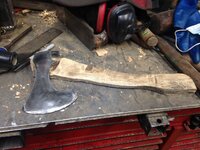
These are some Gary Oak limbs I salvaged and aged for 1 1/2 years or so (until I needed them). You can see the odd shape would be perfect for an adze handle.

IMG_8355 copy.JPG

I made this carving ax from an ax head I came across. I ground an tiny mini adze into the back of the head so I wanted the head to tilt on an angle to expose the mini adze on the back since this was a carving ax and not a chopping ax. These kinks in the limb were just what I needed.

IMG_8361 copy.JPG

IMG_8372 copy.JPG

CarvingAx_8525Sm.jpg

I have other tool handles made from salvaged wood I'll try to post photos of later.
 
To avoid these ads, REGISTER NOW!
Top Bottom