To avoid these ads, REGISTER NOW!

Frost Free Hose Bib

rakane

Well-known member
Joined
Feb 8, 2018
Messages
175
Location
Warren, Oregon
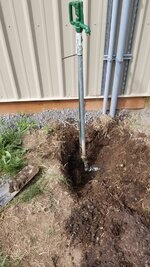
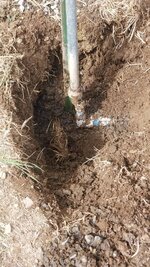
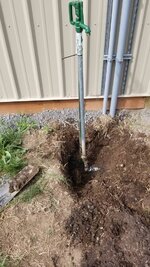
I'm not sure if that is the name, but it had a below ground drop release that empties the pipe.

So my contractor pt one in, put a stake next to it and wrapped a flex tie to the stake.

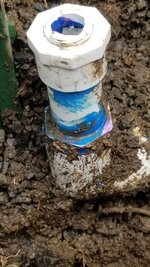
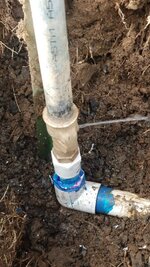
The second time I opened the faucet I must have applied a bit of side torque, the pipe broke off. Now the house water is turned off while I repair this.

Any suggestions on supporting this better?
e65d6fcb494368516a8a932877fcbbef.jpgac0de75a42b1dd5685fd6747de887d23.jpg

Meanwhile is a 30' Grady White.
 

Attachments

  • e65d6fcb494368516a8a932877fcbbef.jpg
    e65d6fcb494368516a8a932877fcbbef.jpg
    119.8 KB · Views: 1
  • ac0de75a42b1dd5685fd6747de887d23.jpg
    ac0de75a42b1dd5685fd6747de887d23.jpg
    174 KB · Views: 1
To avoid these ads, REGISTER NOW!

jdm5

Well-known member
Joined
Jan 1, 2012
Messages
281
Location
CT
Not an expert, but PT 2x4 (or 4x4) into cement, and stainless pipe fasteners to the PT lumber?
 

yeldogt

Well-known member
Joined
Jan 2, 2012
Messages
18,184
They are designed to be under the frost line? So you end up with 3' in the ground for support

Google the install.

We are not allowed have them in my township -- they can be on a farm.

They need to have a stone drain ..... if the ground water is high enough when the faucet is off the pipe is open to the ground water ... if contaminated this water will be delivered to the tap.

They make a type you can install --- google Murdock hydrant
 
Last edited:

PCustoms

Well-known member
Joined
Jul 23, 2011
Messages
23,592
Location
VT
Grandparent's had 2 of these growing up, I don't rember any reinforcement.

If it's frost free, shouldn't that pipe be below the frost line anyway?
 

NUTTSGT

Super Moderator
Staff member
Joined
Sep 14, 2009
Messages
51,168
Location
Northern Central Ohio
Frost free hydrant.


Some guys will (mostly inside farm shops) will put a section of clay tile at the bast and fil lit with a stone (think river rock). This should give it more support and a place for the water to drain into the ground without making a muddy mess.
 

Bert_

Well-known member
Joined
Dec 24, 2016
Messages
9,788
Location
NW Iowa
Obviously the contractor didn't have a clue. What is your frost depth? Here in Iowa the metal pipe and valve would be 4'+ in the ground to get keep from freezing.
 
OP
R

rakane

Well-known member
Joined
Feb 8, 2018
Messages
175
Location
Warren, Oregon
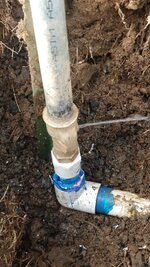
Thanks for the replies. I was out repairing the line to get water back to the house.

So I added used brick under and around to add some support, then poured 3/4 minus to fill the spaces, then more 3/4 minus to the surface, and filled the bucket with 3/4 minus. Tamped dirt and rock down all around.

I'll get u bolts tomorrow, maybe pound that T post in more too.

I appreciate the quick responses.

I live close to the lower Columbia River, a banana belt compared to you central and northern folks. It rarely freezes hard here, maybe 20° for a few days. It does rain. Often.

40862d1c8ed8081f9ffeacd8d2d13684.jpge3996083867f5e7398e60bc716435134.jpgf2819996393b6c792cde3b981bffff5e.jpg2a8f77a948cce477423b423cc4b06a6d.jpg46a0c28b4eb030e5a44a573f1e05b2f4.jpg

Meanwhile is a 30' Grady White.
 

Attachments

  • 40862d1c8ed8081f9ffeacd8d2d13684.jpg
    40862d1c8ed8081f9ffeacd8d2d13684.jpg
    94.9 KB · Views: 0
  • f2819996393b6c792cde3b981bffff5e.jpg
    f2819996393b6c792cde3b981bffff5e.jpg
    119.4 KB · Views: 1
  • 2a8f77a948cce477423b423cc4b06a6d.jpg
    2a8f77a948cce477423b423cc4b06a6d.jpg
    178.6 KB · Views: 1
  • 46a0c28b4eb030e5a44a573f1e05b2f4.jpg
    46a0c28b4eb030e5a44a573f1e05b2f4.jpg
    93 KB · Views: 1
  • e3996083867f5e7398e60bc716435134.jpg
    e3996083867f5e7398e60bc716435134.jpg
    143.9 KB · Views: 1
Last edited:

reader2580

Well-known member
Joined
Dec 31, 2014
Messages
14,571
Location
Minneapolis, MN
The hydrants like that I see in Minnesota are only supported by the hydrant itself. Here they need to be buried about 4 feet deep so there is plenty of support in the ground.
 

LS6 Tommy

Well-known member
Joined
Dec 27, 2013
Messages
26,162
Location
Northern NJ
The PVC and the shallow bury depth are definitely the failure points. I can't count the number of hydrants like that I've used in my life and they were all solid as a rock. I've tied horses to them countless times.

Tommy
 
Last edited:

Fatboy148

Well-known member
Joined
Feb 15, 2017
Messages
999
How deep are the footers on your house? That's (at the least) how deep the water line and base of the hydrant should be.

Don't leave your hose on it in the winter. There would be a vacuum created in the riser and the water will not drain into your sump. It will then freeze in your 20 degree temps and split one part or another of your hydrant. If it breaks, when it thaws, your water may start flowing till it is shut off at the house or the well runs dry.
 

samss

Well-known member
Joined
Aug 20, 2014
Messages
502
Location
Conway, AR
Stainless steel hose clamps or u-bolts would hold the hydrant to the t-post.
+1 bury deeper, gravel at the bottom and brass elbow.
 

Copymutt

Well-known member
Joined
Sep 3, 2016
Messages
3,408
Location
Colorado
Add an antisiphon coupling and you’ll avoid back sucking whatever the hose may be laying in and it will self drain as well. $4.00.
 
To avoid these ads, REGISTER NOW!

SALIV8

Well-known member
Joined
Dec 11, 2008
Messages
2,114
Location
chicago and s/w michigan
I would lengthen and bury that horizontal below the frost heeve, and then extend an additional uni strut to Mount the hose bib to.

Uni strut has lots of different choices, like a 90* piece, that will allow some off the wall mounting options.
 

larry4406

Well-known member
Joined
Jan 27, 2006
Messages
19,652
Location
Northern Virginia
Add an antisiphon coupling and you’ll avoid back sucking whatever the hose may be laying in and it will self drain as well. $4.00.

Timely thread as I am near installing two of these hydrants now. One a Woodford Y34 (new) and the other a Cambell from my parents estate that was unused sitting in the garage.

My understanding of these hydrants is that air admission is needed at the hose connection to vent the pipe riser allowing it to drain out the buried (open) drain port. I will be installing Watts backflows on mine. The instructions for the backflow clearly state to open the vent sleeve for draining. See attached image. When it comes time to tie the water line to the house service (well) I will likely install a spring loaded check valve in the line as added insurance to reduce chance of backflow contamination to the house inside water lines.

I will be bedding the drain port region in a 5 gallon gravel filled bucket (bottom cutout), filter fabric to keep fines out, black poly water line (strain relief), and will likely use a garden Tee post or rebar pounded into the earth and the riser then secured to the post/rebar. Port region set below the frost line (30 inches here in Northern VA).
 

Attachments

  • Watts Backflow.jpg
    Watts Backflow.jpg
    94.3 KB · Views: 18

LOW1

Well-known member
Joined
Jul 20, 2018
Messages
2,659
Location
ontario
I would never attach a farm hydrant directly to abs or PVC. Put 4 feet or so of galvanized on each side of the hydrant and bury the pipe five feet underground
 

tom-ky

Well-known member
Joined
Mar 11, 2017
Messages
512
Location
Morgantown, Ky
Stainless steel hose clamps or u-bolts would hold the hydrant to the t-post.
+1 bury deeper, gravel at the bottom and brass elbow.

I was always told to put a brass elbow on them and a 6" or so brass ****** on them. I always put a t-post beside mine and clamp it, mine are about 24" deep lines.
 

Leaflessshadetree

Well-known member
Joined
Aug 1, 2013
Messages
7,183
Location
Don't ask.
I agree, the bottom (valve) of mine are 4ft down. If I put them that shallow the handle and outlet would be at least 6 ft in the air. Seems strange that on that one the pipe is so short. It obviously isn't made to go that deep.
 

larry4406

Well-known member
Joined
Jan 27, 2006
Messages
19,652
Location
Northern Virginia
I was always told to put a brass elbow on them and a 6" or so brass ****** on them. I always put a t-post beside mine and clamp it, mine are about 24" deep lines.

Plumbers around here just use a brass 3/4 elbow with male threads one leg (to the hydrant) and barb the other and then use black poly with hose clamps. That’s my plan.
 

larry4406

Well-known member
Joined
Jan 27, 2006
Messages
19,652
Location
Northern Virginia
I agree, the bottom (valve) of mine are 4ft down. If I put them that shallow the handle and outlet would be at least 6 ft in the air. Seems strange that on that one the pipe is so short. It obviously isn't made to go that deep.

The manufacturers make different length units for different frost depths which if misapplied could make the installed fixture unusually low or high.
 

yeldogt

Well-known member
Joined
Jan 2, 2012
Messages
18,184
The units have a mark -- you purchase them based on frost depth in the area.

I will state again -- they can be contaminated since they open to ground water when off
 

ALinCarolina

Well-known member
Joined
Dec 29, 2014
Messages
761
Location
NC Piedmont
With your climate you could do what we do in the South. Dig hole, few shovel fulls of gravel, place hydrant and brace it temporarily, add some more gravel, then place some plastic sheeting or at least a layer of dirt, wrap the pipe shaft with tape, add a couple bags of Redi-Mix concrete. Make like a collar of concrete at least two feet wide and 8 to 12" deep.

Only disadvantage is if you ever need to pull it out you will need to tilt the collar of concrete out too. The ones I did years ago with PVC pipes are still doing fine but the last couple had PEX lines to them and should probably be even less of a problem.
 

pattenp

Well-known member
Joined
Jun 4, 2008
Messages
10,175
Location
Virginia - USA
Timely thread as I am near installing two of these hydrants now. One a Woodford Y34 (new) and the other a Cambell from my parents estate that was unused sitting in the garage.

My understanding of these hydrants is that air admission is needed at the hose connection to vent the pipe riser allowing it to drain out the buried (open) drain port. I will be installing Watts backflows on mine. The instructions for the backflow clearly state to open the vent sleeve for draining. See attached image. When it comes time to tie the water line to the house service (well) I will likely install a spring loaded check valve in the line as added insurance to reduce chance of backflow contamination to the house inside water lines.

I will be bedding the drain port region in a 5 gallon gravel filled bucket (bottom cutout), filter fabric to keep fines out, black poly water line (strain relief), and will likely use a garden Tee post or rebar pounded into the earth and the riser then secured to the post/rebar. Port region set below the frost line (30 inches here in Northern VA).

Are you on a municipal water service? If so, lawn hydrants may not be allowed unless fed from a backflow preventer. The vacuum break on a lawn hydrant spigot is really useless because the drain hole below ground is open when the valve is shut allowing ground water to enter the riser pipe so water backing through from a garden hose is a minor problem. If you want to protect the house water then you need a backflow preventer upstream of the lawn hydrant.
 
Last edited:

Larryjones

Well-known member
Joined
Oct 11, 2015
Messages
494
Location
WV
Yes, that base should be below the frost line.


The ole Google says his area has a 12 inch frost line so that looks about right. I would go with a metal line for a ways and bury it in coarse gravel. Maybe he can find a shorter bib so it isn't up in the air so much.
 

larry4406

Well-known member
Joined
Jan 27, 2006
Messages
19,652
Location
Northern Virginia
Are you on a municipal water service? If so, lawn hydrants may not be allowed unless fed from a backflow preventer. The vacuum break on a lawn hydrant spigot is really useless because the drain hole below ground is open when the valve is shut allowing ground water to enter the riser pipe so water backing through from a garden hose is a minor problem. If you want to protect the house water then you need a backflow preventer upstream of the lawn hydrant.

I’m on a private well service. Yes to a backflow/spring check valve at the house source.
 

yeldogt

Well-known member
Joined
Jan 2, 2012
Messages
18,184
Are you on a municipal water service? If so, lawn hydrants may not be allowed unless fed from a backflow preventer. The vacuum break on a lawn hydrant spigot is really useless because the drain hole below ground is open when the valve is shut allowing ground water to enter the riser pipe so water backing through from a garden hose is a minor problem. If you want to protect the house water then you need a backflow preventer upstream of the lawn hydrant.

I have mentioned it twice -- that they can be unsafe (drinking). Especially with septic and private wells where you don't have CL.
 

sberry

Banned
Joined
Jun 18, 2005
Messages
35,747
Location
Brethren, Michigan
The units have a mark -- you purchase them based on frost depth in the area.

I will state again -- they can be contaminated since they open to ground water when off

What does the backflkw do here? If it has anti siphon? If it is off and drains the stand pipe how does ground water get in the feed line?
 

sberry

Banned
Joined
Jun 18, 2005
Messages
35,747
Location
Brethren, Michigan
Back flow is really for well failure. Especily for tank filling where air gal isn't present and for fertigaton systems. If the well quits, pressure drops to 0, has leaky check it can pull fluid back downhole.
 
To avoid these ads, REGISTER NOW!
Top Bottom