

Question about frost line and freezing.
In my pole barn, there is a frost-proof faucet. It’s the kind with a lift up handle and a long pipe with the valve at the bottom.
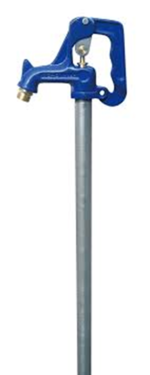
I replaced it about 20 years ago, and since then, I’ve used water from it only 3 or 4 times, i.e., it’s not really necessary.
This morning, while retrieving items from the pole barn, I noticed that the faucet is leaking. Since digging it out to replace it was an awful experience (working upside down in a hole), and I really don’t need water out in the barn, I’m thinking of digging it out and simply capping the flexible PVC or ABS line.
Question 1, what’s the best method of capping or plugging a supply line (black flexible PVC or ABS)?
I’m guessing the prior owners of the house simply T’d off the line from the well to the house to run water to the barn, i.e., no pressure tank or regulator between the well pump and the barn, so the pressure at this outside faucet is higher than what is provided inside the house.
I’m on the fence whether to, after capping or plugging the water supply to the barn, back fill the hole and concrete over it, or leave the hole empty and put a steel plate over the opening.
I would prefer to back fill and concrete, but I don’t trust that the capped line won’t leak. Being able to see the repair and and react to a leak is good peace of mind.
Note, in the spring, I plan to excavate at the well, find and take out the T fitting, thus permanently removing water supply to the barn. After that, I will follow through with back filling and concrete.
So, in the meantime (all winter), if I leave the hole empty and the cap or plug exposed, is there a risk of the cold getting to that repair and freezing/splitting the line?
In my pole barn, there is a frost-proof faucet. It’s the kind with a lift up handle and a long pipe with the valve at the bottom.
I replaced it about 20 years ago, and since then, I’ve used water from it only 3 or 4 times, i.e., it’s not really necessary.
This morning, while retrieving items from the pole barn, I noticed that the faucet is leaking. Since digging it out to replace it was an awful experience (working upside down in a hole), and I really don’t need water out in the barn, I’m thinking of digging it out and simply capping the flexible PVC or ABS line.
Question 1, what’s the best method of capping or plugging a supply line (black flexible PVC or ABS)?
I’m guessing the prior owners of the house simply T’d off the line from the well to the house to run water to the barn, i.e., no pressure tank or regulator between the well pump and the barn, so the pressure at this outside faucet is higher than what is provided inside the house.
I’m on the fence whether to, after capping or plugging the water supply to the barn, back fill the hole and concrete over it, or leave the hole empty and put a steel plate over the opening.
I would prefer to back fill and concrete, but I don’t trust that the capped line won’t leak. Being able to see the repair and and react to a leak is good peace of mind.
Note, in the spring, I plan to excavate at the well, find and take out the T fitting, thus permanently removing water supply to the barn. After that, I will follow through with back filling and concrete.
So, in the meantime (all winter), if I leave the hole empty and the cap or plug exposed, is there a risk of the cold getting to that repair and freezing/splitting the line?
