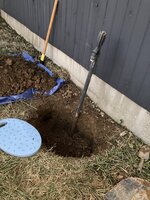
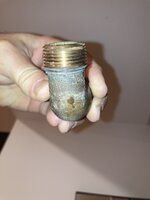
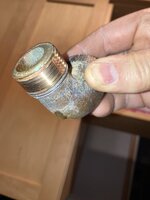
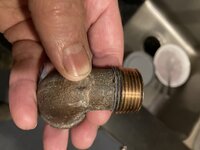
Well I learned that you cannot leave a hose attached to a frostproof yard hydrant in freezing temps. Got away with it for 24 years until now. Standpipe split along it's vertical seam. Got it dug up and new hydrant installed but then I see a hole in the original standpipe from corrosion AND a crack in the 90* elbow connection from the water line. So that brings up a few questions as I have zero plumbing expertise other than kitchen faucets, sink traps, and ripping out flow restrictors in shower heads:
Do I only need to replace only the 90* elbow?
Teflon tape enough for galvanized-to-brass fittings?
There's a backflow checkvalve already in place but it's 24 years old - any reason to replace it while it's exposed?
How did the 90* elbow crack? Freeze? It's at 24" below grade as per my local frostline data (Lexington, KY).
The drain-off leaching area is basically dense-grade type fill without any filter fabric and not very deep (I'm going to use river rock shrouded in landscape fabric and dig out a deeper pocket below weep-hole) so is it possible that the standpipe corrosion is from poor choice of fill and fill depth at original install resulting in continuously saturated soil? Or is it typical for this to happen to galvanized steel in alkaline soil? I sealed the new hydrant standpipe in Flexseal tape. I've also got another non-functioning frostproof hydrant that the same contractor installed just inside my pole barn, but he put it so close to a main cross-member that i cannot remove the head. That gives you some idea why I doubt either were installed with due diligence. Gotta dig that one up next.
The weep hole in the side of base of the hydrant that lets out the volume of water in the standpipe when handle is put in the shut-off position showed no signs of blockage.
I did at least learn to just lay there and watch the fittings for a while after water pressure restored, otherwise I would've never seen the very fine spray out the crack in the elbow. I saw only continuously fresh wet area and the leak-spray was only visible with a flashlight in the dark.
Any thoughts appreciated. Thanks much.
Do I only need to replace only the 90* elbow?
Teflon tape enough for galvanized-to-brass fittings?
There's a backflow checkvalve already in place but it's 24 years old - any reason to replace it while it's exposed?
How did the 90* elbow crack? Freeze? It's at 24" below grade as per my local frostline data (Lexington, KY).
The drain-off leaching area is basically dense-grade type fill without any filter fabric and not very deep (I'm going to use river rock shrouded in landscape fabric and dig out a deeper pocket below weep-hole) so is it possible that the standpipe corrosion is from poor choice of fill and fill depth at original install resulting in continuously saturated soil? Or is it typical for this to happen to galvanized steel in alkaline soil? I sealed the new hydrant standpipe in Flexseal tape. I've also got another non-functioning frostproof hydrant that the same contractor installed just inside my pole barn, but he put it so close to a main cross-member that i cannot remove the head. That gives you some idea why I doubt either were installed with due diligence. Gotta dig that one up next.
The weep hole in the side of base of the hydrant that lets out the volume of water in the standpipe when handle is put in the shut-off position showed no signs of blockage.
I did at least learn to just lay there and watch the fittings for a while after water pressure restored, otherwise I would've never seen the very fine spray out the crack in the elbow. I saw only continuously fresh wet area and the leak-spray was only visible with a flashlight in the dark.
Any thoughts appreciated. Thanks much.