bluedog225
Well-known member
Good morning
I’ve got a Victron 12/1200 inverter. It’s wired up with 2 AWG fine strand wire. As per the manual. This is the largest wire that can be used with this inverter due to the size of the attachment point.
The surge capacity on this 1200 watt inverter is 2400 watts (approximately 200 amps).
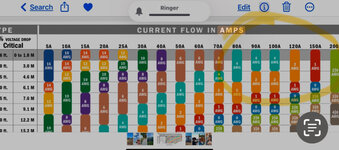
My understanding is that to 2 AWG wire is suitable for loads up to 120 amps. I have the wiring protected by a 300V 125 amp class T fuse in a blue sea fuse holder.
I ran a small refrigerator off this set up for about 12 hours from a warm start. The inverter seemed to handle the load without issue. The refrigerator and freezer got to operating temperature and it seemed to cycle normally. But overnight the fuse blew.
The running load of the refrigerator seems to be between 5 and 10 amps. I don’t have an estimate of the locked rotor amps.
I took apart the fuse and it looks like there was some corrosion in there, but who knows.
My question for you guys is, what’s the appropriate size of a class T fuse on 2 AWG wire in this situation? Am I being too conservative? Note, I need a class T fuse in this application, as this is a lithium iron phosphate battery with a very high discharge rate therefore needing a high amperage interruption capability.
Thanks


I’ve got a Victron 12/1200 inverter. It’s wired up with 2 AWG fine strand wire. As per the manual. This is the largest wire that can be used with this inverter due to the size of the attachment point.
The surge capacity on this 1200 watt inverter is 2400 watts (approximately 200 amps).
My understanding is that to 2 AWG wire is suitable for loads up to 120 amps. I have the wiring protected by a 300V 125 amp class T fuse in a blue sea fuse holder.
I ran a small refrigerator off this set up for about 12 hours from a warm start. The inverter seemed to handle the load without issue. The refrigerator and freezer got to operating temperature and it seemed to cycle normally. But overnight the fuse blew.
The running load of the refrigerator seems to be between 5 and 10 amps. I don’t have an estimate of the locked rotor amps.
I took apart the fuse and it looks like there was some corrosion in there, but who knows.
My question for you guys is, what’s the appropriate size of a class T fuse on 2 AWG wire in this situation? Am I being too conservative? Note, I need a class T fuse in this application, as this is a lithium iron phosphate battery with a very high discharge rate therefore needing a high amperage interruption capability.
Thanks
Last edited: