MBfreak
MEMBER EMERITUS
Hi to all.
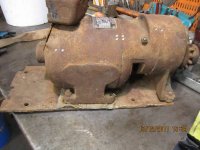
FUTURLINER #8 has found its way to Sweden and is being rebuilt. I am doing the electrical component repair, assembly and testing. Main parts are 1 off 10 kVA 2x120 VAC generator and 4 off 110 VAC 1/3 to 1/2 HP "Gearhead motors" made by the Master Electric Company, Daytona, Ohio around 1950.
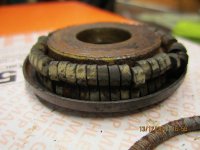
The motors are of a special design, called reluctance motor, which at the time was state of the art for US made single phase reversible motors. They are very well made. The rotor is a commutator rotor that is switched to a squirrel cage rotor as the motor picks up speed. A very well made and cleverly designed centrifugally operated device as per photo. The copper bars overcomes the holding force from a torus spring, flex out and short circuits all the rotor commutator segments. ( Diameter is about 2 ")
On some of the motors the copper in the centrifugal weights has surface corrosion, black and quite hard. I would like to NOT disassemble the hub that comprises two discs riveted together and holding the copper weights in place.
Have been trying to clean this up with acetic acid, got a bit better but not good. Have been trying to locate an industrial type (500W) ultrasonic cleaner, but no go.
Would anybody have a method , and please note that the hub is made of one part in steel and one part in copper, all the weights are copper.
Best regards
Ola
FUTURLINER #8 has found its way to Sweden and is being rebuilt. I am doing the electrical component repair, assembly and testing. Main parts are 1 off 10 kVA 2x120 VAC generator and 4 off 110 VAC 1/3 to 1/2 HP "Gearhead motors" made by the Master Electric Company, Daytona, Ohio around 1950.
The motors are of a special design, called reluctance motor, which at the time was state of the art for US made single phase reversible motors. They are very well made. The rotor is a commutator rotor that is switched to a squirrel cage rotor as the motor picks up speed. A very well made and cleverly designed centrifugally operated device as per photo. The copper bars overcomes the holding force from a torus spring, flex out and short circuits all the rotor commutator segments. ( Diameter is about 2 ")
On some of the motors the copper in the centrifugal weights has surface corrosion, black and quite hard. I would like to NOT disassemble the hub that comprises two discs riveted together and holding the copper weights in place.
Have been trying to clean this up with acetic acid, got a bit better but not good. Have been trying to locate an industrial type (500W) ultrasonic cleaner, but no go.
Would anybody have a method , and please note that the hub is made of one part in steel and one part in copper, all the weights are copper.
Best regards
Ola