To avoid these ads, REGISTER NOW!

Gable end truss supports

oachalon

Well-known member
Joined
Oct 3, 2018
Messages
82
Location
Northeast Ohio
Hi,

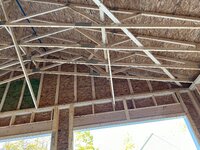
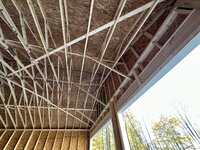
My 32x48 building has scissor trusses, and then standard gable end trusses on the ends. To keep those end walls from having a hinge point there are 2x4s and 2x6s that go from the hinge point on the wall to the scissor trusses. I want to be able to insulate and finish the entire building and I dont really want these just sticking out of the walls to the ceiling. They also might get in the way of my lifts that I want to put in. How can i rebrace these trusses and gable walls to strengthen that hinge point, but also not see the structure when I finish the building.

I am located in Northeast ohio.

Thanks,
 

Attachments

  • IMG_1920.jpeg
    IMG_1920.jpeg
    1.6 MB · Views: 215
  • IMG_1921.jpeg
    IMG_1921.jpeg
    1.5 MB · Views: 200
  • IMG_1922.jpeg
    IMG_1922.jpeg
    1.6 MB · Views: 199
  • IMG_1923.jpeg
    IMG_1923.jpeg
    1.3 MB · Views: 189
  • IMG_1924.jpeg
    IMG_1924.jpeg
    1.2 MB · Views: 168
  • IMG_1925.jpeg
    IMG_1925.jpeg
    1.1 MB · Views: 183
To avoid these ads, REGISTER NOW!

Augus7us

Well-known member
Joined
Jan 14, 2017
Messages
1,190
Location
Central Ohio
In my opinion that is bracing only and they can go. Why bother with scissor trusses if you need 2x4's sticking out below the bottom chord.

Also you can look how they are attached. Does not look structural at all, to me.
 
OP
O

oachalon

Well-known member
Joined
Oct 3, 2018
Messages
82
Location
Northeast Ohio
I will see if I can get the roof design paperwork. He installed the braces after the trusses were up and also the sheething. It was actually one of the last things they did. I wasnt home when they did that part but all he had said to me was I need to put some additional bracing in, the inspector will like it when they come. I didnt know it was that bracing he was putting in.
 

strutaeng

Well-known member
Joined
Dec 12, 2011
Messages
2,263
Location
Dallas, TX
I can tell you they are required. Stopping and starting the studs creates a hinge, as you mentioned. Negative wind pressure will want to blow out that wall at the top plate+bottom plate joint w/o those braces.

Options are replacing the gable studs with full-height studs. Not sure if studs need to be upsized due to the increased slenderness...?

Another option is to add a new beam to span horizontally the full width on the wall. Looks quite a span though.

Another option is to install a rigid L frame with a long horizontal leg at the roof deck and a vertical leg down the gable. This is a steel option to make that happen. Different ways to skin a cat.

Edit: I now see the end is framed with a typical height stud and a gable truss. But everything I mentioned is still true.
 
Last edited:

red61cj5

Well-known member
Joined
Mar 31, 2016
Messages
3,745
Location
West Virginia
No way that's the design bracing. Defeats the point of scissor trusses. Once the inside of the gable has nailers installed and it's all tied into the rest of the assembly with the diagonal bracing (should be included in your paperwork for the trusses), the hinge point is meaningless. It can't drag the whole roof over with it. Look at any home with vaulted ceilings, you don't see a 2x4 coming through those ceilings. Anyway, if there are stresses sufficient to "blow out" an adequately attached wall to gable, those end nailed 2x4's aren't going to do anything about it.
 
Last edited:

strutaeng

Well-known member
Joined
Dec 12, 2011
Messages
2,263
Location
Dallas, TX
Here's a graphical idealized free body diagram of what I believe the condition is. The second figure is unstable with the hinge noted. Needs the diagonal brace. If you flip that figure horizontal, then it's more obvious.

Unfortunately, it seems this condition is not well understood by some framers. The APA has documented this same type of failure with discontinuous studs in vaulted ceilings during high wind events, mostly in tornado investigation, but they noted failures occured even outside the high velocity areas, even below the 90 MPH areas.
 

Attachments

  • IMG_20221023_075453896.jpg
    IMG_20221023_075453896.jpg
    389.7 KB · Views: 159
OP
O

oachalon

Well-known member
Joined
Oct 3, 2018
Messages
82
Location
Northeast Ohio
Are there any mechanical fasteners or hardware I can add to eliminate the need for this bracing? I have to build those gable ends out to be able to add insulation as well as have the drywall flush.

I know suggestions were given, but what about triangle bracing on every stud point from the gable truss to the top plate as well as some specific metal ties?

Thanks for the suggestions.
 

WNYflyer

Well-known member
Joined
Sep 13, 2009
Messages
2,119
Location
Lockport, NY
Yup, you have the dreaded hinge joint. Unfortunately it seems if these types of buildings are not designed and sold as a complete package then there is often a knowledge gap on how the trusses and required truss bracing work with the side and especially end/gable walls. Truss manufacturer gives the contractor what he requests and could give a **** on whether your walls are framed correctly so as to provide proper anchoring structure for his required bracing. With the hinge you basically have something like two connected bicycle chain links. much movement in the joint but ends up trying to act somewhat like a catenary wire and throwing all kind of different loads where they are not designed to go.

No easy answers on how to handle the problem but as noted above strutaeng gave some good guidance
 

Augus7us

Well-known member
Joined
Jan 14, 2017
Messages
1,190
Location
Central Ohio
I still see them as temporary bracing and nothing more. The guy that put them up can tell you they are admantium but that doesn't make it so.

A few 2x4's wedged up in your truss and butted up against an OSB wall with a few 16d nails is not providing you anything structural. If a tornado hit that building I'll bet a paycheck that the damage will be identical with or without a couple 2x4's jammed in there.
 
OP
O

oachalon

Well-known member
Joined
Oct 3, 2018
Messages
82
Location
Northeast Ohio
I can tell you they are required. Stopping and starting the studs creates a hinge, as you mentioned. Negative wind pressure will want to blow out that wall at the top plate+bottom plate joint w/o those braces.

Options are replacing the gable studs with full-height studs. Not sure if studs need to be upsized due to the increased slenderness...?

Another option is to add a new beam to span horizontally the full width on the wall. Looks quite a span though.

Another option is to install a rigid L frame with a long horizontal leg at the roof deck and a vertical leg down the gable. This is a steel option to make that happen. Different ways to skin a cat.

Edit: I now see the end is framed with a typical height stud and a gable truss. But everything I mentioned is still true.

Sorry to sound stupid, could you draw up these options for me on the pictures? Just trying to see exactly what you are saying.
 

Walkers

Well-known member
Joined
May 17, 2021
Messages
3,912
Location
Cave Creek Az
Are there any mechanical fasteners or hardware I can add to eliminate the need for this bracing? I have to build those gable ends out to be able to add insulation as well as have the drywall flush.

I know suggestions were given, but what about triangle bracing on every stud point from the gable truss to the top plate as well as some specific metal ties?

Thanks for the suggestions.
FWIW, I seriously doubt those were anything but bracing to keep things true during construction. Both my house and shop are built the same way with no bracing. If the bracing was required there would at the very least be an H25 on the end, and some sort of legitimate blocking built into the truss to attach to.
 

Walkers

Well-known member
Joined
May 17, 2021
Messages
3,912
Location
Cave Creek Az
Without ripping out sheathing and siding and walls, what are peoples best thoughts on addressing this?
Go to your building authority and see if you can get a copy of your plans, or check with your local truss companies to see if they have them. Your truss engineering will show them if needed. You could even take some pics and measurements to your local truss company and get their opinion.
 
To avoid these ads, REGISTER NOW!
OP
O

oachalon

Well-known member
Joined
Oct 3, 2018
Messages
82
Location
Northeast Ohio
FWIW, I seriously doubt those were anything but bracing to keep things true during construction. Both my house and shop are built the same way with no bracing. If the bracing was required there would at the very least be an H25 on the end, and some sort of legitimate blocking built into the truss to attach to.
That additional bracing was added at the end of the job, not in the middle. They had outside bracing during construction which was removed.
 

Uncle murph

Well-known member
Joined
Jan 28, 2021
Messages
1,462
Location
Harford county
Hi,

My 32x48 building has scissor trusses, and then standard gable end trusses on the ends. To keep those end walls from having a hinge point there are 2x4s and 2x6s that go from the hinge point on the wall to the scissor trusses. I want to be able to insulate and finish the entire building and I dont really want these just sticking out of the walls to the ceiling. They also might get in the way of my lifts that I want to put in. How can i rebrace these trusses and gable walls to strengthen that hinge point, but also not see the structure when I finish the building.

I am located in Northeast ohio.

Thanks,
They are temporary and totally redundant after the sheeting went on.That being said,check the drawings that were included with the truss package.
 

jack stand

Well-known member
Joined
Feb 29, 2012
Messages
3,329
Location
Lakes Region Maine
Without ripping out sheathing and siding and walls, what are peoples best thoughts on addressing this?
Half a dozen here say to check the truss suppliers provided field installed lateral bracing.
Scissor trusses are not new and neither is "platform" framing.
You're builder did a nice looking framing job and I don't know why he would have added bracing that intrudes into the "living space". You need those papers from the truss supplier.
There are plenty of additional bracing opportunities within the trusses but start by confirming the field instructions by the truss company were completed.
 

Pen & Wrench

Well-known member
Joined
Jan 12, 2015
Messages
658
Location
Huron, SD
Some have said they are required and I would say they are correct. Having owned a garage with no bracing on the gable end, and seeing that wall move a couple inches back and forth in a heavy wind, me and my neighbor quickly put some bracing on it and that solved my problem, otherwise I think it would have seen damage to the gable end over time. Maybe there's another way to do it, but it sure looks like it still needs to have bracing of some kind. Scissor truss or not, you still have the issue of stabilizing that part of the building, in my humble opinion. Disclaimer, I'm not an engineer.
 

Jackfre

Well-known member
Joined
Dec 26, 2010
Messages
4,410
Location
N CA
Curious if sheathing the gable end walls with plywood and the ply overlapping the hinge point would tie the wall together better or at least strengthen the hinge point?
 

KenC

Well-known member
Joined
Dec 20, 2009
Messages
2,578
IMO, the truss manufacturer is not the correct source for engineering info since the issue really is a wall design question, not truss or truss installation. Trusses just set on a designed wall system.

Assuming the building was bought as a package the engineer that stamped it has the last word.

Do you have drawings, stamped?

I'm in the camp requiring bracing. Not saying the existing bracing is the best or only way, but something is needed.

I'd consult with an engineer.

If that bracing was all removed, I'd bet you can shake that wall with hand pressure at the top of the studs. Especially on the door end. Again, IMO, the end walls should have been baloon framed. Platform framing works because most example have a floor plane between platforms that provides the rigidity to the structure.
 

KenC

Well-known member
Joined
Dec 20, 2009
Messages
2,578
Curious if sheathing the gable end walls with plywood and the ply overlapping the hinge point would tie the wall together better or at least strengthen the hinge point?
Not an engineer but common sense says, yes. But, how much and is that enough? If the builder did the same on the exterior sheathing that would also help a lot. But I see know indication in the pics of any sheathing joints other than the hinge point. Even with that improvement I'd still be concerned on the door end wall. Really very little strength against wind load there.
 
OP
O

oachalon

Well-known member
Joined
Oct 3, 2018
Messages
82
Location
Northeast Ohio
I received a copy of my truss specifications, its attached. They also just gave the BSCI B1 and B3 handout for the bracing that was it. The building was not part of a package. The drawings were basic drawings just needed for my county and stamped by the county. You did not have to give much as far as truss specifications in the drawing.

Definitely open to suggestions on being able to remove these braces and replace with something that doesnt impede in the "living space".
 

Attachments

  • 19641_TDD's.pdf
    32.8 KB · Views: 23
OP
O

oachalon

Well-known member
Joined
Oct 3, 2018
Messages
82
Location
Northeast Ohio
I spoke with the builder (amish FYI), he was on a job site hard to understand exactly what he said. I think he mentioned possibly running angled steel up the entire walls and the gable end trusses. He said even with the bracing removed it would pass inspection up here.
 

mike93lx

ALLIANCE MEMBER
Joined
Dec 9, 2013
Messages
37,487
Location
Richmond, VA
I spoke with the builder (amish FYI), he was on a job site hard to understand exactly what he said. I think he mentioned possibly running angled steel up the entire walls and the gable end trusses. He said even with the bracing removed it would pass inspection up here.
Inspection isn't always the best standard to measure against
 

billconner

Well-known member
Joined
Jul 20, 2021
Messages
6,963
Location
Thousand Islands NYS
If the shearing on exterior spans the "hinge" line, consider adding studs to gable so flush with framing in wall below and sheathing interior. It will make for a very stiff wall from bottom plate to eave. Improved if after framing you could foam spray the framing and exterior sheathing, and then glue as well as screw the interior sheathing.
 

Zeke

Well-known member
Joined
Aug 13, 2009
Messages
17,176
Location
Long Beach CA, the sewer by the sea.
If the shearing on exterior spans the "hinge" line, consider adding studs to gable so flush with framing in wall below and sheathing interior. It will make for a very stiff wall from bottom plate to eave. Improved if after framing you could foam spray the framing and exterior sheathing, and then glue as well as screw the interior sheathing.
Not gonna help much with the door end but doing this at the other end will certainly provide additional strength. I didn't notice the flat studs above the top plate until I went back and looked.

Good idea. For the door end I like the steel idea. But maybe it too should extend past the hinge line. Gonna take some extra work to do that.
 
To avoid these ads, REGISTER NOW!
Top Bottom