To avoid these ads, REGISTER NOW!

Gantry Crane I-beam sizing

Snip

Well-known member
Joined
Jan 9, 2011
Messages
446
Location
Crossville, Tennessee
I'm thinking about building my own gantry crane. Pre retirement I was a millwright/machinist/fabricator/general mechanic at a large wastewater plant and still have a Bridgeport, lathe and welders. Planning an adjustable height using 4x4x3/16 and 3.5x3.5x3/16 for the uprights. I would like to know what size I-beam you would recommend for the top. I would like to have at least a 10' span and would like to have a 2t capacity. Beams i'm seeing are listed by height x lbs per ft. Also planing 2 support pins per side, maybe 3/4" diameter? TIA for your thoughts and input.
 
To avoid these ads, REGISTER NOW!

nadogail

Well-known member
Joined
Jan 23, 2009
Messages
31,933
Location
Coronado, CA
I once had a catalogue from a company that made and sold portable gantry cranes, they listed the sizes of their structural members; I gave it away to a fabricator more than 20 years ago. The Logo in their advertising showed a hippopotamus being hoisted by their equipment.

IMHO, try google to locate portable gantry cranes.
 

blazemaster83

Well-known member
Joined
Oct 8, 2009
Messages
604
Location
Lacey, Wa.
I have a wallace 3 ton gantry, 15ft span with square tube legs that I turned into an adjustable height model years ago, it uses a s10x24.5 beam. You could just check out what beam companies use to make their commercial gantries (wallace, gorbel, etc.)
 

matt_i

Well-known member
Joined
Mar 14, 2008
Messages
10,725
Location
SE Michigan
I have a 8'3" span using S6 x 12.5# for 2t working load.

This .pdf has some good info for generalized overhead hoist beam sizing. Can also study Wallace catalogs they typically give you a beam height right there.

https://www.harringtonhoists.com/tech_support/edocs/EDOC 0367 rev02.pdf

The adjustable height is a good idea - were I to redo it that way I would try to carve out the welded seam from the tubing to get a better/closer sliding fit. There are some great youtube videos, but I think for the size and length involved a bandfile (mini belt sander with 1/2" wide belt) would work well.

Relative to your pin, the 3/4" in double-shear sounds good.

Some weak links are the swivel casters, the 4000# load isn't guaranteed to be in the center, potentially it could be trolleyed to either end and concentrate load, so those deserve some up-sizing rather than just 4000/4 = 1000# capacity. Larger casters also roll better.

Tying the lower leg of the typical triangular lower structure is also important unless you have an extremely beefy center section.

Last thing I would advise is to locate the parking spot for the gantry before you build it. I had it straddling a 8'0" workbench until I finally reclaimed that space but apart from a few lifting jobs as years went by it sat more and more and that parking spot became important. I haven't finalized a new parking spot yet but it could involve new mods....

I used this detail in making it semi-portable instead of fully-welded.

gantry_hoist_02.jpg
 

GMCGarage

Well-known member
Joined
Jan 31, 2017
Messages
1,264
I'm thinking about building my own gantry crane. Pre retirement I was a millwright/machinist/fabricator/general mechanic at a large wastewater plant and still have a Bridgeport, lathe and welders. Planning an adjustable height using 4x4x3/16 and 3.5x3.5x3/16 for the uprights. I would like to know what size I-beam you would recommend for the top. I would like to have at least a 10' span and would like to have a 2t capacity. Beams i'm seeing are listed by height x lbs per ft. Also planing 2 support pins per side, maybe 3/4" diameter? TIA for your thoughts and input.

Quick calc looks like any W4 or W6 passes the test.
 
Last edited:

manwithtools

ALLIANCE MEMBER
Joined
Aug 24, 2015
Messages
13,739
Location
Lebanon, TN
I have a 8'3" span using S6 x 12.5# for 2t working load.

This .pdf has some good info for generalized overhead hoist beam sizing. Can also study Wallace catalogs they typically give you a beam height right there.

https://www.harringtonhoists.com/tech_support/edocs/EDOC 0367 rev02.pdf

The adjustable height is a good idea - were I to redo it that way I would try to carve out the welded seam from the tubing to get a better/closer sliding fit. There are some great youtube videos, but I think for the size and length involved a bandfile (mini belt sander with 1/2" wide belt) would work well.

Relative to your pin, the 3/4" in double-shear sounds good.

Some weak links are the swivel casters, the 4000# load isn't guaranteed to be in the center, potentially it could be trolleyed to either end and concentrate load, so those deserve some up-sizing rather than just 4000/4 = 1000# capacity. Larger casters also roll better.

Tying the lower leg of the typical triangular lower structure is also important unless you have an extremely beefy center section.

Last thing I would advise is to locate the parking spot for the gantry before you build it. I had it straddling a 8'0" workbench until I finally reclaimed that space but apart from a few lifting jobs as years went by it sat more and more and that parking spot became important. I haven't finalized a new parking spot yet but it could involve new mods....

I used this detail in making it semi-portable instead of fully-welded.

gantry_hoist_02.jpg

I made mine similar, except I designed the legs to clamp to the I-Beam. That way, you don't have to fully remove the hardware to remove the legs. I used hydraulic rams for cherry pickers (engine hoist) to allow easy telescoping of the vertical supports. Also used 3/4" D handle hitch pins from tractor supply for easy of removal and insertion - for the price, you almost cant make your own.
 

matt_i

Well-known member
Joined
Mar 14, 2008
Messages
10,725
Location
SE Michigan
Quick calc looks like any W4 or W6 passes the test.

At first I was thinking "no way" but then ran numbers and it fits with equations.

There are a couple unique considerations in a gantry that aren't present in a simply-supported beam however....the load beam is also responsible for maintaining the geometry of the structure, and so misalignments from slight grades or the final geometry of the legs after it was welded up and side loads from events like trying to roll over a rock with a caster all get transmitted "up-top"

Some of the conservatism revolves around the top flange (in compression). The bottom flange (in tension) self-aligns more or less, but compression is unpredictable and can result in a curve or worse buckling. An S-shape has a disadvantage in the Iyy direction (as if was loaded like an H instead of an I) over a wide-flange, but the wide-flange has a disadvantage when it comes to trolleys because of the longer and less beefy flange.

How to fix? A lot of high-end monorails use an S-shape combined with a cap channel to make a fancy "T" shape....think Texas or Tennessee university logos... The cap-channel is skip-welded and results in a lightweight and rigid beam optimized for medium-span monorail or bridge-rail use.

In construction, the beam is usually spec'd as something like "top flange fully braced" meaning every structural member that crosses is perpendicularly is also fixed to it. And that helps resolve the compression instability.
 

gearhead1

Well-known member
Joined
Oct 14, 2013
Messages
1,935
Location
NC
A36 is a 36,000 psi yield strength material.

So, the max moment would be 5’x4000lbs=20,000ft-lb (convert to in-lbs)
C is the distance from the neutral axis to the outermost fiber (units of inches)
I=moment of inertia (units of in^4)

Typically a safety factor of 5 is used for overhead loads.

Stress = M * c / I

So select a beam that has a stress of 7200 psi or under given the 2 tons of load and 10’ span.
 
Last edited:

gearhead1

Well-known member
Joined
Oct 14, 2013
Messages
1,935
Location
NC
If I look at a S10x35, I get a stress of 8163psi. This would give a safety factor of 4.4. (36,000 / 8163)

I’d personally do that for home use. I’d also stencil a 4000lb load limit on the beam too.

If you make the span wider, the stress gets worse. So if you decide later to make it longer, you need to re-figure the beam size.
 
To avoid these ads, REGISTER NOW!

nadogail

Well-known member
Joined
Jan 23, 2009
Messages
31,933
Location
Coronado, CA
I once had a catalogue from a company that made and sold portable gantry cranes, they listed the sizes of their structural members; I gave it away to a fabricator more than 20 years ago. The Logo in their advertising showed a hippopotamus being hoisted by their equipment.

IMHO, try google to locate portable gantry cranes.

If I remember correctly, I was referring to the Wallace company.
 

ssdave

Banned
Joined
Apr 11, 2015
Messages
2,913
Location
Eastern Oregon
PL/4 is the moment. 4000*10*12/4 = 120,000 lb-in.

M/fb = S so 120,000/36000 = S = 3.33

Using a load factor of 5 gives Srequired = 16.67

Smallest/lightest beam that will work is a S6x12.5 with an S = 22.1, or a load factor of 6.6 times. That margin will account for the weight of the beam and hoist.

I see gearhead did the same calculation, and concluded it was unsafe, and recommends a 10x35 with an S = 147. Take your choice, his is a lot more conservative recommendation.

I did some quick googling, and find that a factor of safety of 8 or 9 is recommended for lifting apparatus.

So, using that, S required = 9 x 3.33 = 29.97

An S8x18.4 has S = 57.6, so meets that criteria. It would have a factor of safety of 57.6/3.33 = 17.3.

The harrington chart referenced above (https://www.harringtonhoists.com/tech_support/edocs/EDOC 0367 rev02.pdf) recommends a S10x25.4 beam with an S of 124 for a 10 foot span and 2 ton load. The factor of safety would be roughly double the S8x18.4, or about 35.

So, a few different choices of recommendations available. You can never go wrong going bigger, except harder to handle the weight of the beam.

If I was going to install the beam permanently in place, and it is rigidly attached, level and not twist, I'd be pretty comfortable at the S6. If it was going to be on a portable stand, level, hard floor, I'd be wanting to go with the S8. Twisted, not level, soft floor, I'd be looking at the S10.
 
Last edited:
OP
S

Snip

Well-known member
Joined
Jan 9, 2011
Messages
446
Location
Crossville, Tennessee
Thank you again to all of you for your input and advice. Some very in-depth calculations. I was originally thinking the 10' wide for clearance unloading material off of my car trailer but hadn't thought about the width of my 4 post lift on order (Advantage DX-9000 XLT). I'm very glad I checked the specs, 119" wide. That would have been a big screw up on my part, not being to straddle the lift. New plan will be 12' beam. It will be used on a flat concrete floor (one man hobby shop) and would rarely, if ever see over 3k on it, lifting my Milling machine. With all of the info here I think I would be safe going with the S8 beam 12' long and marking it as a 3k limit. Opinions?
Thank you all again
 

matt_i

Well-known member
Joined
Mar 14, 2008
Messages
10,725
Location
SE Michigan
I'd use the S8 x 18.4# that you are suggesting. It meets criteria for < L/480 deflection and approx 6x safety factor to A36 yield.

As I think I might have posted. keeping the connection from verticals to horizontal rigid is very important, as well as a set of 2 casters being able to bear the full working load (if the trolley rolls to either end under load)

Another thought, that choice drives you to a 1.5t hoist. I'm not sure how common that is (maybe you already have one :)) on the used market, you might consider upsizing to a 2t WLL working load limit and then more common rigging might be available. The counterpoint is that the casters get more expensive or harder to find for the upsized load...
 
Last edited:

sberry

Banned
Joined
Jun 18, 2005
Messages
35,747
Location
Brethren, Michigan
Last thing I would advise is to locate the parking spot for the gantry before you build it. I had it straddling a 8'0" workbench until I finally reclaimed that space but apart from a few lifting jobs as years went by it sat more and more and that parking spot became important. I haven't finalized a new parking spot yet but it could involve new mods....
Actually maybe first. There are a lot of different styles. Mine has seen 2 revisions, replaced the beam and raised the height. Both schemes involved the parking and in some sense for a particular type of job. Mine is 19 ft.
 

sberry

Banned
Joined
Jun 18, 2005
Messages
35,747
Location
Brethren, Michigan
I dont roll mine under load. It has a shelf made from light beam laid on side for a tool station, table this side and a tool cart the other. This station feeds 2 bays.
 

Attachments

  • A frame connection.JPG
    A frame connection.JPG
    37.5 KB · Views: 94
  • A frame paint (2).jpg
    A frame paint (2).jpg
    99 KB · Views: 95
  • A frame yel.jpg
    A frame yel.jpg
    39.6 KB · Views: 97
  • a frame  tool backs.jpg
    a frame tool backs.jpg
    102.3 KB · Views: 104
  • motor crane 3.JPG
    motor crane 3.JPG
    22 KB · Views: 107
  • motor crane 6.JPG
    motor crane 6.JPG
    32.6 KB · Views: 111
  • motor crane1.JPG
    motor crane1.JPG
    16.6 KB · Views: 85

sberry

Banned
Joined
Jun 18, 2005
Messages
35,747
Location
Brethren, Michigan
I moved it about twice for 1 job since I had it when I first rigged up, been sitting within the same 5 ft for last 20+ years. Got a 120V circuit. I would add one more outlet and another switch box if I was going to do it again but aint gonna bother at this point.
 

Attachments

  • tools turnstyle.jpg
    tools turnstyle.jpg
    112.2 KB · Views: 80
  • tractorr lights.jpg
    tractorr lights.jpg
    104.9 KB · Views: 81

labonbjones

Member
Joined
Oct 6, 2020
Messages
16
Location
Elkhart, IN
Snip, in hindsight, would you build your own gantry again instead of buying a kit? What was your cost in material and time to fab?
 

GMCGarage

Well-known member
Joined
Jan 31, 2017
Messages
1,264
At first I was thinking "no way" but then ran numbers and it fits with equations.

There are a couple unique considerations in a gantry that aren't present in a simply-supported beam however....the load beam is also responsible for maintaining the geometry of the structure, and so misalignments from slight grades or the final geometry of the legs after it was welded up and side loads from events like trying to roll over a rock with a caster all get transmitted "up-top"

Some of the conservatism revolves around the top flange (in compression). The bottom flange (in tension) self-aligns more or less, but compression is unpredictable and can result in a curve or worse buckling. An S-shape has a disadvantage in the Iyy direction (as if was loaded like an H instead of an I) over a wide-flange, but the wide-flange has a disadvantage when it comes to trolleys because of the longer and less beefy flange.

How to fix? A lot of high-end monorails use an S-shape combined with a cap channel to make a fancy "T" shape....think Texas or Tennessee university logos... The cap-channel is skip-welded and results in a lightweight and rigid beam optimized for medium-span monorail or bridge-rail use.

In construction, the beam is usually spec'd as something like "top flange fully braced" meaning every structural member that crosses is perpendicularly is also fixed to it. And that helps resolve the compression instability.

I just ran a 2 min calc. Its not a huge span or load. So many options.
 
OP
S

Snip

Well-known member
Joined
Jan 9, 2011
Messages
446
Location
Crossville, Tennessee
labonbjones,
I have not built mine as of yet, i'm still in the design and material stages. The gantry will be one of the first projects (other than a workbench) done when the shop gets completed so I can get the Mill and Lathe off of the pallets I made for shipping them here when we moved.
As far as buying one complete, as a kit or building one, i'm in the building my own camp. Looking at quality made adjustable gantrys with the capacity and sizing I'm looking at would run over 2k. I think I should be able to build one at least as good as what I am seeing for under 1k in materials with a good supply of drops when complete. As I enjoy fabrication and have the time (retired) I don't figure that into the equation. For me it's "fun" time.

sberry,
Two very nice Gantrys you have built there, later version looks very stout and a stable.
I agree with you as for looking at sizing and storage options prior to building. I have re-sized my plans once (so far) to clear the car trailer. I think I have the storage thing figured out also, side 10x10 door access to the 12 deep lean to area, I will build the unit so it lowers far enough to clear the door if I need the additional floor space in the shop. Thank you for the thought.
 

jkuro

Well-known member
Joined
Apr 28, 2009
Messages
552
Most suppliers of steel beams have an engineer on staff. When you buy your beam they will usually calculate the size of beam you need. Keep it simple, call they first
 
OP
S

Snip

Well-known member
Joined
Jan 9, 2011
Messages
446
Location
Crossville, Tennessee
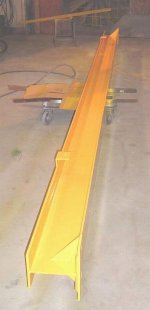
Yesterday I ran across a deal on a 20' beam measuring 10" tall with 4" flanges. I did some more measuring and it turned out to be a W10x12 beam and I picked it up. I spent a little time on one of the engineering sites plugging in weights on a 12' beam. I'm not sure if I'm doing it right but I was doing a single point centered load doing 1k lb intervals (it used Kips which i think is equal to pounds?) and it kept saying "Pass" until I went past 8K. If I am doing this correct it would give me a 2-1 safety ratio for a 2t gantry? It would rarely, if ever, see that. The calculation is showing the load on top of the beam but a trolly would be hanging on the lower flange. Is this going to work, or what would the allowable loading be on this beam? Thank you
 

WNYflyer

Well-known member
Joined
Sep 13, 2009
Messages
2,119
Location
Lockport, NY
See post 5 for a similar calculation and explanation.

https://www.garagejournal.com/forum/showthread.php?t=457837&highlight=gantry+build

Also,rough idea based on your conditions assuming I interpreted them correctly. "W" Wide Flange sections often are not good for monorails because the trolley wheel loads often overstress the bottom flange locally before the global allowable beam bending stresses are reached. This local overstress is due to the thin and wide flanges of "W" sections as compared to narrow thick flanges of "S" sections. Of course either can work as long as appropriately designed.

View media item 110351
 
Last edited:
To avoid these ads, REGISTER NOW!
Top Bottom