To avoid these ads, REGISTER NOW!

Garage AIR design experience?

lilscorpion

Well-known member
Joined
Mar 15, 2010
Messages
3,599
Location
Colorado
My last garage had black pipe run everywhere. It worked well but when I mined 10 years ago, and I was disassembling it so I could take it with me, I found the inside to have significant rust buildup. As a result, I never did plumb the new house. I’ve been able to get by with a single line and stage the hose around to the various machines or work areas. Life had changed a little in this last year. My son is now of age so there will be multiple users possibly at once in the shop and I’m tired of dragging a hose around the shop. I want connections closer to the places I use air (for convenience reasons) and dragging hoses around for two users is stupid. My compressor is a multi-stage 175psi unit. It has kept up with a single user just fine.

When we do use air in the shop, we use it like I did when I had my shop - machines require it, we have higher volume air tools like DA sanders, HVLP guns, etc and I will use them for extended periods of time. I’ve been doing some research and tripped across some info in system design.
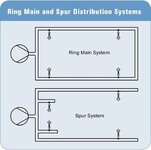
Below are two different common designs. To date I’ve only used a spur system.
916505d05f1633d8c1ce1861516c1957.jpg

The primary benefits do the Ring Distribution System is that air is more balanced everywhere because it flows from more than one direction making starvation at a single point less likely. I’ve found more complex designs that incorporate multiple loops with multiple feeders. Some have both spur and rings integrated where the rings are typically for multi- user spaces (like automotive garages where there’s multiple mechanics) which have other areas nearby where there’s very few, if not only one, users (like a machine shop). Obviously such a design is not necessary for my 3-car garage. 🤪

When I put the system together, I’ll be adding back into the mix a system dryer, some particulate filters, and pressure regulators at usage points. All will work just fine in either design (I think).

Any practical experience you can share to help me decide if the Ring design is necessary enough to justify the additional expense and time?

TIA,

Matt
 

Attachments

  • 916505d05f1633d8c1ce1861516c1957.jpg
    916505d05f1633d8c1ce1861516c1957.jpg
    41.5 KB · Views: 1
To avoid these ads, REGISTER NOW!

Strouty

Well-known member
Joined
Mar 21, 2010
Messages
38,212
Location
Southern Maine
I would go with the spur system, you can add one side easily and then add the other side later. Also you don't need to run the piping through the garage door wall. I will tell you that when I routed all my plumbing, I went against the grain and I am very happy with it. I tilted all my pipes so that they drained back towards the compressor, each drop had an extended space to collect and drain water from it. My run is only about 30' and it has multiple drops, I get NO water at the last drop, I mean none, zip, nada, even on hot humid days.
 
OP
L

lilscorpion

Well-known member
Joined
Mar 15, 2010
Messages
3,599
Location
Colorado
I would go with the spur system, you can add one side easily and then add the other side later. Also you don't need to run the piping through the garage door wall. I will tell you that when I routed all my plumbing, I went against the grain and I am very happy with it. I tilted all my pipes so that they drained back towards the compressor, each drop had an extended space to collect and drain water from it. My run is only about 30' and it has multiple drops, I get NO water at the last drop, I mean none, zip, nada, even on hot humid days.


Does your system stay pressurized all the time or do you depressurize it at the end of the day (or some other interval)?
 

Strouty

Well-known member
Joined
Mar 21, 2010
Messages
38,212
Location
Southern Maine
Right now, it depressurizes due to an issue with the air compressor, but once I figure out the issue, it will be pressurized all the time.
 

Strouty

Well-known member
Joined
Mar 21, 2010
Messages
38,212
Location
Southern Maine
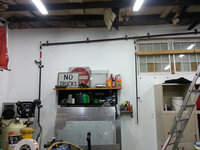
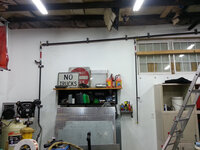
This is what it looks like back when I first installed it. I have changed compressors and done a few tweaks, but it is essentially the same. I set it up so that I could add another segment into it later.

5c7b0ee3cf541001533e44f86986ab00.jpg

c1a73f2cceec5f0ebf1c4a1454b98e42.jpg

I am going to reconfigure the shop in the future, when I do that, I will be using something like rapid air, I think the extra costs will be worth every penny.
 

Attachments

  • c1a73f2cceec5f0ebf1c4a1454b98e42.jpg
    c1a73f2cceec5f0ebf1c4a1454b98e42.jpg
    525.4 KB · Views: 1
  • 5c7b0ee3cf541001533e44f86986ab00.jpg
    5c7b0ee3cf541001533e44f86986ab00.jpg
    709.8 KB · Views: 2

matt_i

Well-known member
Joined
Mar 14, 2008
Messages
10,725
Location
SE Michigan
In my mind the ring system is sort of an easy upgrade when you run out of air way at the end of the run. Usually its in a plant where its sometimes hard to predict how machines will be setup as processes change over time, and the air headers don't get redone as part of relocations or new lines of machinery. Couple that with machines like air-driven presses which usually need a fair amount of inrush (burst) to work correctly and develop the full tonnage/poundage to perform the process.

So...that said, if you have a shop where the layout is pretty fixed...and I think yours is if I recall some of your other threads, I would just try to design the header(s) so you have large diameter pipes going to the points where you know you will need large volume.

Also consider that you can always go ring in the future, you can plan that possibility out ahead of time if your spur is mostly in a "U" shape already. You could put in caps or unions just sitting there waiting. But if its based on a single backbone trunk line, then I would just size it for what you need right now.
 

59 wagon man

Well-known member
Joined
Oct 25, 2010
Messages
1,589
Location
hollywood fla
just my .02
I have had my compressor on the floor, hung from the ceiling and now it is outside my garage in a Rubbermaid shed ,it's been that way about 10 yrs now. as soon as the airline enters the garage there is a pressure gauge and shutoff valve . then the line runs straight up to the ceiling and head to both ends of the garage but on just one side. then a hose reel with 50' hose by the drive in door and a 25' right near the front of the lift . I hate running pipe for free(anything at my house not making me any money or fun) I do it all day so it was quick and easy with 3/4" copper and it does stay pressurized obviously size will affect yours as mine is 20' x 26'
t.i.p. airtools has some great airline info on their site
 
Last edited:

Strouty

Well-known member
Joined
Mar 21, 2010
Messages
38,212
Location
Southern Maine
Following the standard designs will let your condensed water flow away from the compressor and actually direct it to more drops. I have found that it takes very little steel, copper, aluminum, line to actually condense the air, like a 10' section, this includes your vertical run as well. As long as you have a good sized drip loop, you can collect that moisture right at the first drop. If you angle the pipe away from the compressor, it ends up letting the condensed moisture roll down the main system and letting all you drops get a taste of this moisture. And yes, the water will roll backwards, against the "airflow".
 
OP
L

lilscorpion

Well-known member
Joined
Mar 15, 2010
Messages
3,599
Location
Colorado
In my mind the ring system is sort of an easy upgrade when you run out of air way at the end of the run. Usually its in a plant where its sometimes hard to predict how machines will be setup as processes change over time, and the air headers don't get redone as part of relocations or new lines of machinery. Couple that with machines like air-driven presses which usually need a fair amount of inrush (burst) to work correctly and develop the full tonnage/poundage to perform the process.

So...that said, if you have a shop where the layout is pretty fixed...and I think yours is if I recall some of your other threads, I would just try to design the header(s) so you have large diameter pipes going to the points where you know you will need large volume.

Also consider that you can always go ring in the future, you can plan that possibility out ahead of time if your spur is mostly in a "U" shape already. You could put in caps or unions just sitting there waiting. But if its based on a single backbone trunk line, then I would just size it for what you need right now.


Good points. In the shop I used to have a CNC plasma cutting table all day, the vise and feed on my automatic cold saw was pneumatic, and I’d frequently be using blowguns at a few stations at once. I have none of that constant high demand to contend with.

I couldn’t make sense of the 1” fastpipe system over the 3/4” but having that extra volume in the line will help reduce the spikes if they occur.
 
Last edited:
OP
L

lilscorpion

Well-known member
Joined
Mar 15, 2010
Messages
3,599
Location
Colorado
just my .02
I have had my compressor on the floor, hung from the ceiling and now it is outside my garage in a Rubbermaid shed ,it's been that way about 10 yrs now. as soon as the airline enters the garage there is a pressure gauge and shutoff valve . then the line runs straight up to the ceiling and head to both ends of the garage but on just one side. then a hose reel with 50' hose by the drive in door and a 25' right near the front of the lift . I hate running pipe for free(anything at my house not making me any money or fun) I do it all day so it was quick and easy with 3/4" copper and it does stay pressurized obviously size will affect yours as mine is 20' x 26'
t.i.p. airtools has some great airline info on their site


I wish I could get my compressor outside. The HOA here makes outbuildings difficult (almost to the point if uselessness) and freezing could be an issue. It would be my preference if, for nothing more, to get my floor-space back and not to have to hear it.
 
OP
L

lilscorpion

Well-known member
Joined
Mar 15, 2010
Messages
3,599
Location
Colorado
If you can afford it, I would always choose the larger piping, gives you more volume as a bonus.


They have fastpipe up to 2” I think. Is there a point where line size gets too large and impacts performance? If I did trunk and branch. The trunk could be larger, say 1 1/2” and branches of 1”.
 
To avoid these ads, REGISTER NOW!

Strouty

Well-known member
Joined
Mar 21, 2010
Messages
38,212
Location
Southern Maine
I wish I could get my compressor outside. The HOA here makes outbuildings difficult (almost to the point if uselessness) and freezing could be an issue. It would be my preference if, for nothing more, to get my floor-space back and not to have to hear it.

I would love to do this as well, but freezing is my concern as well.

They have fastpipe up to 2” I think. Is there a point where line size gets too large and impacts performance? If I did trunk and branch. The trunk could be larger, say 1 1/2” and branches of 1”.

I think this would depend on your compressor, you could end up having it run constantly and unless it is designed for it, it would be an issue.
 

sberry

Banned
Joined
Jun 18, 2005
Messages
35,747
Location
Brethren, Michigan
Why would it run continiously if the pipe is larger? This is a common 3 car garage correct? Not a General Motors plant?
The line size only needs to be sized for the tools. I want it level or sloped away. If it can be a long vertical is good. A loop won't help in a small garage unless the line is under sized and use is often limited by compressor size. If there is a fuzz of drop when someone does come on with another sander on occasion is a deal killer and,,, not really such a problem as most loss occurs in the final, mainly down the hose goes to the tool.
It is typical and easy to over estimate the demand on piping, you will not have a whole crew of hard rock miners working here even with your son helping.
It doesnt matter how much connected equipment you have, only the use. You may have had several blow guns hooked on but were you running them at the same time,, and if there was a couple # drop on the main was a life changing issue?
 

sberry

Banned
Joined
Jun 18, 2005
Messages
35,747
Location
Brethren, Michigan
Get a real grip and make it easy and good use, make it work well which usually equates to convenience. Get inside the garage, locate a regulator in a good spot, add a coupleT after to take off where needed, fix a whip at a bench or hook to plasma, 1 or 2 well placed reels is worth a hundred hydrants and the only quick connects needed are at the tool end of the hose so no unhooking sections of charged hose is needed by the operators.
1 regulator fan feed several places, in a small garage maybe all. 2 easy, nothing wrong with that but a bunch not needed and all this **** is in the way with limited space.
 

Strouty

Well-known member
Joined
Mar 21, 2010
Messages
38,212
Location
Southern Maine
My point was that if the compressor is too small, the piping essentially creates a large tank, if you are using air continuously, like a blow gun or blast cabinet, the compressor may end up running constantly trying to fill the "tank". I didn't mean that the compressor would run continuously just because you installed bigger air line.

My compressor takes 6 and a half minutes to fill a 200 plus gallon system, so if I end up using air quicker than the pump can create it (and I can), then my compressor would run continuously, if it was a smaller compressor it would be even worse, this is why they make little pancake compressors with a small tank. As an extreme example, hook a pancake compressor up to an 80 gallon tank, see what happens when you start using tools.
 

sberry

Banned
Joined
Jun 18, 2005
Messages
35,747
Location
Brethren, Michigan
In my own case have a manifold and risers and a majority of the turns with 3/4 then the runs are 1/2, one the mains with a t to a convenience reel is 100 ft long which feeds 4 or 5 possible outlets. 3 reels and 2 f ixxed whips from 1 regulator. On occasion multiple men,, NEVER a drop issue and nothing sensitive if there ever was.
120ft of pipe to this filter, hose from regulator to another 60 ft of 1/2 regulated line with the reels and whips for tools at hoist.
 

Attachments

  • air 3.jpg
    air 3.jpg
    78.8 KB · Views: 52
Last edited:

sberry

Banned
Joined
Jun 18, 2005
Messages
35,747
Location
Brethren, Michigan
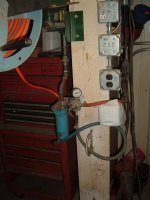
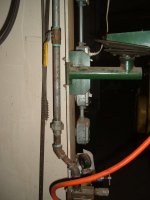
Only 1 90 degree elbow up top feeding the filter, I did use 2 45's at the end to offset in to it, so insignificant but note the service valve on end of pipe before any unions and ittings, also at height can be reached without a ladder. I could have even skipped a union here but I had whole box full for free.
Pics 3 and 4 are paint booth, note valve before hose which feeds reels, its on a regulated line comes from that other reg and I shut it off when not in use as there is a bunch of stuff connected i just only need on occasion. Parts of the system are on 24/7.
 

Attachments

  • paint air 2.jpg
    paint air 2.jpg
    93.8 KB · Views: 45
  • paint air dis.jpg
    paint air dis.jpg
    43.2 KB · Views: 42
  • air 4.jpg
    air 4.jpg
    71.1 KB · Views: 42
  • air 3.jpg
    air 3.jpg
    78.8 KB · Views: 46
  • paint bay after.jpg
    paint bay after.jpg
    142.3 KB · Views: 47
Last edited:

ddawg16

Well-known member
Joined
Jul 11, 2008
Messages
21,005
Location
S. California
I did my garage with 3/4" copper.....but when I did it, PEX was not well known yet....at least to me.

I retrospect, I wish I had done PEX for air. 1" dia PEX is just over about $1/ft. Kinda hard to beat that with iron or copper when you also factor in labor.

But....fittings are a bit more....
 

MattT

Well-known member
Joined
Feb 20, 2010
Messages
3,201
Following the standard designs will let your condensed water flow away from the compressor and actually direct it to more drops. I have found that it takes very little steel, copper, aluminum, line to actually condense the air, like a 10' section, this includes your vertical run as well. As long as you have a good sized drip loop, you can collect that moisture right at the first drop. If you angle the pipe away from the compressor, it ends up letting the condensed moisture roll down the main system and letting all you drops get a taste of this moisture. And yes, the water will roll backwards, against the "airflow".

The standard as you call it is primarily applicable to multiple user set ups where air is flowing constantly. On a single user home mechanic set up there's probably enough zero flow time to allow condensate to drain back to the tank.

The other thing is it's best practise to tee "drops" off the top of the header so the condensate just rolls on past. Then tee drip legs off the bottom of the header at low spots for the condensate to drain into. A lot of people get this wrong including large industrial users who should know better.
 

Strouty

Well-known member
Joined
Mar 21, 2010
Messages
38,212
Location
Southern Maine
The standard as you call it is primarily applicable to multiple user set ups where air is flowing constantly. On a single user home mechanic set up there's probably enough zero flow time to allow condensate to drain back to the tank.

The other thing is it's best practise to tee "drops" off the top of the header so the condensate just rolls on past. Then tee drip legs off the bottom of the header at low spots for the condensate to drain into. A lot of people get this wrong including large industrial users who should know better.

The fluid will flow against the pressure in any system due to gravity. If you condense it early, there is no reason to send it to the end of the line. If I were to do it again, I would do a couple more up and down runs with drip legs at the bottom of each run, I think this would essentially stop all moisture from moving forward. In regards to a large industrial setup, then you would be talking about after coolers and probably refrigerated dryers. Most people make the mistake of not allowing the air to condense until it actually hits the tools. Even a water separator will not remove water unless you cool it down enough to condense it and that is where most people use confirmation bias (no water in the trap, so no water in the system) as a way to judge how much moisture they have.
 

BigWarehouse

Well-known member
Joined
May 10, 2018
Messages
74
Location
The South
I did my garage with 3/4" copper.....but when I did it, PEX was not well known yet....at least to me.

I retrospect, I wish I had done PEX for air. 1" dia PEX is just over about $1/ft. Kinda hard to beat that with iron or copper when you also factor in labor.

But....fittings are a bit more....

PEX all the way! If you must use hard lines use copper. I don't understand why they even still sell black iron pipe! You should not be using that for anything in 2019. If you want some hard lines to condense water, nothing better at heat transfer than copper. And of course never any rust!

PEX is fantastic for air. You can get brass fittings online super cheap, and you can get plastic ones even cheaper. This is essentially the same as the Rapid Air system, which I also can't understand why anyone would buy. It's repackaged PEX with bad fittings and valves. That is literally all Rapid Air is! At significantly higher prices...
 

MattT

Well-known member
Joined
Feb 20, 2010
Messages
3,201
The fluid will flow against the pressure in any system due to gravity.

It's the speed of the airflow that moves the water against gravity.

In regards to a large industrial setup, then you would be talking about after coolers and probably refrigerated dryers.

An aftercooler will only do so much. Seen plenty of water problems downstream from them. And dryers, or adequate storage which also helps, is the exception IME.
 

Corsair4360

Well-known member
Joined
Nov 7, 2013
Messages
63
Location
Logan, Utah
I helped a buddy put in his automotive shop air system. He had a huge air compressor (15 hp or more as I recall and an equally large tank). We put in 4" main lines (100 feet long in some instances) to increase the volume of air for lifts and air tools. Never heard a complaint about that in the 15+ years I occasionally helped and often visited him at the shop.
 
To avoid these ads, REGISTER NOW!
Top Bottom