I haven't had much luck trying to find out how much weight can be stored in a garage attic space. I haven't gone as far as contacting any builders because I figure they'd say don't do it period. I know it depends on the construction itself. In my garage, the attic trusses are on 24" centers, and I know some garages may have 16" centers. I've read in forums that the space wasn't built for storage so forget about, but I've also read that some folks have been doing it for twenty years with no visible sagging. I'm curious to see what's said here, as it seems like a lot of you are doing your own builds.


You are using an out of date browser. It may not display this or other websites correctly.
You should upgrade or use an alternative browser.
You should upgrade or use an alternative browser.
Garage Attic Storage...
- Thread starter benjacobs
- Start date
cw_racefan
Well-known member
- Joined
- Feb 7, 2006
- Messages
- 254
benjacobs said:I haven't had much luck trying to find out how much weight can be stored in a garage attic space. I haven't gone as far as contacting any builders because I figure they'd say don't do it period. I know it depends on the construction itself. In my garage, the attic trusses are on 24" centers, and I know some garages may have 16" centers. I've read in forums that the space wasn't built for storage so forget about, but I've also read that some folks have been doing it for twenty years with no visible sagging. I'm curious to see what's said here, as it seems like a lot of you are doing your own builds.
Assuming you're talking a truss roof, it really depends more on the truss spans and construction than truss spacing. Typically normal roof trusses are not designed to take much load. That being said, I have laid thin OSB in my attic over our attached garage and use it for light storage. Things like empty boxes, empty luggage, etc. I wouldn't put anything much heavier than that up there. My detached garage I built with attic trusses, which are designed for heavier loading (though in my case, still light at only 20psf).
StingRay
Well-known member
It depends on where you live and when the building was constructed. In some areas even moderately accessible spaces must have a 20 psf live load capacity for the bottom chord of the truss in case it gets used for storage. Around here it's 7 psf dead load only unless it's specifically built for storage. Check with the local building codes people they might be able to help you. If it's built for the 7 psf bottom chord dead load which is planned to be strictly insulation and cieling material then little capacity is left for any live load. If you know what kind of insulation and cieling material you have you can calculate the difference and what's left could be used for storage. When you think about it though it's all based on distributed load so even at a straigth 7 psf with no cieling or insulation, point or concentrated loading is very limited. Really you aren't even supposed to stand on the bottom chord of a truss. The point loading is too high.
jarhead
Well-known member
I am doing mine right now. I am using OSB on top of the trusses. I will be laminating 12 foot 2X4s along each truss. Mine span 24 feet so I am a little concerned but I wont be overloading it either.
When I designed trusses for a living, I found it was hard to design a simple truss that couldn't handle more than the min. loads. I have the software, so if you give me a good discription of your trusses,(span, pitch, chord sizes, web size and configration, and the plate sizes) I can get a rough figure. Anothre option is to start loading it up, slowly, and regularly check for sag. I wouldn't recomend this if your ceiling is finished as it could develop a crack.
Inetmonkey
Well-known member
You should be able to get engineering specs on the trusses from the builder or possibly the city. When I got my permits, I was required to give them a copy of the calcs from the engineer who designed my trusses.
cc_rider
Well-known member
The bottom chord of the truss is 2x4, right? Could he scab on a 2x6 or 2x8 alongside the bottom chord, to increase the bending resistance?
Plus depending on the type of truss, adding 'collar ties' across the roof chords, just below the peak, can help reduce the tendency of a truss to pull away from the peak. Imagine the roof chords 'sliding down the roof' away from the center; adding 1x4 ties across them can help. BUT I am not a truss designer; looks like there's probably folks here who can analyze your trusses and offer the PROPER recommendations.
One thing I've done whenever adding collar ties and such is to use deck screws rather than nails. I don't like hammering nails into old existing structures, especially in the attic. Hammering stirs up tons of dust, and seems like it 'rattles' the structure. For small jobs the difference in price is not significant, and screws just seem more elegant. Plus, easier to undo if you mess up. Be warned though; if the wood is old you may have to pre-drill your holes. The wood in my 85-year-old house is hard as a rock; pre-drilling is the only way to get a long screw all the way in.
c.
Plus depending on the type of truss, adding 'collar ties' across the roof chords, just below the peak, can help reduce the tendency of a truss to pull away from the peak. Imagine the roof chords 'sliding down the roof' away from the center; adding 1x4 ties across them can help. BUT I am not a truss designer; looks like there's probably folks here who can analyze your trusses and offer the PROPER recommendations.
One thing I've done whenever adding collar ties and such is to use deck screws rather than nails. I don't like hammering nails into old existing structures, especially in the attic. Hammering stirs up tons of dust, and seems like it 'rattles' the structure. For small jobs the difference in price is not significant, and screws just seem more elegant. Plus, easier to undo if you mess up. Be warned though; if the wood is old you may have to pre-drill your holes. The wood in my 85-year-old house is hard as a rock; pre-drilling is the only way to get a long screw all the way in.
c.
I know there are many different ways to construct a garage, so contacting the builder about attic storage is the best bet. Especially, if you're like me and you don't have any real experience with building structures and/or the math behind it. Thank you all for your feedback, I appreciate the responses.
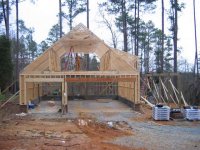
My attic trusses are spec'd for 40 psf Live and 10 psf dead load. When I initially talked to one truss company, they told me that attic trusses had to be made for these loads where as normal trusses could be designed for "light storage". My bottom cords are 2x10 and there is a 16 ft wide room in the middle.
Attachments
Arbee,
Thanks for the info. That's a pretty sweet build you've got going there. I'm construction-ally challenged, so I have to ask.. what's the difference between a live and dead load? I tried Google, but I wasn't able to find consistent explanations. Also, I'm probably making this more difficult than it is, but how would you interpret 10 psf and 40 psf? I mean, say the space is 10' x 10'. Would 10 psf mean the total space is rated to hold a thousand pounds, and 40 psf would be 4k pounds? Or, am I thinking of it the wrong way? Thanks.
Thanks for the info. That's a pretty sweet build you've got going there. I'm construction-ally challenged, so I have to ask.. what's the difference between a live and dead load? I tried Google, but I wasn't able to find consistent explanations. Also, I'm probably making this more difficult than it is, but how would you interpret 10 psf and 40 psf? I mean, say the space is 10' x 10'. Would 10 psf mean the total space is rated to hold a thousand pounds, and 40 psf would be 4k pounds? Or, am I thinking of it the wrong way? Thanks.
stihl036
Member
arbee said:My attic trusses are spec'd for 40 psf Live and 10 psf dead load. When I initially talked to one truss company, they told me that attic trusses had to be made for these loads where as normal trusses could be designed for "light storage". My bottom cords are 2x10 and there is a 16 ft wide room in the middle.
Do you have a link to your garage build. Looks awesome! Is the attic going to be a living space?
WW

With regard to live versus dead load, my understanding is the dead load is the amount of weight the floor will support at all times. For a 100 sq ft area rated at 10 psf dead load, you could store 1000 lbs of stuff including furniture, cabinets etc. I think the 40 psf live load is a measure of the stiffness like when you walk on the floor. The truss specs will often quote a deflection value at the specified live load. This is my understanding anyway.
I don't have a link to the build yet. I'd like to put together a thread in the gallery but haven't taken the time. The garage is complete on the exterior but the interior walls are still uninsulated/bare studs. It is wired. The room upstairs is 16' x 32' and will only be used for storage as far as current plans go.
Here is a picture of the completed exterior.

I don't have a link to the build yet. I'd like to put together a thread in the gallery but haven't taken the time. The garage is complete on the exterior but the interior walls are still uninsulated/bare studs. It is wired. The room upstairs is 16' x 32' and will only be used for storage as far as current plans go.
Here is a picture of the completed exterior.
Last edited:
How about this much weight?
I spoke to the truss engineers before putting it up there and they gave a rating of how many pounds per square foot I could have, they also said that if I added blocking in between each truss and added 1 inch of floor it would increase it by a certain amount, I don't remember all the figures but the compressor is way under the wieght limitations. I did all the reinforcing they suggested and then some extra.
You also want to be using plywood up there with h clips, not OSB for the floor.

I spoke to the truss engineers before putting it up there and they gave a rating of how many pounds per square foot I could have, they also said that if I added blocking in between each truss and added 1 inch of floor it would increase it by a certain amount, I don't remember all the figures but the compressor is way under the wieght limitations. I did all the reinforcing they suggested and then some extra.
You also want to be using plywood up there with h clips, not OSB for the floor.
Last edited:
Inetmonkey
Well-known member
G M said:How about this much weight?
I spoke to the truss engineers before putting it up there and they gave a rating of how many pounds per square foot I could have, they also said that if I added blocking in between each truss and added 1 inch of floor it would increase it by a certain amount, I don't remember all the figures but the compressor is way under the wieght limitations. I did all the reinforcing they suggested and then some extra.
You also want to be using plywood up there with h clips, not OSB for the floor.
I don't even want to think about how much fun it was to muscle that sucker up there. What did you bribe your buddies with? Gold? If I asked for help with something like that from my computer geek pals for pizza & beer, they'd laugh me off the planet!

Inetmonkey said:I don't even want to think about how much fun it was to muscle that sucker up there. What did you bribe your buddies with? Gold? If I asked for help with something like that from my computer geek pals for pizza & beer, they'd laugh me off the planet!
The hard part was to get the compressor off of the 5 ton truck, after half an hour of tryiing to figure that out we just ended up taking the pump and motor off of the tank and then take each piece off the truck. Getting it up there was pretty easy actually, the next bay has a taller ceiling so we just hooked up a racheting hoist thingy and lifted it up. The motor weighs just as much as the tank and pump does. OSB isn't really meant to be used as a floor, it would fall apart eventually. I layed down 2 sheets of 1/2" ply, each sheet going the oppposite direction of each other.
StingRay
Well-known member
Dead load is the non variable fixed load of the building materials like insulation, sheeting, roofing, gyproc, etc. Live load is the variable load imposed by living in the space like people, furniture, etc. 40 psf is a standard living space live load but not a true storage live load allowance. Actual storage live load allowances are usually at or above 100psf. Roof trusses have top chord and bottom chord live and dead load allowances. Storage trusses or attic trusses will have a set of ratings for section that can be occupied. All of these ratings are in psf so remember that because a hundred sqare feet at 10psf can support 1000 lbs you can't toss a big block Chevy up there. The rating 10psf really means 10 pounds on one square foot.
arbee said:With regard to live versus dead load, my understanding is the dead load is the amount of weight the floor will support at all times. For a 100 sq ft area rated at 10 psf dead load, you could store 1000 lbs of stuff including furniture, cabinets etc. I think the 40 psf live load is a measure of the stiffness like when you walk on the floor. The truss specs will often quote a deflection value at the specified live load. This is my understanding anyway.
I don't have a link to the build yet. I'd like to put together a thread in the gallery but haven't taken the time. The garage is complete on the exterior but the interior walls are still uninsulated/bare studs. It is wired. The room upstairs is 16' x 32' and will only be used for storage as far as current plans go.
Here is a picture of the completed exterior.
64HemiSavoy
Member
arbee said:With regard to live versus dead load, my understanding is the dead load is the amount of weight the floor will support at all times. For a 100 sq ft area rated at 10 psf dead load, you could store 1000 lbs of stuff including furniture, cabinets etc. I think the 40 psf live load is a measure of the stiffness like when you walk on the floor. The truss specs will often quote a deflection value at the specified live load. This is my understanding anyway.
I don't have a link to the build yet. I'd like to put together a thread in the gallery but haven't taken the time. The garage is complete on the exterior but the interior walls are still uninsulated/bare studs. It is wired. The room upstairs is 16' x 32' and will only be used for storage as far as current plans go.
Here is a picture of the completed exterior.
Shop looks great, what was the span for your trusses? I just got a quote for the same type of truss system for a 36' span. Planning on 60' depth with 12' ceilings.
My trusses are 32 ft wide. 10/12 pitch. 16 ft room in the middle. They ran about $170 each. My garage is 32 feet deep. I have a 2 ft foundation and normal studs for a 10' ceiling. I also had the truss company add part of the shed roof into the truss. You can see this in the picture in my previous post in this thread.
The Money Pit
Well-known member
Looks like a larger version of my room above my garage. It's 12' wide and 36' long with a full bath and HVAC up and downstairs. No. That's not me. It's a good friend of mine.

Money Pit, How'd you work out your stair well to the room above?
I built my stair way along the back wall. 2 trusses are placed beside each other to give a 4 ft opening. One thing that bothers me about my layout is how to close off the upstairs from the garage below if/when I decide to heat/cool either the room above or the garage. Do you have pictures of your stair well / room?
I built my stair way along the back wall. 2 trusses are placed beside each other to give a 4 ft opening. One thing that bothers me about my layout is how to close off the upstairs from the garage below if/when I decide to heat/cool either the room above or the garage. Do you have pictures of your stair well / room?
The Money Pit
Well-known member
Here's a few pictures of how my stairs were done. I've got tons of pictures so if you want to see anything specific, just let me know!
You can see that the gable truss and the first truss in were framed together. 1 for ease of securing the first trusses to the walls and also for the stairwell.

This is the back wall.

Looking up. We used 4 stringers.

Looking down.

I wanted seperation between the two floors so we built a wall and a closet with a small access under the stairs. I also put the panel box in the closet to keep the look a little cleaner. We also nailed the stairs into the wall. The stairs didn't move at all after that.

I had a bathroom framed upstairs next to the hallway. I guess if you don't have a wall where my bathroom is, railing would work just fine too.

My garage is finished up to the last stages of finishing the sheetrock so like I said, I've got lots of pictures.
You can see that the gable truss and the first truss in were framed together. 1 for ease of securing the first trusses to the walls and also for the stairwell.
This is the back wall.
Looking up. We used 4 stringers.
Looking down.
I wanted seperation between the two floors so we built a wall and a closet with a small access under the stairs. I also put the panel box in the closet to keep the look a little cleaner. We also nailed the stairs into the wall. The stairs didn't move at all after that.
I had a bathroom framed upstairs next to the hallway. I guess if you don't have a wall where my bathroom is, railing would work just fine too.
My garage is finished up to the last stages of finishing the sheetrock so like I said, I've got lots of pictures.
Last edited: